Depression glass values: is yours worth anything?
By Ellen Whitlock ·
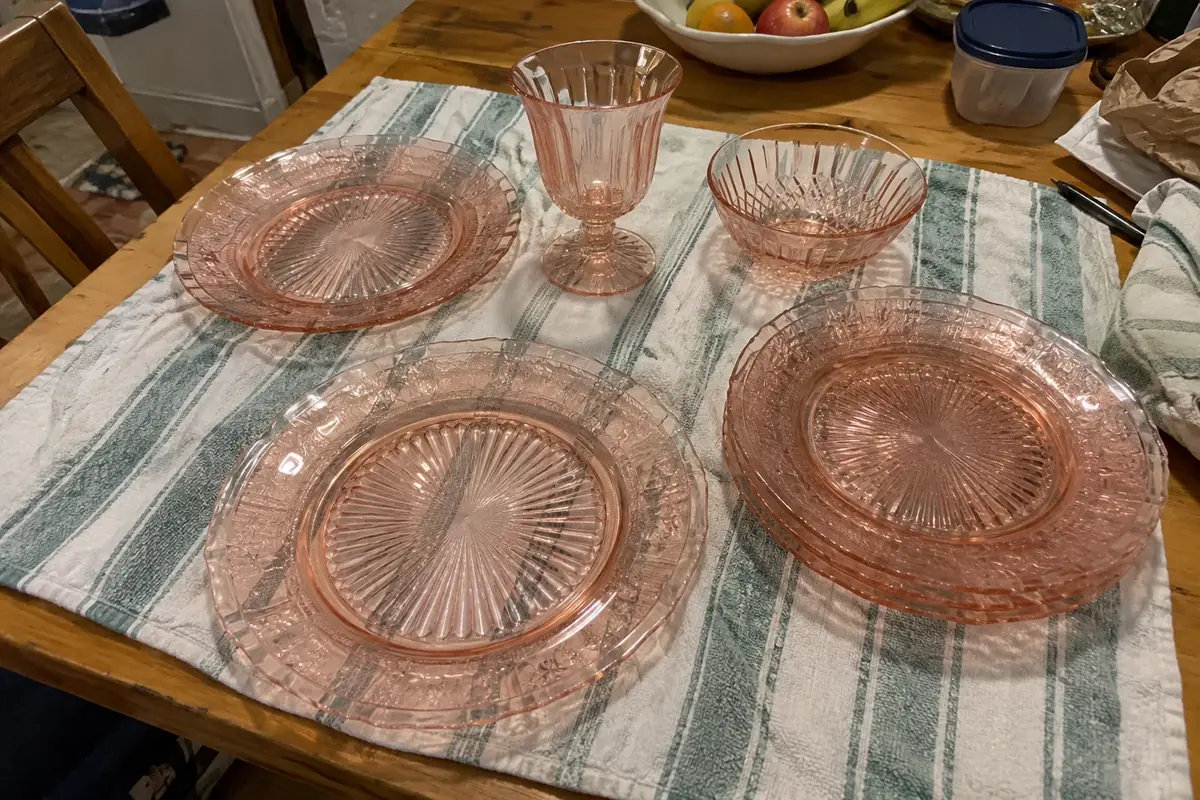
Most everyday depression glass, such as plates, cups and bowls in common colors, is worth about $5 to $25 each. Pink pieces run $10 to $60. Pitchers, butter dishes and cookie jars in popular patterns bring $50 to $350, and scarce colors and forms reach $400 to $1,250 or more.
What is depression glass worth?
Most depression glass sells for little, and a few colors and forms sell for a lot. Pattern, color, form and condition decide where yours lands.
| Type of piece | Typical value |
|---|---|
| Everyday plates, cups, sherbets and bowlsCommon colors and patterns; condition moves the price. | $5–$25 |
| Pink plates, cups, tumblers and bowlsCup and saucer at the low end, dinner plate and Old Colony flower bowl higher. | $10–$60 |
| Pitchers, butter dishes and cookie jars in popular patternsIncludes Waterford Waffle, June and pink Mayfair pieces; guides disagree on Mayfair. | $50–$350 |
| Cobalt blue Royal Lace pitchers, tumbler sets and cookie jarsA pitcher, a set of six tumblers or an original cookie jar. | $150–$500 |
| Scarce forms and colorsCherry Blossom child's butter dish and lamp shade, Adam butter dish, blue Mayfair tumbler set. | $400–$1,250 |
| Mixed sets and lots of everyday piecesSmall groups of plates, bowls or a pitcher and glasses. | $30–$150 |
Figures are guide values, asking prices and a few auction results. A piece can be rare but unpopular, which keeps the price low.
According to Vintage Green Antiques, a pink dinner plate runs $15 to $45, and cobalt blue is the rarest and most valuable color, followed by red or ruby.
How to identify depression glass
Depression glass is inexpensive pressed glass made from 1929 to 1939. More than twenty manufacturers made over 100 patterns, including Anchor Hocking, Federal, Hazel-Atlas and Jeannette. A piece marked Arcoroc, France or Indonesia is not depression glass, and a listing that says 'Depression style' describes newer glass.
| Mark | Years |
|---|---|
| Anchor over H · Anchor HockingAn anchor laid over an H, used after the 1937 merger | 1938 on |
| H over A · Hazel-AtlasA large H with a small A under its crossbar; often mistaken for Anchor Hocking | 1923 on |
| F in a shield · FederalA shield with an F inside, on the bottom of some pieces | |
| J in a square or triangle · JeannetteA J inside a square or triangle on some pieces | |
| 1976 or 1977 · Indiana MadridThe year on the base of authorized amber Madrid reproductions | 1976–1977 |
Much depression glass carries no mark, so a blank base rules nothing out. A piece dated 1976 or 1977 is not a 1930s original.
Five steps to sort your depression glass
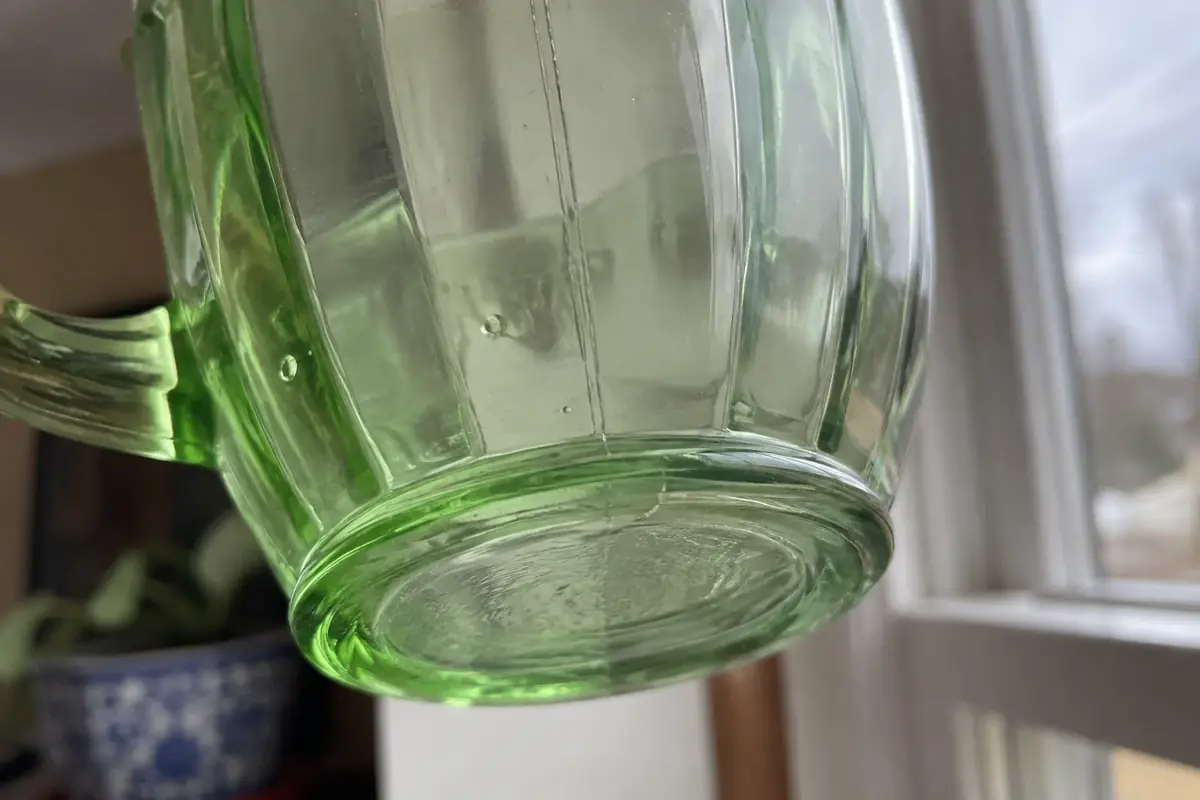
- Color and shine. Hold it to a window: most pieces are light to medium green, pink, amber or clear, and cobalt blue, ruby red, black and amethyst are rarer. An oil-slick shine is a different market; see what carnival glass is worth.
- Blacklight. Uranium glass typically glows vivid green under ultraviolet light, and cadmium glass glows red, orange or yellow. If yours glows, see how to identify uranium glass.
- Pattern. Match the molded design, whether flowers, geometric shapes, scrolls, birds or fruit, to a pattern name. Cherry Blossom shows cherries, leaves and flowers.
- Base. Turn it over and compare any mark with the table. Many pieces are unmarked.
- Condition. Run a fingertip around every rim, handle and foot for chips, cracks, cloudiness and repairs.
What makes one piece of depression glass worth more?
- Pattern
- A piece can be rare but unpopular, which keeps its value low. Popular patterns are easy to find and carry little value, while rare ones fetch more at auctions and estate sales. One guide gives Princess an average of about $20.
- Color
- Pink pieces are among the most sought after. Rarity varies by pattern, so the same color can matter more in one pattern than another.
- Form
- Saucers and other place-setting pieces are easier to find than cups, lids, pitchers or distinctive serving forms.
- Condition
- Chips, cracks, deep scratches, cloudiness and repairs reduce collector interest.
- Authenticity
- A reproduction is not the piece the price guides describe. An original Royal Lace cookie jar is given at $350 to $500 against $20 for the reproduction.
- Matched sets
- Complete matched groups appeal more to collectors than unrelated pieces. One guide reports a 70-piece pink Princess dinnerware set at $850, against $10 to $30 for single pink items.
Is my depression glass a reproduction?
Many popular patterns have been reproduced, and Cherry Blossom so often that there are reproductions of the reproductions, according to Antique Trader. Much of the depression glass on online auction sites is reproduction glass made in Asia. Signs to check:
- Bubbles and seams: National Appraisal Consultants says originals show small bubbles, seams and straw marks that reproductions typically lack, and reproductions are thicker and heavier.
- Cherry Blossom cherries: two bumps on an original, three on a reproduction.
- Cherry Blossom lids and saucers: real butter dish lids have three lines around the pattern's edge, and genuine saucers are about as thick as a nickel in the center.
- Royal Lace cookie jars: an original has a mold seam in the lid and a plunger mark on the bottom; a reproduction is plain and smooth.
- Mayfair cookie jars and whiskey tumblers: both have been reproduced.
- Colors: reissued Avocado came in off or never-made colors, and reissued Madrid in pink and blue shades somewhat different from the originals.
Pink depression glass values
Guides put pink pieces anywhere from a few dollars to over a hundred. A pink American Sweetheart cup and saucer in excellent to mint condition is about $10 to $15.
Pink Mayfair (Open Rose) is where guides disagree most: one puts a cookie jar at $150 to $350, another gives the pattern an average of $50 to $100. The piece, its condition and the reproduction question decide the price.
A mint Cherry Blossom mug is listed at almost $400, while another guide reports $182 for one.
Where to sell depression glass
Start by deciding whether to sell everything at once or piece by piece. Depression and Elegant Glass says dealers may pay 20 to 50 percent of what a collector would for a bulk lot. Options include local dealers, flea markets, consignment auction houses, eBay and Etsy, and eBay and Replacements.com show current asking prices. Glass with chips or cracks is likely unsalable, so be candid about flaws.
Common depression glass questions
Is depression glass worth anything?
Yes, and it has been highly sought after since the 1960s. Prices are lower than in the late 1990s or early 2000s, though, especially for a casual seller.
What is the most valuable color of depression glass?
There is no single answer, because rarity depends on the pattern. One guide names pink Cameo as the rarest.
Is pink depression glass worth more than green?
In common forms, often yes. In Cameo, though, green is the inexpensive color while pink and yellow can be worth hundreds.
How can I tell if my depression glass is a reproduction?
Start with the pattern: Adam, Avocado, Cameo, Cherry Blossom, Madrid, Mayfair, Miss America, Sandwich and Sharon have known reproductions. If it looks too perfect, it is probably not the real thing.
Does depression glass glow under a blacklight?
Some does. Most green depression-era pieces contain a little uranium, so they glow under ultraviolet light.