Deruta Rooster Pitcher Value Guide
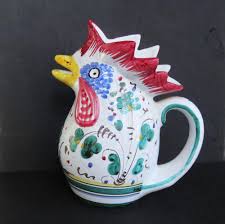
- Period
- 1950-1970
- Origin
- Italy
- Materials
- Ceramic, Glazed Earthenware
- Category
- Deruta ceramics
The Deruta Rooster Pitcher is a quintessential example of Italian majolica, originating from the historic ceramic hub of Umbria. These vibrant glazed earthenware pieces became iconic mid-century collectibles after American tourists popularized them as symbols of good luck following World War II.
What Is Deruta Rooster Pitcher Worth?
The typical price range for Deruta Rooster Pitcher is $75 - $120 based on recent sales. However, values can vary depending on the item's condition, rarity, and other factors such as:
- Condition of the glaze, as chips or 'flea bites' on the beak and comb significantly reduce the $75-$120 market value.
- Intricacy of the hand-painted motifs, with more detailed floral or geometric patterns commanding higher prices.
- Size of the pitcher, with larger water-pitcher variants being more desirable than smaller creamers.
- Authenticity of the provenance, specifically pieces confirmed to be from the 1950-1970 post-war export era.
How to Identify Deruta Rooster Pitcher?
- Look for the 'Deruta Italy' mark or the artist's initials hand-painted on the base of the pitcher.
- Examine the glaze for the characteristic high-gloss majolica finish over a buff-colored earthenware body.
- Verify that the decorative patterns are hand-painted, showing slight variations in brushstrokes typical of 1950s-1970s production.
- Identify the specific rooster silhouette, which features a functional pouring beak and a curved tail acting as the handle.
History of Deruta Rooster Pitcher
The rooster, particularly in Tuscany, is a symbol of good fortune. This tradition became popular in the United States when many American tourists returned from Italy with these pitchers after World War II. The town of Deruta, in Umbria, Italy, has been a center for ceramic production since the Middle Ages, known for its vibrant hand-painted majolica.
Shop Similar
VINTAGE 7" DERUTA ROOSTER Pitcher,arabesco,plus Gr…
etsy.com · $45
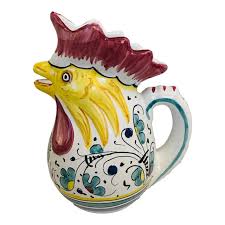
Cottura Rooster Pitcher | Chairish
chairish.com · $85
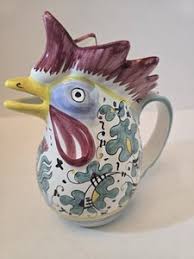
Deruta Rooster Pitcher | eBay
ebay.com
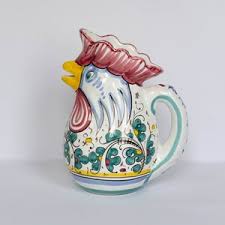
Vintage Hand-painted Italian Rooster Pitcher, Mart…
etsy.com
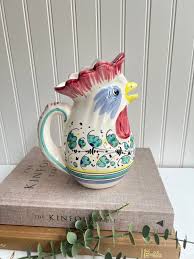
Handpainted Italian Rooster Pitcher | Vibrant Cera…
etsy.com
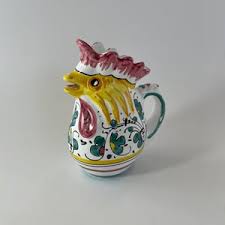
Deruta Italy Rooster - Etsy Ireland
etsy.com
Have an antique to identify?
Get an instant AI appraisal with values, history, and market insights.
Download for iPhone