Enoch Wood's English Scenery Platter Value Guide
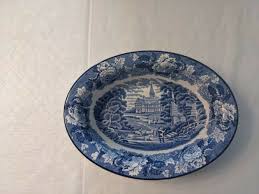
- Period
- 1930-1950
- Origin
- United Kingdom
- Materials
- Ironstone, Ceramic, Glaze
- Category
- Enoch wood pottery
This oval serving platter is a quintessential example of Wood & Sons' English Scenery series, which captures the romanticized pastoral life of the 18th and 19th centuries. Produced in Burslem, Staffordshire, these pieces are highly collectible for their intricate transferware designs and their connection to Enoch Wood, the 'Father of the Pottery.'
What Is Enoch Wood's English Scenery Platter Worth?
The typical price range for Enoch Wood's English Scenery Platter is $40 - $44 based on recent sales. However, values can vary depending on the item's condition, rarity, and other factors such as:
- Physical condition, specifically the absence of chips, cracks, or heavy crazing in the glaze.
- The clarity and crispness of the transferware scene, as blurred prints are less desirable to collectors.
- Market demand for the specific oval platter shape within the $40 to $44 price range.
- The presence of a clear, legible manufacturer's mark on the base to confirm its 1930-1950 era origin.
How to Identify Enoch Wood's English Scenery Platter?
- Check the underside for the 'English Scenery' backstamp featuring the Wood & Sons name and Burslem origin.
- Examine the border for the characteristic floral and foliate patterns that frame the central bucolic landscape.
- Verify the material is heavy ironstone with a clear glaze, typical of mid-20th century United Kingdom production.
- Look for the specific deep blue transfer print that depicts detailed rural English architecture and figures.
History of Enoch Wood's English Scenery Platter
Enoch Wood was a renowned master potter known as the Father of the Pottery. His firm, Wood & Sons, operated in Burslem, Staffordshire, and produced the celebrated English Scenery series which captured the romanticized pastoral life of the 18th and 19th centuries.
Shop Similar
Vintage Blue & White Enoch Woods English Scenery O…
ebay.com · $28
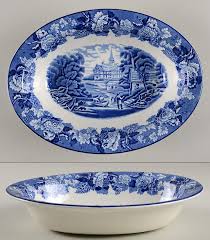
English Scenery Blue (Old Backstamp, Smooth) 9" Ov…
replacements.com · $28
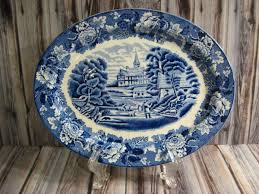
WOOD & SONS ENGLISH SCENERY WOODS WARE SMALL PLATT…
ebay.com · $40
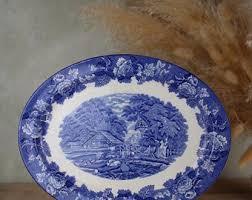
Enoch Woods Ware Blue and White Large Platter | Vi…
etsy.com · $67
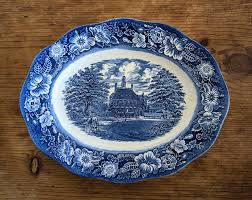
1970s Staffordshire Liberty Blue Oval Serving Dish…
chairish.com · $210
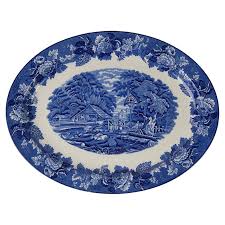
Enoch Wood's Blue and White English Scenery Platte…
1stdibs.com · $452
Have an antique to identify?
Get an instant AI appraisal with values, history, and market insights.
Download for iPhone