Is my carnival glass worth anything?

By Ellen Whitlock ·
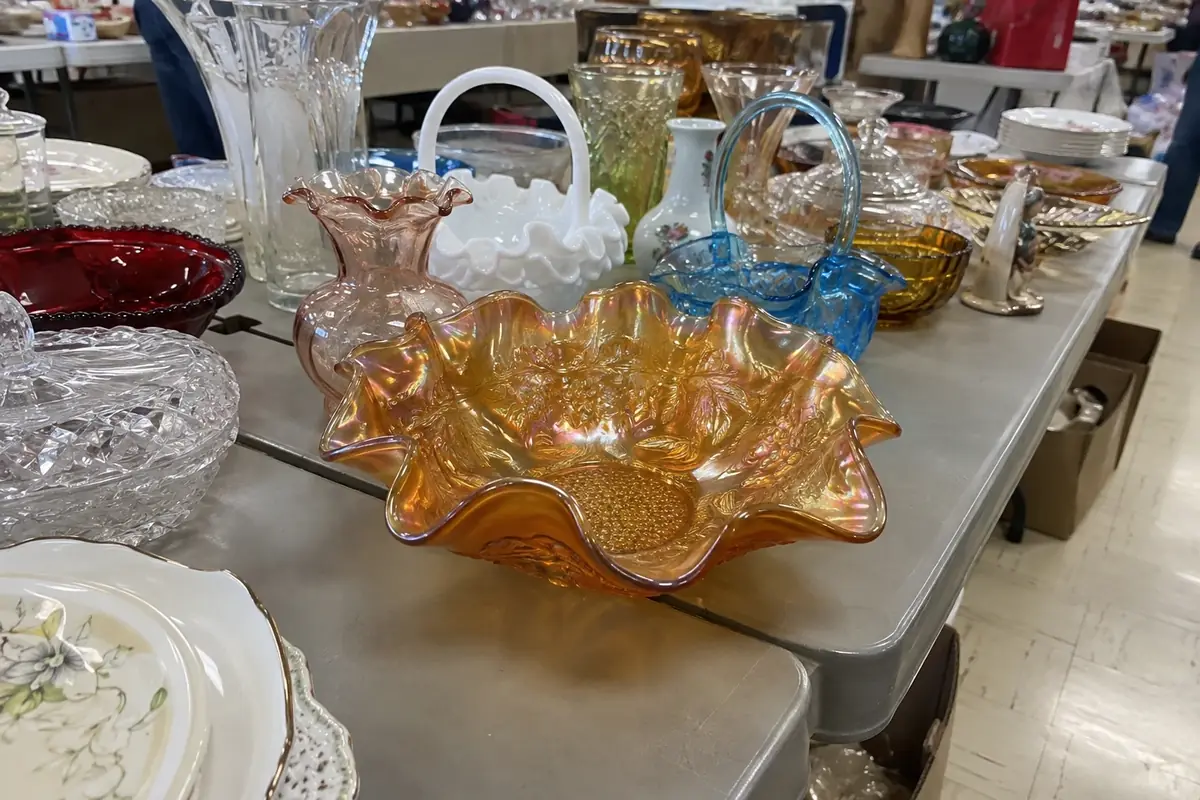
Most carnival glass is worth about $15 to $50 a piece. Common bowls, vases and water sets run roughly $30 to $150, scarcer colors and patterns $100 to $300, and only a small share passes $1,000. A few rarities have topped $100,000.
What is carnival glass worth?
Most carnival glass is a modest find. Where yours lands depends on the color, the pattern, the shape and the condition. Antique Answers says only a small number of pieces, less than half a percent of the results it reviewed over about 20 years, reached four figures.
| Type of piece | Typical value |
|---|---|
| Common tumblers, plates and small dishesMarigold or amethyst. Condition and the strength of the sheen decide where one lands. | $15–$50 |
| Bowls, vases and water sets in common patternsSize and completeness move the price. | $30–$150 |
| Scarcer colors or patternsBlue, green, aqua and better patterns. Color and pattern decide where a piece lands. | $100–$300 |
| Rare pattern, color and form, in strong conditionNamed patterns such as Dugan Farmyard bowls and Northwood Tree Trunk vases. | $1,000–$3,800 |
| Top-tier rarities and one-off whimsiesFrom the Northwood Tornado vase to the Millersburg People's Vase. | $19,000–$155,000 |
Those everyday prices are auction results. Dealers commonly ask $35 to $85 for smaller pieces.
According to ddoty.com, a single 2017 auction of a specialist collection averaged more than $2,400 a lot across nearly 500 lots, with its best-known results reaching $60,000. That was a specialist collection, not a typical cupboard.
How to identify your carnival glass
Most U.S. carnival glass was made before 1925, and Fenton kept making iridescent glass until it closed in 2007. Makers' marks help tell old from revival, though many pieces carry none. These are the ones to know.
| Maker · mark | Years |
|---|---|
| Northwood · Underlined N in a circleClassicMoulded into the glass, sometimes faint, mainly on pressed patterns and novelties | 1905–1916 |
| Fenton classic · No markClassicClassic Fenton has no mark, so any Fenton logo means revival | 1907 on |
| Fenton · Script in an ovalThe earliest revival mark, a plain oval with no number | 1970–1979 |
| Fenton · Oval with a decade number8 for the 1980s, 9 for the 1990s, 0 for the 2000s | 1980–2009 |
| Imperial · Iron Cross, NUART, NUCUTClassicUsed on select patterns; most Imperial carnival glass is unmarked | 1917 on |
| Westmoreland · WG or WESTMORELANDClassic pieces are unmarked; the mark shows up on revival pieces | 1970 on |
| Millersburg · No markClassicMillersburg never signed or trademarked its glass, so a marked piece is not Millersburg | to 1911 |
Most carnival glass is unmarked. Classic-period pieces are the more valuable group.
Five checks for your carnival glass
- Look for the sheen. Carnival glass must show a notable iridescent sheen whatever its base color. Colored glass with no rainbow shimmer is something else, often Depression glass; see Depression glass values.
- Name the color. Marigold, an orange-gold to copper base with rainbow highlights, is the most common. Amethyst, blue, green, red and amber are also found. A yellow-green piece may be vaseline glass; if so, see how to identify uranium glass.
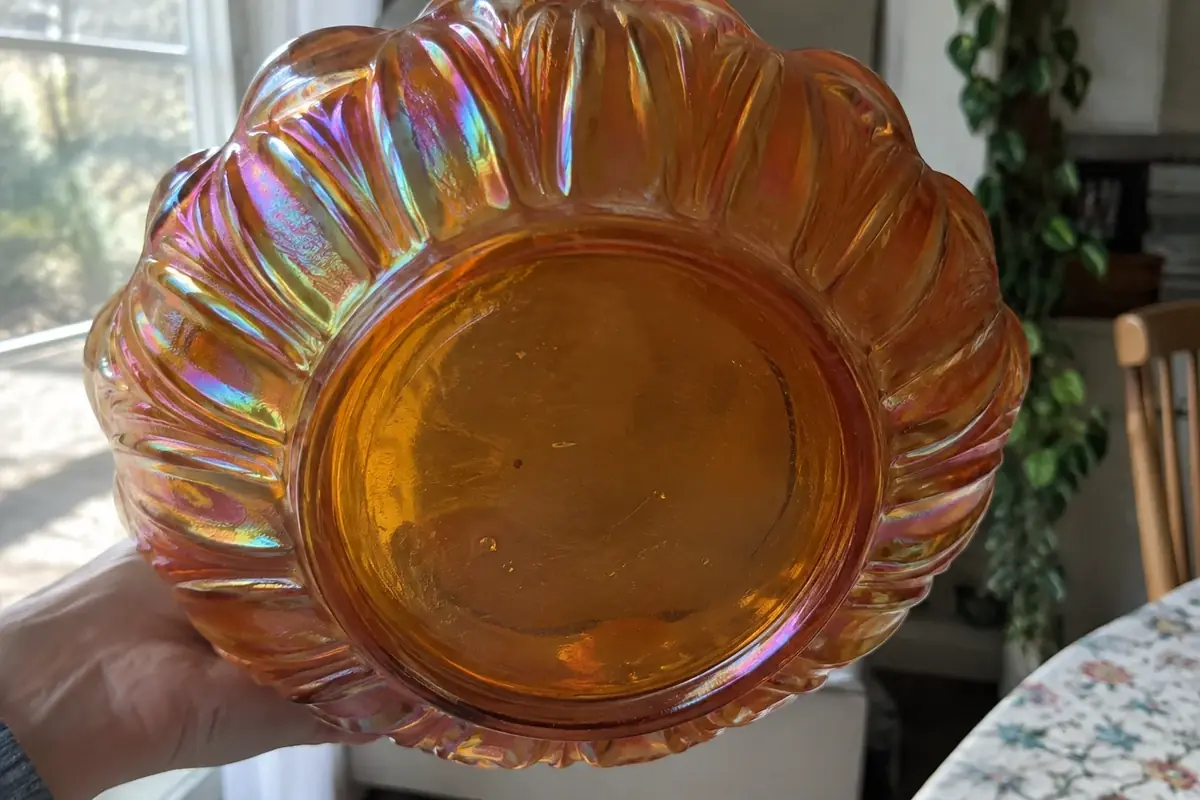
- Turn it over. Carnival Glass Worldwide says classic American carnival glass usually has no iridescence on the base, while reproductions often do. A shimmering base is a reason to look harder.
- Look for a mark. Match what you find to the table; finding none is normal. For more on Fenton, see the Fenton glass guide.
- Study the pattern, then the condition. Most glass companies listed their patterns in old catalogs that you can search online. Chips, cracks, scratches and lost sheen all lower the price.
What makes one carnival glass piece worth more?
Carnival glass comes in more than 2,000 patterns and more than 60 colors, so two bowls that look alike can sit at opposite ends of the range.
- Color
- Marigold is the most common color and sits at the bottom of the range, while red is scarcer and commands a premium. A Northwood Grape and Cable punch bowl set in marigold has been reported at about $2,000, against $95,000 for the punch set in aqua opal. Those are different sales, so read it as the size of the gap, not a formula.
- Maker
- Northwood, Millersburg, Dugan, Imperial and early Fenton are the makers collectors look for. A Dugan Farmyard bowl has reached about $2,100, and the Millersburg People's Vase in blue reached $155,000 in 2018.
- Form and size
- Vases, punch sets and unusually large pieces outprice small dishes in the same pattern, and complete sets are worth much more than single pieces. A 6-inch vase brought about $46, against a four-figure price for a 12-inch vase in the same pattern.
- Condition
- Cracks, chipped edges, deep scratches, discoloration, etching and lost sheen all cut the price. Collectors look first for good iridescence, good color and a piece in perfect shape.
- Age
- Old pieces from before 1940 hold the most value, and older carnival glass tends to be worth more than later revival production.
- Rarity
- Pieces with only 2 to 6 known examples command a premium. Whimsies, shapes reworked from a standard mold, are the usual source of these one-offs. A Northwood Tornado whimsy vase in celeste blue reached $60,000 at a June 2017 specialist-collection auction.
Is my carnival glass fake?
Most pieces people call fake are honest revival glass, not forgeries. Imperial reissued water sets with a peanut logo in 1977, and Mosser and L.G. Wright made pieces in the 1970s and 1980s, some of them unmarked. True fakes are rarer. Counterfeits from the Far East copied Northwood patterns such as Grape and Cable, Peacocks and Good Luck, sometimes with a fake N, and Fenton's Stag and Holly is also copied often. Tamarack Shack Antiques lists the warning signs. Look for:
- A dull surface, less fine detail or thicker glass
- An N mark with no circle around it
- A color the original maker never used, such as Mosser's red and Hunter Green Dahlia tumblers, a pattern Dugan never made in those colors
- Different details: Mosser's Dahlia tumblers have three flowers where the originals have four
- A maker's mark, which proves nothing, because some reproductions kept the original mark
Where to sell carnival glass
Everyday pieces move through antique dealers, antique fairs, eBay, Etsy and Facebook carnival glass buy-and-sell groups. If you think yours is scarce, an auction house is the better first stop; Invaluable shows regional houses such as Dees Auction Company and Dennis Auction Service listing carnival glass. Top-tier pieces go through specialist events, like the Karen Engle collection auctioned by Wroda Auctions at the American Carnival Glass Association convention. The International Carnival Glass Association can help you name a pattern before you list it.
Common carnival glass questions
Is carnival glass worth anything?
Yes, usually a modest amount. The pattern and color decide which end of the range yours is on.
How can I tell if my carnival glass is fake?
Most pieces called fake are honest revival glass, not forgeries. Fenton's Stag and Holly and Northwood's Grape and Cable are among the patterns that get copied.
What color of carnival glass is worth the most?
Red beats common marigold, and collectors are currently chasing aqua opalescent and emerald green.
How old is carnival glass?
Fenton introduced its iridescent Iridill glass in 1908, and most U.S. carnival glass was made before 1925. Revival production ran for decades, so the mark and details decide age.