How much is Fenton glass worth?
By Ellen Whitlock ·
Most Fenton glass is worth about $5 to $200 for everyday pieces. One price guide tracking 84,806 Fenton pieces puts the average near $90. Cranberry opalescent, Burmese and carnival pieces bring more, and rare art glass can pass $1,200. Check the base for an oval logo to date it.
What is Fenton glass worth?
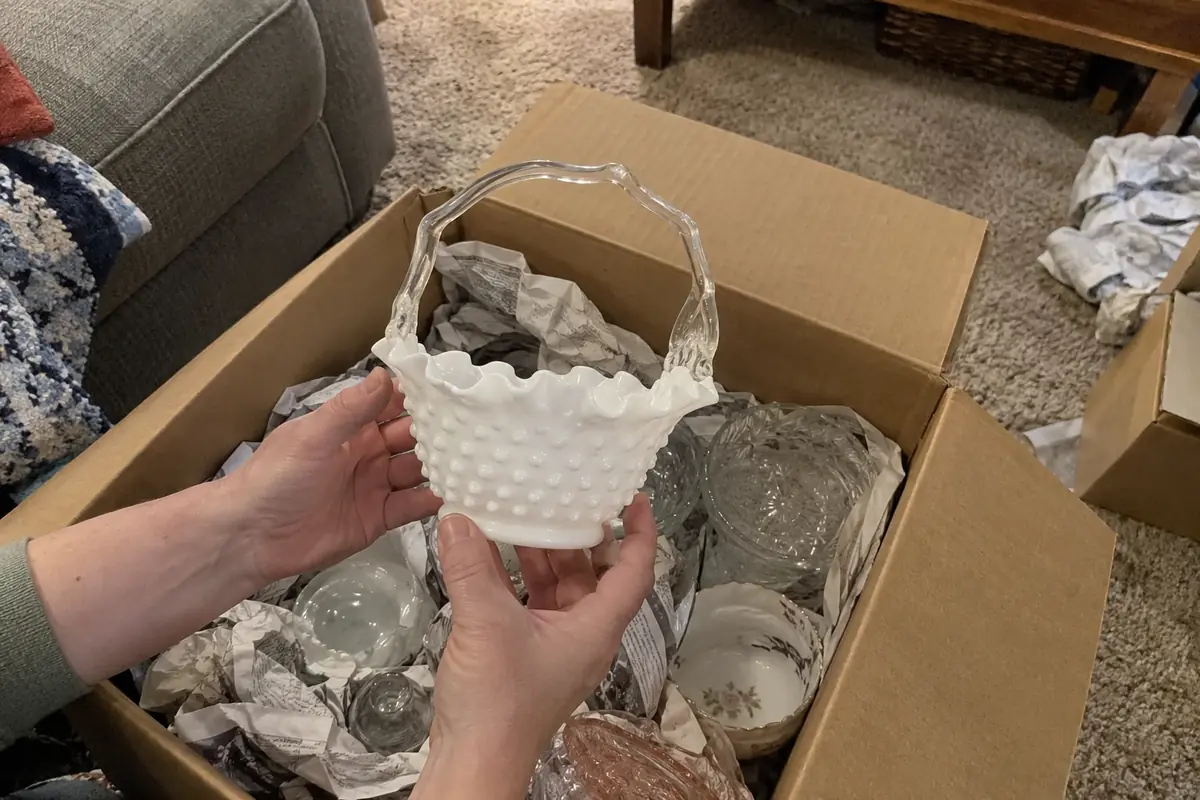
Most Fenton is modest money, and common pieces are easy to find because the company sold so much of it through five-and-dime stores in wooden barrel assortments. Where yours lands depends on the glass type, the decoration and the condition.
| Type of piece | Typical value |
|---|---|
| Small hobnail and milk glass vases, bells, slippersSmall plain white pieces sit at the low end. | $5–$45 |
| Milk glass baskets, pitchers, lamps, four-horn epergnesHandled baskets sit low; complete epergnes and lamps sit high. | $20–$200 |
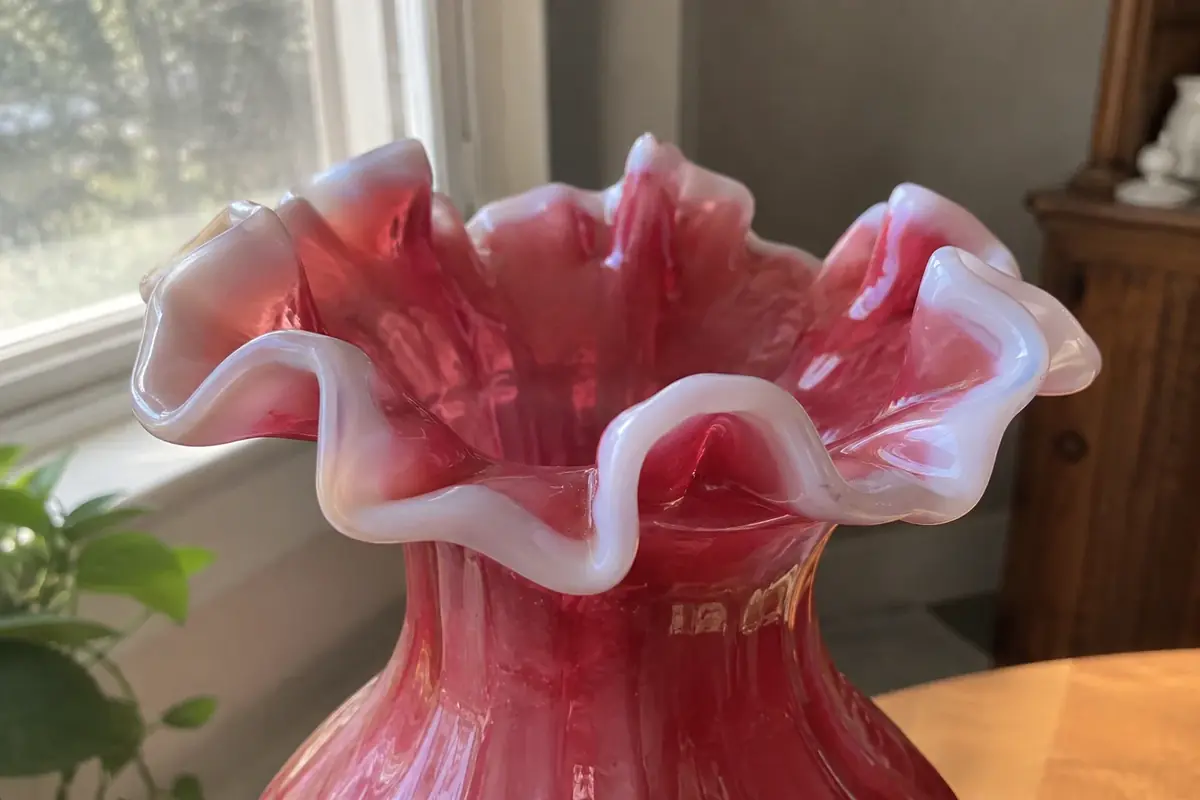
| Cranberry and other opalescent vasesSmall coin dot vases sit low; larger hobnail and Spanish Lace vases sit higher. | $30–$200 |
| Cranberry opalescent pitchers, water sets, epergnesA lone pitcher sits low; a full water set or epergne sits high. | $150–$700 |
| Common-pattern carnival glassBowls, compotes and bon bons; auction houses estimate cobalt water sets slightly higher. | $65–$150 |
| Burmese vases and epergnesSmall hand-painted vases sit low, large artist-signed pieces high, and rare cameo-carved examples go higher. | $75–$600 |
| Rare art glassMosaic vases, Gone With the Wind lamps and limited cameo vases; single pieces have reached well beyond the top. | $1,200–$3,000 |
These are typical values for used pieces. Carnival glass has its own market; see what carnival glass is worth.
Collection Hero tracks 84,806 Fenton pieces, with an average of $89.73 and a high of $11,111.
How to date Fenton glass from the marks
Fenton Art Glass made its first carnival glass toward the end of 1907. A raised script Fenton in an oval means the piece is from 1970 or later, according to Glass Bottle Marks, and a tiny number under the n narrows it to a decade. Before 1970 the company used paper labels, so an unmarked piece can still be early Fenton.
| Mark | Years |
|---|---|
| No mark · paper labelsFenton did not mold a mark into early glass, and paper labels often wash off | to 1969 |
| Blue paper labelReads Authentic Fenton Handmade | 1957–1971 |
| Gold or black-and-gold labelSame wording as the blue label, and just as easy to lose | 1970–1985 |
| Oval · carnival glass firstRaised script Fenton in an oval, added so buyers could tell new carnival from old | 1970–1973 |
| Oval · no numberOn nearly all lines, with no digit under the n | 1974–1979 |
| Oval · decade numberA tiny digit under the n gives the decade: 8, 9, 0 or 1 | 1980–2011 |
| Script F · vertical ovalGlass made from molds Fenton obtained from other companies | 1983 on |
| OVG monogramOlde Virginia Glass line, with the letters overlapping vertically | 1970–1979 |
| Ohio productionProduction moved to Mosser Glass in Ohio after Williamstown closed | 2011 on |
A missing paper label tells you nothing, because they wash off easily. Use a bright light and a magnifier for the tiny number.
Five checks for your Fenton piece
- The base. Look at the center for a raised script "Fenton" in an oval.
- The tiny digit. Look under the n with a bright light and a magnifier; no digit means the 1970s.
- No mark at all. Look for a leftover paper label, then judge by color, pattern and shape.
- The edge. Hand-crimped ruffles vary a little in spacing, and machine copies look too perfect.
- Damage and parts. Run a fingertip around the rim for chips and flea bites, and count tumblers, shades and horns, because a complete set is worth more.
What makes one Fenton piece worth more than another?
- Glass type
- Plain white hobnail is the commonest and cheapest Fenton. Cranberry opalescent, Burmese and carnival colors cost more for the same shape; a small cranberry opalescent hobnail vase runs $45–$120, well above a white one the same size.
- Hand painting
- A hand-painted Burmese vase with an artist's name usually beats a plain one. A signature alone is no guarantee, though: an artist-signed Peach Blow pitcher sold for just $55 in 2021.
- Condition
- Chips, cracks, sun cloudiness and rim damage cut value fast, and carnival glass should have its iridescence intact. Even a small flea bite on the rim can knock 30–50% off.
- Complete sets
- A pitcher with its tumblers, or an epergne with every horn, is worth more than the parts alone. A cranberry opalescent water set with a pitcher and six tumblers runs $350–$700, well above the pitcher by itself.
- Rarity
- Limited editions, special orders and unusual forms are where Fenton reaches four figures. Only 35 black cameo vases were made, and one was reported at $1,249.
- Early lines
- A line made for a short time can be harder to find, and older glass draws collectors, though price depends on the piece. Ivory Crest, made only in 1940–41, averages $102.09 in one price guide.
Real Fenton, later reissue or look-alike?
According to Carnival Glass Worldwide, Fenton reissued its own old patterns, and those usually carry the company logo, so a marked carnival piece can be a later reissue rather than an early original. Signs to weigh:
- A Pansy item with HOACGA 2000 on the base is a club souvenir made from an entirely new mold.
- Red Dahlia pieces are Mosser reproductions, and a red Classic Pony plate is a reproduction because that pattern was never made in red.
- A crisp, new-looking piece from a Fenton mold can be new, since Fenton says its glass is still handcrafted in the USA from original molds.
Some custard-colored Fenton is uranium glass, which collectors treat as more collectible; see how to identify uranium glass.
Where to sell Fenton glass
Sort first. Common milk glass sells cheaply in bulk: Antique Trader reports five assorted pieces bringing $8.05 together at a June 2026 estate sale. Sell the cranberry, Burmese, signed and carnival pieces on their own, and because glass is fragile, one guide recommends antique malls over shipping. Fenton's own site says it can no longer research value and points owners to a local antiques dealer, eBay or a collector club.
Common Fenton questions
Is Fenton glass worth anything?
Yes. Value runs from a few dollars for common white pieces up to four figures for limited art glass, so sort by color and glass type first.
How can I tell how old my Fenton glass is?
Turn the piece over for the oval logo, then look for a tiny digit under the n that narrows it to a decade. With no mark, judge by color, pattern and shape.
What is the most valuable Fenton glass?
The highest price in one guide is $11,111, and a pedestal mosaic art vase reached $5,500 in an online auction. Those are rarities, not typical pieces.
Is Fenton glass still made?
Traditional glassmaking at the Williamstown, West Virginia factory ended in July 2011. Fenton says its glass is still handcrafted in the USA from original Fenton molds at a glass factory in Ohio.
What does a flame or star on the base of my Fenton mean?
A flame, star or block letter marks a preferred second, a piece with a small flaw that generally sells for less than a first-quality one.