Marigold Carnival Glass Footed Bowl Value Guide
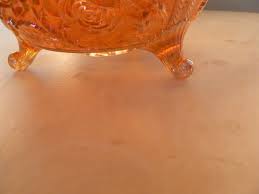
- Period
- 1907-1930
- Origin
- United States
- Materials
- Pressed glass, metallic salts
- Category
- Marigold glass
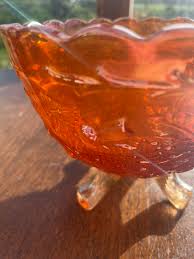
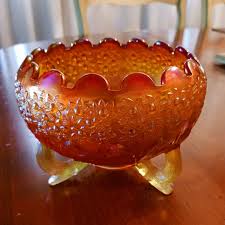
This Marigold Carnival Glass footed bowl represents a pivotal era in American decorative arts, serving as an affordable alternative to high-end iridescent art glass. Produced between 1907 and 1930 by iconic makers like Fenton and Northwood, these pieces are prized for their vibrant orange-gold 'oily' sheen created through metallic salt applications.
What Is Marigold Carnival Glass Footed Bowl Worth?
The typical price range for Marigold Carnival Glass Footed Bowl is $40 - $50 based on recent sales. However, values can vary depending on the item's condition, rarity, and other factors such as:
- Condition is paramount, as chips or 'flea bites' on the delicate footed base significantly reduce the $40-$50 market value.
- The intensity and clarity of the iridescence, specifically the presence of pink or green highlights within the marigold finish.
- Rarity of the pressed pattern, with intricate floral or geometric designs commanding higher prices than common motifs.
- Manufacturer attribution, with pieces from Northwood or Imperial often fetching a premium over unmarked carnival prizes.
How to Identify Marigold Carnival Glass Footed Bowl?
- Look for the characteristic 'Marigold' finish, which displays a warm orange-gold base with a rainbow-like iridescent shimmer.
- Examine the base for a footed design and pressed glass mold marks typical of early 20th-century American manufacturing.
- Check for specific maker marks on the interior bottom, such as the Northwood 'N' in a circle or Fenton's distinct patterns.
- Verify the weight and texture; authentic pieces are made of heavy pressed glass rather than thin modern reproductions.
History of Marigold Carnival Glass Footed Bowl
Carnival Glass was first developed around 1907 and produced mainly by American companies like Fenton, Northwood, and Imperial. It was an affordable imitation of expensive iridescent art glass. This pressed glass received its characteristic rainbow sheen by spraying the hot glass with metallic salts, which created the oily, colorful effect. It acquired the name 'Carnival Glass' because it was frequently given away as prizes at carnivals, fairs, and movie theaters in the 1910s and 1920s.
Shop Similar
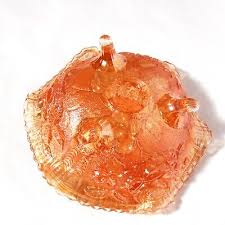
Vintage Imperial Glass Marigold Lustre Rose 7.5 in…
ebay.com · $24
Vintage Marigold Carnival Glass Bowl (BL)Q | eBay
ebay.com · $50
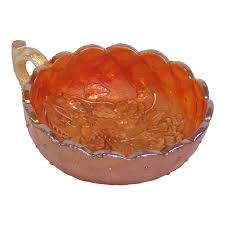
Imperial Marigold Carnival Glass Quilted Pansy Flo…
chairish.com · $50
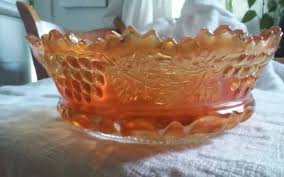
Northwood Carnival Glass Bowl, Marigold Color With…
etsy.com · $95
Vintage Imperial Glass Marigold Domed Butter/Chees…
ebay.com.au
Sowerby Glass England Carnival Thistle and Thorn F…
etsy.com
Related Items
Have an antique to identify?
Get an instant AI appraisal with values, history, and market insights.
Download for iPhone