Theodore Haviland Apple Blossom China Value Guide

- Period
- 1940-1955
- Origin
- United States
- Materials
- Porcelain, Gold Gilding
- Category
- Theodore haviland china
Theodore Haviland Apple Blossom China is a quintessential example of mid-century American fine dining, produced between 1940 and 1955. This pattern gained immense popularity after the firm transitioned production from Limoges to the United States, becoming a staple of sophisticated 20th-century tablescapes.
What Is Theodore Haviland Apple Blossom China Worth?
The typical price range for Theodore Haviland Apple Blossom China is $45 - $50 based on recent sales. However, values can vary depending on the item's condition, rarity, and other factors such as:
- The presence of intact gold trim, as wear or fading significantly reduces the market value of $45-$50.
- Condition of the porcelain, specifically looking for the absence of 'crazing' or chips which are common in mid-century sets.
- The completeness of the set, as individual tea cups and saucers are more valuable when sold as a matching pair.
- Clarity and vibrancy of the Apple Blossom floral transfer, with crisp colors fetching higher prices from collectors.
How to Identify Theodore Haviland Apple Blossom China?
- Look for the 'Theodore Haviland New York' backstamp which distinguishes these American-made pieces from earlier French imports.
- Verify the presence of the specific Apple Blossom floral motif characterized by soft pink petals and green foliage.
- Check for the hand-applied gold gilding along the scalloped edges of the tea cups and saucers.
- Confirm the porcelain body is fine, translucent white, typical of the high-quality standards maintained by the Haviland family.
History of Theodore Haviland Apple Blossom China
Theodore Haviland, son of David Haviland, established his own firm in Limoges, France, in 1890. This specific Apple Blossom pattern became one of the most iconic and sought-after designs produced after the company moved much of its production to the United States during the mid-20th century. It represents the quintessential mid-century American fine dining aesthetic.
Shop Similar
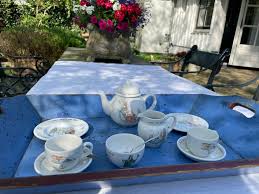
Wedgwood Peter Rabbit Kinderthee- of Koffieservies…
etsy.com · $242
Vintage Fine Bohemian Dinnerware China Set. Made C…
ebay.com · $999

Royal Doulton -The Chelsea Rose H480-England-Dinne…
ebay.com
Experience the thrill of second-hand shopping at R…
instagram.com
Vintage Dishes
academialovart.pt
Pathfinders Family... - Pathfinders Family Inc / T…
facebook.com
Have an antique to identify?
Get an instant AI appraisal with values, history, and market insights.
Download for iPhone