Deciphering the Bottom of the Bowl: How to Spot a $5,000 Pottery Signature

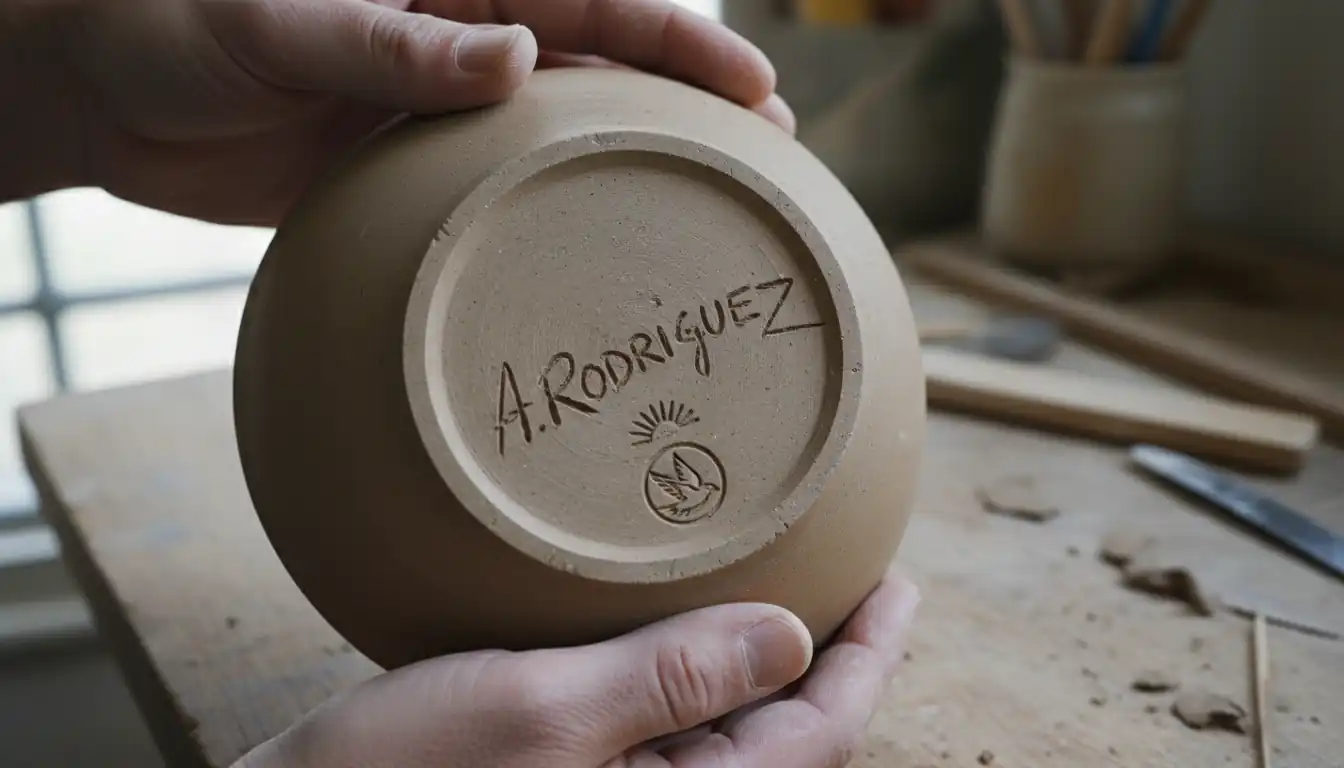
Imagine standing in a dimly lit estate sale, the air thick with the scent of old paper and floor wax. You spot a small, cream-colored vase tucked behind a stack of chipped dinner plates. It has a certain weight to it, a glow that suggests it didn't come from a big-box retailer. You turn it over, and there it is: a faint, blue-inked symbol that looks like a tangled knot.
Is this a mass-produced souvenir or a rare piece of 18th-century creamware worth thousands of dollars? This moment is the ultimate "fork in the road" for every collector. The difference between a $5 donation and a $5,000 windfall often comes down to your ability to read the "language" written on the bottom of that bowl.
Learning to identify pottery signatures is part art and part forensic science. By the time you finish this guide, you will understand the physical evolution of maker's marks, the specific symbols that signal high value, and how to use modern tools to verify your finds in seconds.
The Anatomy of a Maker's Mark
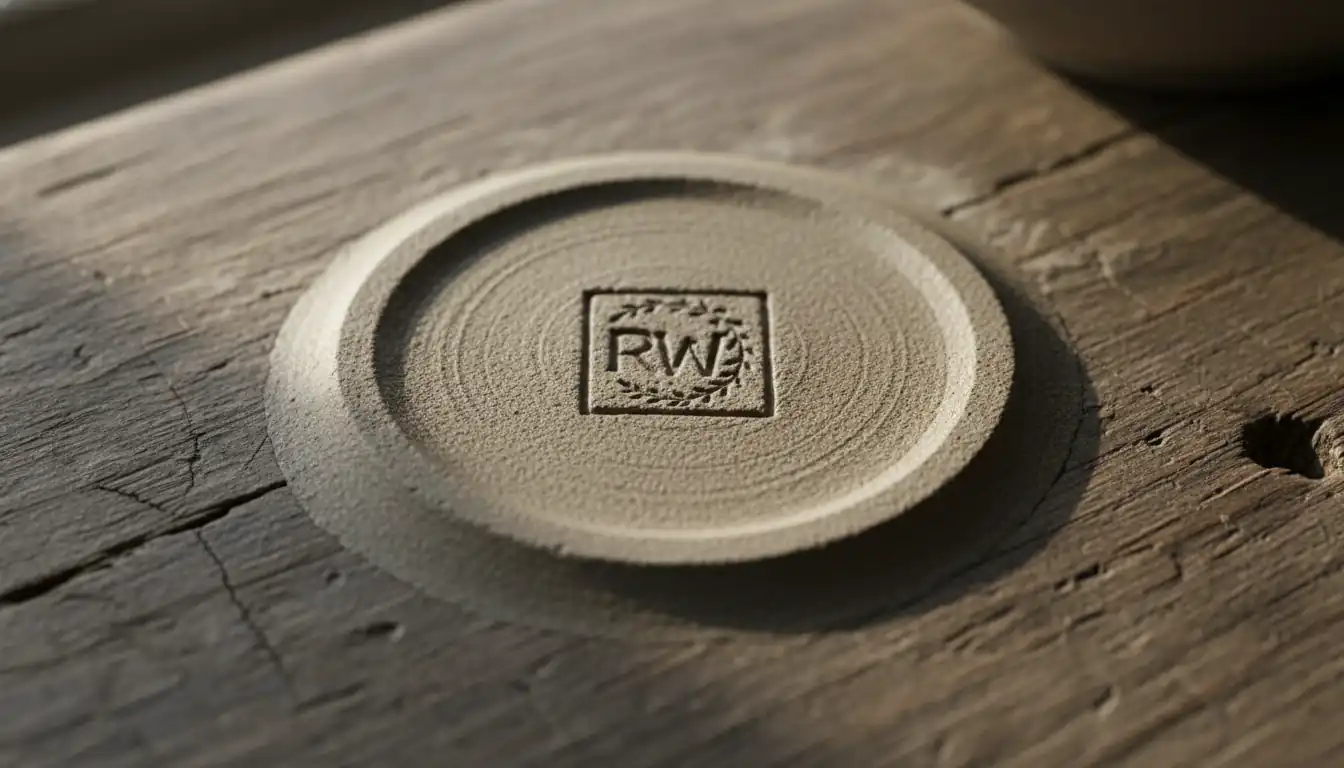
Before you can identify who made a piece, you must understand how they marked it. The physical method used to apply a signature is one of the most reliable ways to date a piece of ceramics. Pottery marking has evolved from primitive hand-carvings to sophisticated industrial prints, and each method leaves a distinct "fingerprint" on the clay.
Deciphering Incised vs. Stamped Signatures
The earliest marks were almost always incised. This means the potter used a sharp tool—perhaps a needle or a wooden stylus—to carve their name or initials directly into the "leather-hard" clay before it was fired. When you run your finger over an incised mark, you can feel the ridges where the clay was pushed aside.
Incised marks often suggest a lower production volume. They are common on folk art, studio pottery, and very early European earthenware. Because they are done by hand, they are rarely perfect. You might see shaky lines or uneven depths. If you find a piece where the signature looks like it was scratched in with a nail, don't dismiss it. In the world of high-end studio pottery, that "messy" signature could be the mark of a master.
In contrast, impressed marks are made using a physical stamp. Think of this like a wax seal. A metal or wooden die is pressed into the wet clay, leaving a clean, recessed image. These marks are usually much more uniform than incised ones. They signal a transition toward more organized workshops where branding needed to be consistent across hundreds of pieces. An impressed mark is crisp; the edges of the letters or symbols are sharp and vertical.
Understanding Painted and Underglaze Marks
As ceramic technology advanced, makers moved away from physically altering the clay and began using pigments. This is where the distinction between "underglaze" and "overglaze" becomes vital for your investigation.
- Underglaze Marks: These are applied to the "bisque" (fired but unglazed) clay before the final clear glaze is added. Because the glaze sits on top of the mark, the signature is protected forever. It will look slightly soft or "fuzzy" around the edges because the pigment bleeds slightly into the clay during the high-heat firing.
- Overglaze Marks: These are painted on top of the finished, glazed piece and then fired a second or third time at a lower temperature. These marks feel slightly raised to the touch. Because they sit on the surface, they are prone to wear. If you see a mark that is partially rubbed off, it is likely an overglaze mark.
| Mark Type | Physical Characteristic | Common Era |
|---|---|---|
| Incised | Carved into clay; rough edges | Pre-18th Century / Studio Pottery |
| Impressed | Stamped into clay; crisp edges | 18th - 19th Century |
| Underglaze | Painted under the glass; permanent | 19th Century - Present |
| Transfer Print | Detailed "stamped" ink; very uniform | Late 19th Century - Present |
Once you identify the method of application, you have already narrowed down the age of the piece by decades. A rubber-stamped mark with perfect sans-serif typography is almost certainly a product of the industrial age, whereas a hand-painted cobalt blue monogram suggests an earlier, more artisanal origin.
Iconic Hallmarks of High-Value Ceramics
Once you understand the "how," you can move on to the "who." Certain symbols act as a shorthand for quality and prestige. However, the most famous makers changed their marks frequently to combat forgeries or to reflect changes in ownership. Knowing these subtle shifts is how you answer the question: How do you identify valuable pottery marks?
The Prestige of Meissen and Wedgwood Symbols
Meissen is perhaps the most famous name in European porcelain, and their "Crossed Swords" mark is the gold standard for collectors. But not all swords are created equal. The mark was introduced around 1722, but its appearance changed every few decades.
In the mid-18th century, the swords were often curved with small, delicate pommels (the knobs at the end of the handles). By the "Marcolini" period (1774–1814), a small star or dot was often placed between the hilts. If you find a piece where the swords are perfectly straight and look like they were drawn with a ruler, it is likely a later 19th or 20th-century piece. While still valuable, it won't command the five-figure prices of the earlier, hand-painted versions.
Wedgwood offers a different kind of lesson in mark evolution. Early pieces were simply impressed with the name "Wedgwood." If you find a piece marked "Wedgwood & Bentley," you have hit the jackpot; this mark was only used between 1769 and 1780 during the partnership of Josiah Wedgwood and Thomas Bentley.
Pro Tip: Look for the "Made in England" stamp. This was added after 1891 to comply with the McKinley Tariff Act in the United States. If a piece is simply marked "England," it likely dates between 1891 and 1908. If it says "Made in England," it is almost certainly post-1908.
Decoding Chinese Reign Marks and Dynastic Symbols
Chinese ceramics present a unique challenge because marks are often written in "Kaishu" (standard script) or "Zhuanshu" (seal script). These marks, usually found in a square or a vertical line on the base, often indicate the reign of a specific Emperor.
However, there is a catch: Chinese potters often used "apocryphal" marks. This means a 19th-century potter might put a 15th-century Ming Dynasty mark on a vase out of respect for the earlier era, not necessarily to deceive. To tell a real Ming mark from a 19th-century tribute, you have to look at the quality of the calligraphy. Real imperial marks were written by master calligraphers; the lines are fluid, confident, and perfectly balanced. If the characters look stiff or cramped, it is likely a later reproduction.
Identifying the Unidentifiable
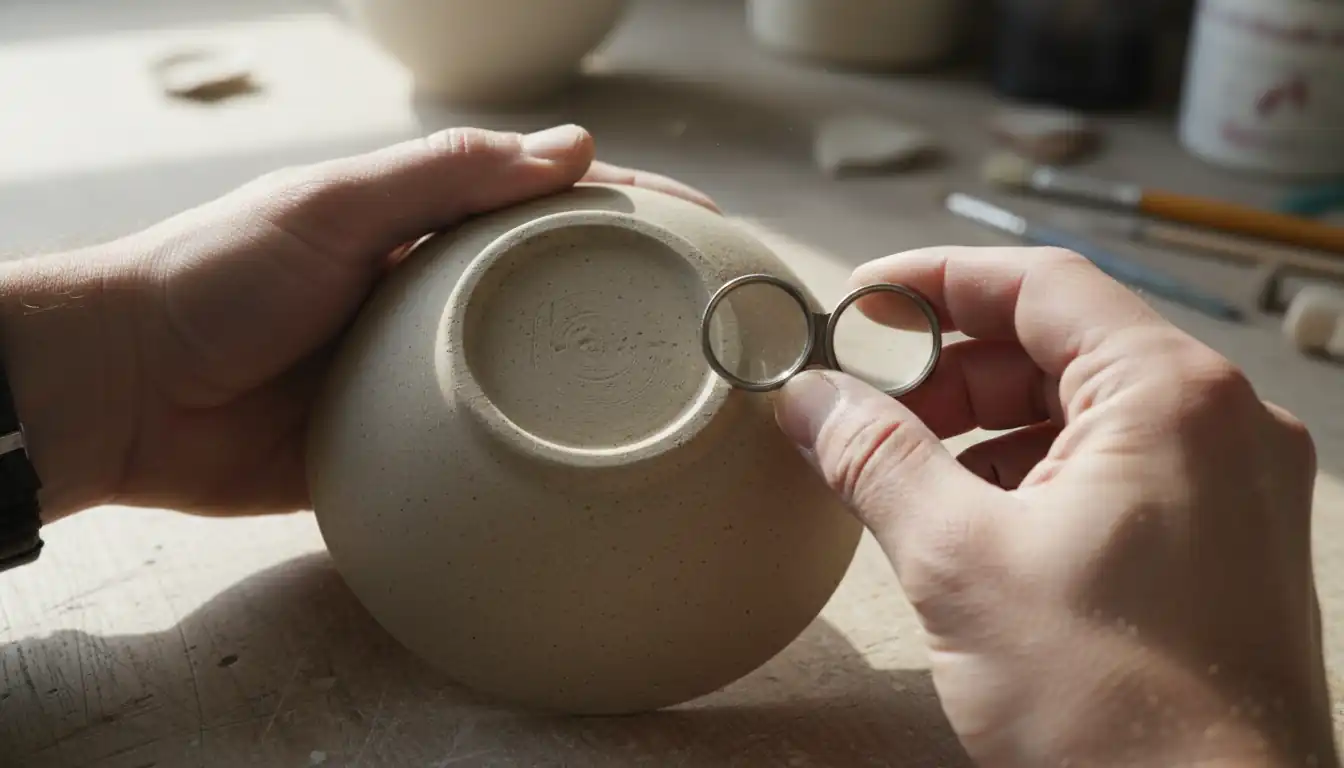
What happens when you flip a piece over and find... nothing? No name, no swords, no dates. This is a common hurdle, but it doesn't mean the piece is worthless. In fact, many of the world’s most valuable early ceramics were never marked at all. To solve this mystery, you have to stop looking for a signature and start looking at the "body" of the work. This is the essence of answering the question: How to identify unmarked pottery?
Reading the Clay Body and Glaze When Marks Are Missing
The first thing to examine is the "paste" or the clay itself. If you look at the unglazed "footring" (the circular rim the piece stands on), what do you see?
- Hard-paste porcelain will look white, dense, and almost glass-like.
- Earthenware will look porous, often reddish or cream-colored, and will feel much lighter than porcelain.
- Bone china has a distinct translucency. If you hold a piece of bone china up to a light and place your hand behind it, you should be able to see the shadow of your fingers through the ceramic.
The glaze also tells a story. Look for "crazing"—those tiny spiderweb cracks in the surface. While often seen as a flaw, the pattern of crazing can indicate age. In older pieces, crazing is often deep and irregular. In modern "shabby chic" reproductions, the crazing is often too uniform, looking like it was printed on rather than occurring naturally over a century of temperature changes.
Using UV Light and Tactile Clues for Authentication
A blacklight (UV light) is a secret weapon for the serious collector. When you shine a UV light on a piece of pottery, it reveals things the naked eye cannot see.
- Hidden Repairs: Modern epoxies and glues used to fix cracks will glow a bright, neon color under UV light, while the original porcelain will remain dull.
- Overpainting: If someone tried to paint over a chip or even "add" a signature later, the new paint will stand out as a dark patch against the original glaze.
You can also use the "tongue test" for bone china. While it sounds strange, lightly touching your tongue to an unglazed edge of a piece can tell you if it is "true" bone china or a clever imitation. Bone china is non-porous and will feel smooth, whereas earthenware will "stick" slightly to your tongue as the porous clay absorbs moisture.
The Digital Revolution in Pottery Appraisal
For decades, identifying a mystery mark meant lugging a five-pound reference book to every garage sale. These books were filled with thousands of tiny black-and-white sketches, and if your mark was slightly smudged or unusual, you were out of luck. The world of collecting has changed, and the barrier to entry has dropped significantly thanks to mobile technology.
Why Traditional Reference Books Are Failing Modern Collectors
The problem with physical guides is that they are static. They can't account for the thousands of new forgeries entering the market every year, and they certainly can't help you identify a piece based on its shape or color alone. If you are standing in a crowded auction house, you don't have twenty minutes to flip through an index. You need an answer before the auctioneer drops the hammer.
This is where the shift toward AI-driven identification has become a necessity. Modern collectors are no longer relying solely on memory; they are using their smartphones to bridge the gap between "curiosity" and "certainty."
Leveraging AI for Instant Origin and History
The Relic app has become a staple for collectors who need professional-grade insights without the professional-grade price tag. Instead of squinting at a faded mark, you can simply take a photo. Relic’s AI doesn't just look at the signature; it analyzes the entire "DNA" of the object—the silhouette, the glaze texture, and the specific pigments used.
For example, if you find a vase with a cryptic floral pattern and no mark, Relic can cross-reference that pattern against a massive database of known makers. Within seconds, it can tell you that the specific shade of "Flow Blue" and the shape of the handle belong to a specific Staffordshire pottery from the 1860s.
With a 4.9-star rating from over 20,000 users, it’s clear that this technology is filling a massive void. Whether you are a professional dealer looking for market research or a "picker" trying to decide if a $10 bowl is worth the risk, having an instant appraisal and historical context in your pocket changes the math of collecting. It removes the "guesswork" that often leads to expensive mistakes.
Protecting Your Find from Forgeries
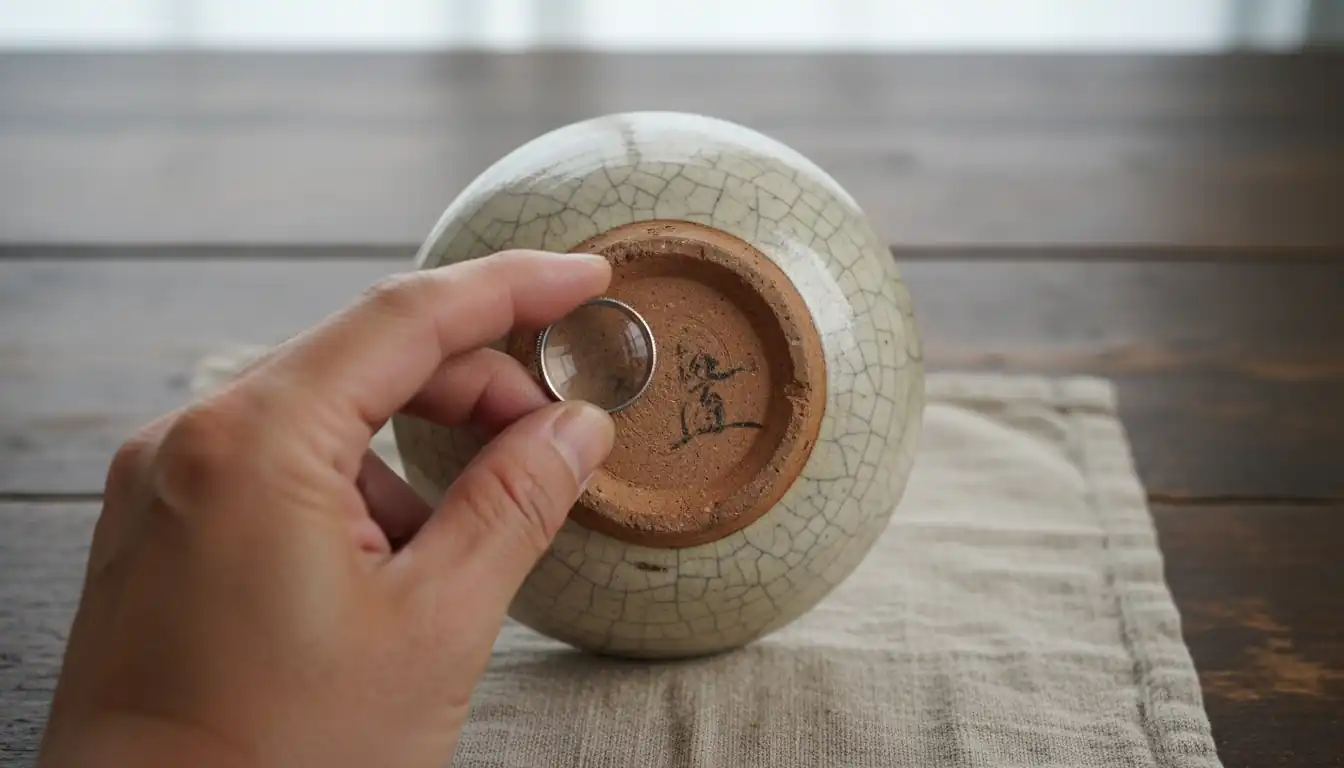
The more valuable a mark is, the more likely it is to be faked. Forgers have become incredibly sophisticated, using chemical baths and even "re-firing" old pieces to create a convincing patina of age. To protect your investment, you must look past the signature and evaluate the piece as a whole.
Red Flags of Modern Reproductions
One of the most common tricks is "tea-staining." Forgers will soak a new, crazed piece of pottery in strong tea or tobacco juice to make the cracks look old and dirty. To spot this, look at the bottom of the piece. Real age-related dirt is uneven; it accumulates where the piece touches the table. If the "dirt" is perfectly even across the entire base, it’s likely a chemical stain.
Another red flag is the "Borghese" or "Sèvres" style marks. Many 20th-century imports from Italy and Asia used the famous "interlaced Ls" of the French Sèvres factory. However, these modern marks are often applied with a rubber stamp or a modern decal. If the mark looks too perfect—if every line is exactly the same width—it is almost certainly a modern reproduction. Real 18th-century Sèvres marks were hand-painted and will show slight variations in the thickness of the brushstrokes.
- Check the Weight: Modern reproductions are often much heavier or much lighter than the originals because the clay composition is different.
- Listen to the "Ring": Gently tap the rim of a porcelain piece with your fingernail. High-quality, old porcelain will ring with a clear, bell-like tone. Modern earthenware or low-quality porcelain will produce a dull "thud."
Professional Verification and Appraisal Steps
While apps like Relic provide an incredible first line of defense and a wealth of historical data, there comes a point where a physical appraisal is necessary—especially if you believe you’ve found a $5,000 treasure.
If your digital identification suggests a high-value item, your next step should be a certified appraisal for insurance purposes. This involves a professional examining the piece in person to verify its condition and provenance. Remember, a signature is just one piece of evidence. A true appraisal looks at the "total package": the mark, the material, the history, and the current market demand.
Conclusion
Spotting a $5,000 pottery signature isn't about luck; it's about training your eyes to see what others miss. By understanding the physical anatomy of a mark—whether it's incised, impressed, or painted—you can immediately place a piece in its correct historical era. By learning the specific evolutions of hallmarks like Meissen and Wedgwood, you can separate the common from the extraordinary.
Even when the bottom of the bowl is blank, the clay and glaze still speak. And in those moments when the mystery feels too deep to solve on your own, technology like the Relic app provides a bridge to expert-level knowledge.
The next time you’re at a thrift store or an estate sale, don’t just look at the price tag. Flip the piece over. Look at the footring. Study the signature. You might just be holding a piece of history in your hands. Your next step? Start practicing. Grab a piece of pottery in your own home, examine its mark, and see what its "fingerprint" tells you about its journey from the kiln to your kitchen.
Identify antiques instantly
Point your camera at any antique, collectible, or vintage item. Get valuations, history, and market insights in seconds.
Download for iPhone