Hidden Fortune or Yard Sale Junk? Decoding the Secret Symbols on Your Vintage Ceramics

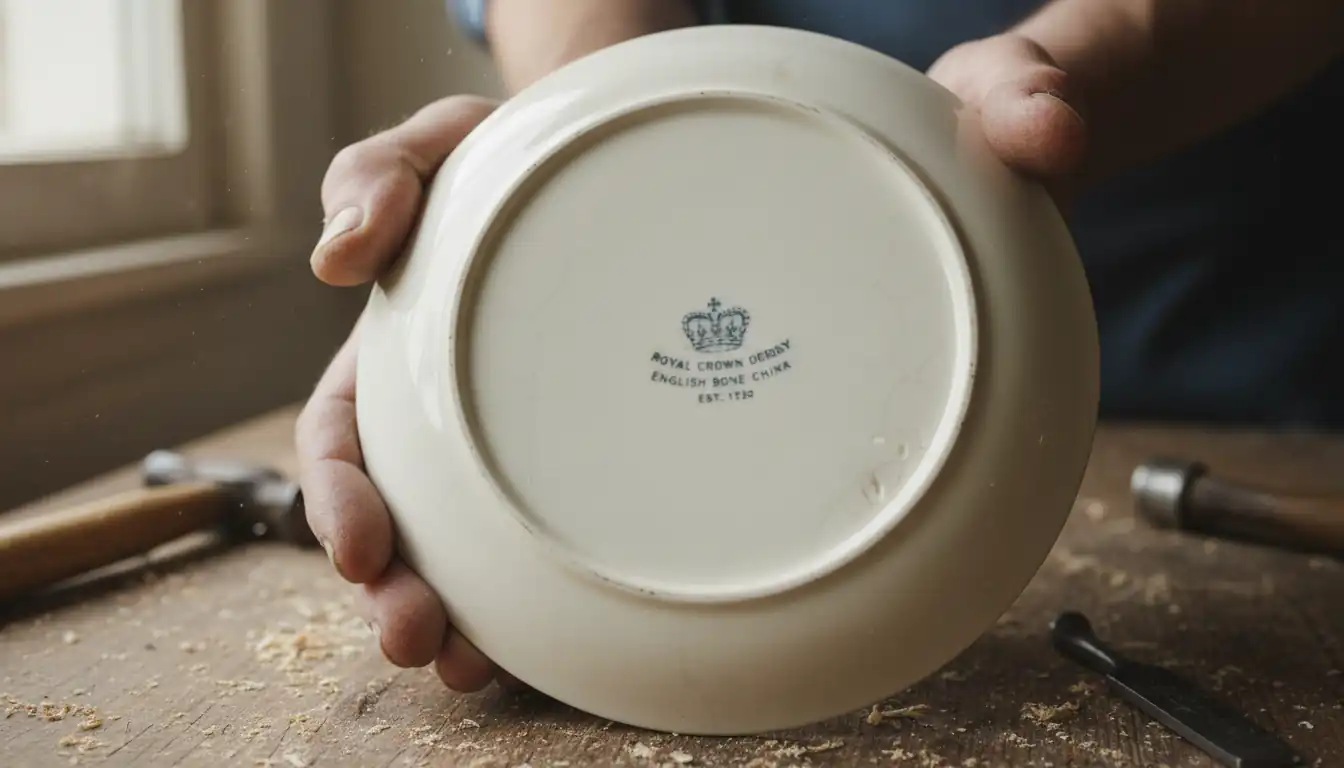
You are standing in a crowded thrift store, your eyes scanning rows of chipped mugs and dusty plates. Suddenly, a small, heavy vase catches your eye. It has a strange, hand-painted symbol on the bottom—a tiny blue anchor or perhaps a stylized crown. Your heart beats a little faster. Is this a discarded masterpiece worth thousands, or just another piece of mass-produced yard sale junk?
The difference between a "find of a lifetime" and a dusty paperweight often hides in plain sight. For centuries, ceramicists have used a secret language of symbols, marks, and material quirks to sign their work. These marks were never intended for the casual observer; they were professional signatures meant to denote quality, origin, and royal patronage. Learning to read these symbols transforms you from a casual shopper into a historical detective.
In this guide, you will learn how to decode the visual shorthand of maker’s marks, identify the physical "tells" of high-quality clay, and use modern technology to verify your finds instantly. By the time you finish reading, you will know exactly how to spot the difference between a 19th-century treasure and a modern reproduction.
Decoding the Visual Language of Maker's Marks
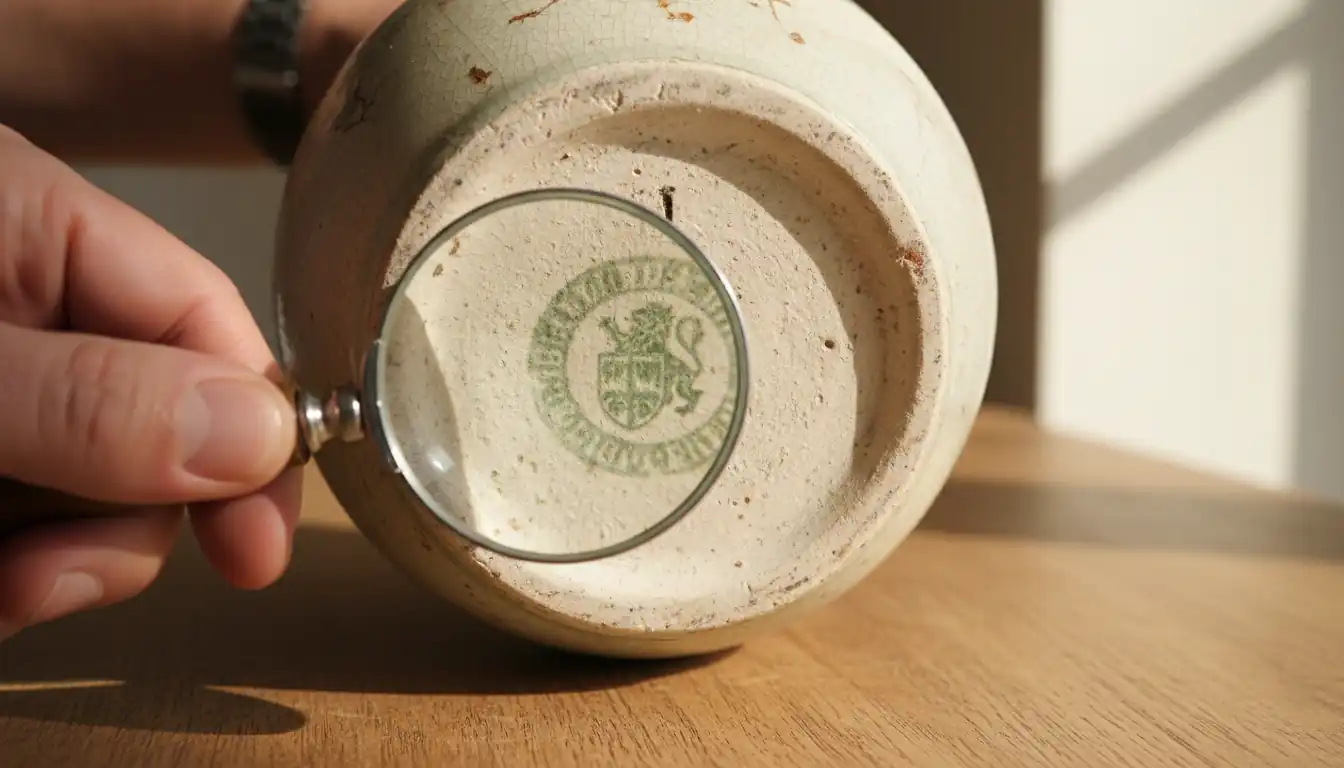
Before literacy was widespread, symbols did the heavy lifting of branding. A potter in 18th-century Europe couldn't always rely on a customer being able to read a name, but everyone recognized the prestige of a crown or the reliability of an anchor. These marks were more than just logos; they were guarantees of a specific standard of craftsmanship.
Common Symbols and Their Meanings
When you flip a piece of pottery over, you are looking for a "maker's mark." These are often under the glaze, meaning they were applied before the final firing. The symbols used by different factories often reflected their location or their primary benefactors.
- The Anchor: This is one of the most common symbols in ceramic history. While many associate it with maritime themes, it was famously used by the Chelsea Porcelain Factory in London. A small, neatly painted red anchor often signifies early Chelsea pieces (circa 1750), while a gold anchor suggests a slightly later, more ornate period.
- The Crown: If you see a crown, you are likely looking at a piece that had royal patronage. Factories like Royal Derby or Royal Worcester used various crown designs to show they were suppliers to the British monarchy. The specific shape of the arches on the crown can often tell you the exact decade the piece was produced.
- The Crossed Swords: This is the iconic mark of Meissen, the first European factory to produce true hard-paste porcelain. Two blue swords crossing each other have been used since the 1720s. However, because Meissen was so successful, these swords are among the most forged marks in history.
- Animals and Mythical Creatures: Lions, eagles, and sphinxes were popular for nationalistic reasons. A lion passant (walking) often points toward English origins, while an eagle might suggest German or American manufacture depending on the stylistic execution.
| Symbol | Common Association | Notable Factory |
|---|---|---|
| Anchor | Maritime/Stability | Chelsea, Davenport |
| Crossed Swords | Excellence/Prestige | Meissen |
| Crown | Royal Patronage | Royal Worcester, Derby |
| Lion | Strength/British Origin | Staffordshire |
| Bee | Industry/Hard Work | Various (often 19th century) |
The Mystery of the Fuku Mark
One of the most frequent questions new collectors ask is about a specific square mark often found on Japanese ceramics. This is the Fuku mark. Unlike European marks that usually point to a specific factory owner, the Fuku mark is a "mark of commendation."
The word "Fuku" translates to "happiness" or "good fortune." It is written in a stylized kanji character inside a square border. You will most commonly find this on Japanese Arita or Imari ware, particularly pieces made during the Edo period (17th to 19th centuries).
It is important to understand that the Fuku mark doesn't necessarily mean the piece is an antique. Because the symbol represents a wish for luck, it has been used continuously for hundreds of years. A Fuku mark on a piece from 1750 looks very different from one made in 1980. On older pieces, the blue cobalt ink often "bleeds" slightly into the glaze, and the character is painted with a confident, calligraphic brushstroke. Modern versions tend to look more like a stamped decal—perfectly uniform and lacking the soul of a hand-painted mark.
The Fuku mark is a cultural signature. It tells you less about who made the piece and more about the intent behind the object—a vessel meant to bring luck to its owner.
Material Clues That Speak Louder Than Stamps
While the mark on the bottom is a great starting point, marks can be faked. The clay itself, however, rarely lies. To truly identify a piece of vintage ceramics, you have to look at the "canvas"—the physical material the potter used. The most honest part of any ceramic piece is the "foot," the unglazed ring on the bottom where the item sat in the kiln.
Clay Body Composition and Construction
When you touch the foot of a piece, you are feeling the raw history of the object. There are three primary types of ceramic bodies, and knowing the difference is your first line of defense against misidentification.
- Earthenware: This is the oldest and most common type of pottery. It is fired at lower temperatures and remains porous. If you look at the unglazed foot of an earthenware plate, it will look earthy, often reddish or cream-colored. It feels warm to the touch and is relatively thick. If you tap it, it will produce a dull "thud" rather than a ring.
- Stoneware: Fired at higher temperatures, stoneware is dense and stone-like (hence the name). It is usually grey or brown and is non-porous even without glaze. You’ll often find this in antique crocks or mid-century studio pottery.
- Porcelain: This is the "white gold" of the ceramic world. True porcelain is made from kaolin clay and fired at extremely high temperatures until it vitrifies (turns into glass). The foot of a porcelain piece will be white, smooth, and very hard. If you hold a porcelain plate up to a bright light, you should be able to see the shadow of your hand through it.
18th-century Chelsea porcelain, for example, has a very distinct "moons" effect. When held to the light, you can see small, bright translucent spots in the body. This was a result of the specific chemical recipe used at the time. Modern mass-produced "fine china" won't have these quirks; it will be perfectly uniform and sterile.
Glaze Tells and Finishes
The glaze is the "skin" of the ceramic piece. How that skin has aged can tell you if a piece is truly vintage or a clever modern imitation.
Crazing vs. Cracking Crazing is the network of fine, spider-web lines that appear in the glaze. This happens because the clay body and the glaze expand and contract at different rates over decades of temperature changes. While some modern potters intentionally "crackle" their glaze for aesthetic reasons, authentic age-related crazing usually has a random, organic flow. If the crazing looks too perfect or uniform, be suspicious.
Salt-Glazing If you find a piece of stoneware with a texture like an orange peel, you are likely looking at salt-glaze. This technique involved throwing common salt into the kiln at the height of the firing. The salt vaporized and reacted with the silica in the clay to create a glass-like, pitted surface. This was incredibly popular in the 18th and 19th centuries for utilitarian items like jugs and mugs.
The "Wear" Pattern Look at where the piece touches the table. On a genuine antique, the foot rim will show "shelf wear." This isn't just dirt; it's a subtle smoothing of the raw clay from being moved across surfaces for a hundred years. If a piece claims to be from 1850 but the bottom is as rough as sandpaper and perfectly clean, it likely hasn't spent much time on a shelf.
Instant Identification with Modern AI Technology
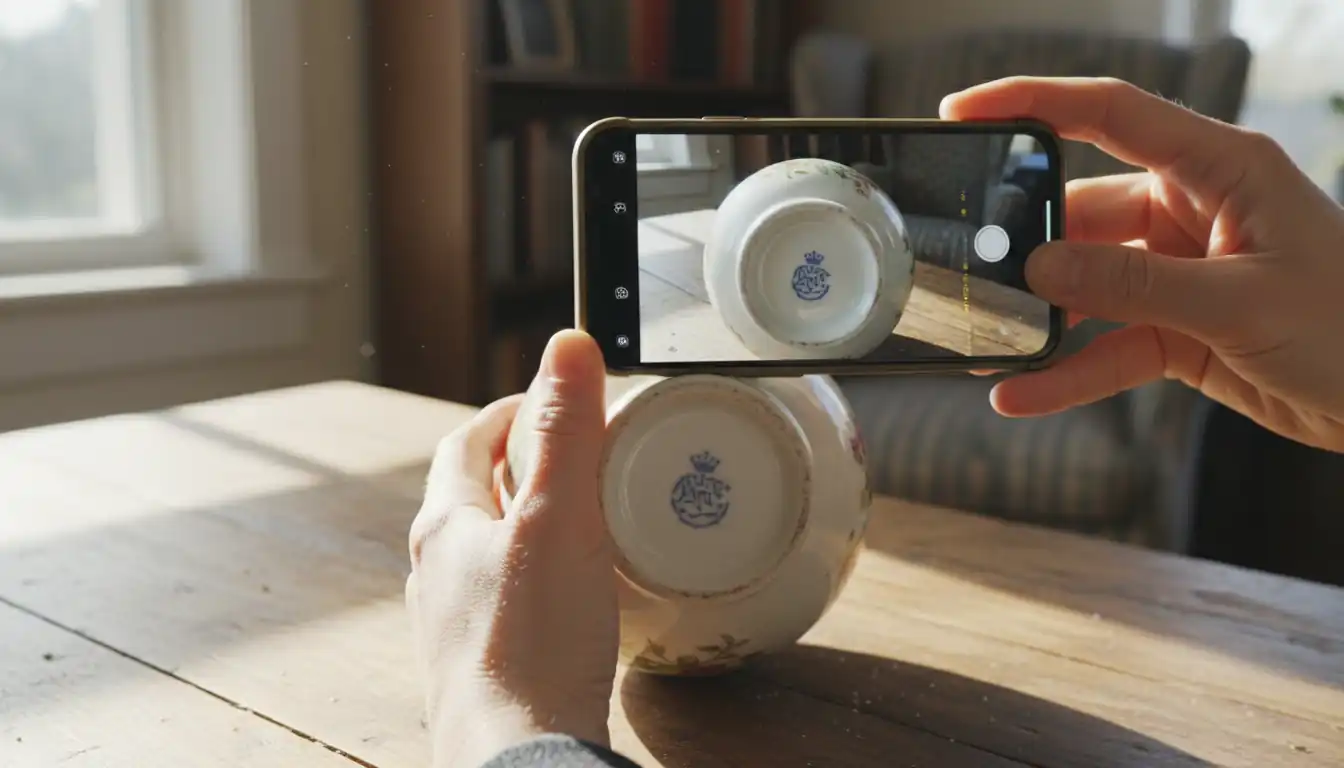
For decades, identifying ceramics required a library of heavy reference books. You would have to spend hours flipping through Kovel’s New Dictionary of Marks or Godden’s Guide to British Porcelain, trying to match a blurry symbol on a plate to a tiny line drawing in a book. Even then, you might misidentify a "Davenport" mark for a "Longport" mark because they both used anchors.
The margin for error was huge, and in the fast-paced environment of an estate sale or a busy auction, you simply didn't have the time to do the research. This is where technology has completely changed the game for modern collectors.
Why Traditional Research Often Fails
Traditional research relies on your ability to describe what you see. But how do you describe a specific shade of cobalt blue or the exact curvature of a hand-painted leaf? Words often fail when it comes to the nuances of art. Furthermore, many marks were used by multiple factories or were "borrowed" by competitors, making a text-based search frustratingly vague.
You might find a mark that looks like a "B," but is it for "Boullemier," "Berlin," or "Bordeaux"? Without a side-by-side visual comparison, you are just guessing.
Using Relic for Real-Time Appraisals
This is where the Relic app becomes an essential part of your toolkit. Instead of guessing, you can use the power of advanced AI to do the heavy lifting. Relic works by using your iPhone's camera to analyze the item in front of you.
When you encounter a mysterious mark or a piece with no mark at all, you simply take or upload a photo to the app. Relic’s AI doesn't just look for a matching symbol; it analyzes the shape, the glaze, the color palette, and the overall "hand" of the artist.
- Instant History: Within seconds, the app can provide the origin and history of the piece. It can tell you if that "Fuku" mark is a 19th-century original or a 1970s reproduction.
- Real Appraisals: Beyond just identification, Relic provides a real appraisal based on current market data. This is vital when you are trying to decide if a $50 price tag at a thrift store is a bargain or a rip-off.
- Expert in Your Pocket: With over 20,000 reviews and a 4.9-star rating, the app acts as a digital expert that travels with you. Whether you are a professional dealer or a weekend picker, having access to a searchable catalog of scanned items and market insights ensures you never leave a fortune behind.
Using a tool like Relic allows you to move through a sale with confidence. You no longer have to wonder if you're looking at a piece of Sevres or a "Sevres-style" imitation. The AI compares your photo against a massive database of known originals, giving you a level of accuracy that was previously only available to high-end auction house specialists.
Regional Signatures and Historical Context
To truly decode a ceramic piece, you have to understand the "vibe" of the era and region it came from. Marking styles weren't just random; they followed the fashion and politics of the time.
European Porcelain Powerhouses
In the 18th century, porcelain was the ultimate status symbol. European monarchs competed to have the best "porcelain laboratory." This led to very distinct regional styles.
Meissen (Germany): Meissen is the gold standard. Their early work often featured "Kakiemon" styles—Japanese-inspired designs with lots of white space and delicate flowers. Their mark, the crossed swords, is almost always in underglaze blue. If you see crossed swords that look like they were stamped on top of the glaze, it's almost certainly a later copy.
Sèvres (France): Sèvres was the playground of the French aristocracy. Their pieces are known for incredibly rich colors like "Bleu Céleste" (heavenly blue) and "Rose Pompadour." The mark is usually two interlaced "L"s. Inside the "L"s, you will often find a letter. This is a date code. An "A" means 1753, a "B" means 1754, and so on. This level of precision makes Sèvres a favorite for serious collectors.
Staffordshire (England): The Staffordshire region was the industrial heart of English pottery. Unlike the royal factories of the continent, Staffordshire was about production and export. You will find a lot of "transferware" here—pottery where the design was printed from a copper plate rather than hand-painted. The marks here are often more corporate, featuring the name of the pattern (like "Willow" or "Blue Italian") alongside the maker's name.
The Rise of Mid-Century Modern Studio Pottery
As we moved into the 20th century, the "vibe" of ceramic marks shifted. The focus moved away from giant factories and toward the individual artist. This is the era of Mid-Century Modern (MCM) studio pottery.
In this period, marks became much more personal. Instead of a crown or an anchor, you might find a simple incised signature or a "monogram" (a combination of the artist's initials).
- The Artist's Hand: Look for marks that are scratched into the wet clay before firing. This suggests a handmade, artisanal piece rather than something from a mold.
- California Pottery: Factories like Edith Heath or Bauer focused on solid colors and architectural shapes. Their marks are often simple embossed names on the bottom of the piece.
- Scandinavian Influence: Pieces from companies like Royal Copenhagen or Rörstrand often feature very minimalist marks—sometimes just three wavy lines representing the three straits of Denmark.
One famous example of regional quirkiness is the Chelsea "botanical" dishes. In the mid-1700s, the Chelsea factory produced plates painted with hyper-realistic vegetables and insects. These were inspired by the Chelsea Physic Garden nearby. The marks on these are often tiny and tucked away, as the factory didn't want to distract from the artistry of the painting.
Avoiding the Counterfeit Trap
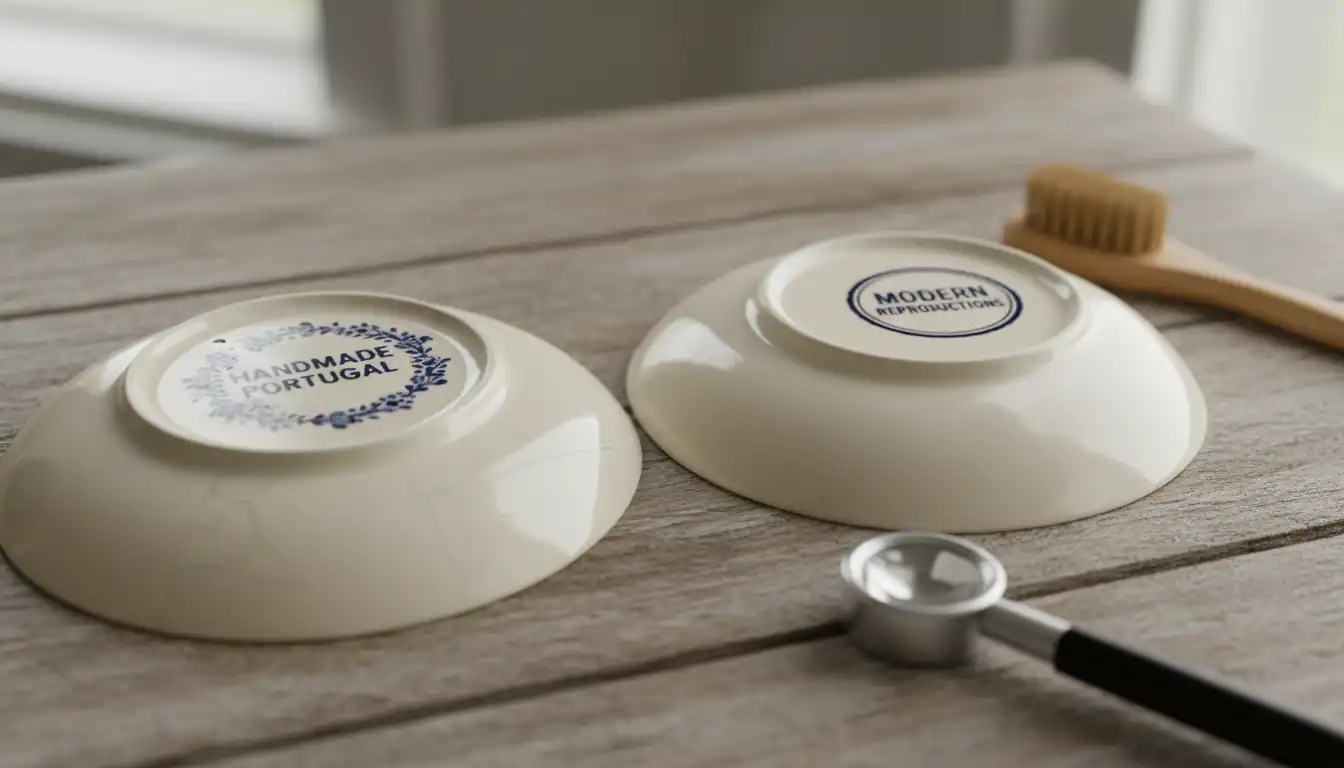
The more valuable a ceramic category becomes, the more fakes enter the market. Some "fakes" are actually honest reproductions made decades later to honor an original style, while others are deliberate attempts to deceive. Being a successful collector means knowing how to spot the red flags.
Common Identification Mistakes
One of the biggest mistakes beginners make is trusting a mark blindly. Just because a plate says "Meissen" doesn't mean it was made in the Meissen factory.
Over-Glaze vs. Under-Glaze Marks Most prestigious factories applied their marks under the glaze. This means the mark is protected by the glass-like layer and cannot be scratched off. If you can feel the texture of the mark with your fingernail, or if it looks like it was "stamped" on top of a finished plate, be very careful. This is a common sign of a later addition or a cheap reproduction.
The "Too Perfect" Syndrome Hand-painted marks from the 18th and 19th centuries have character. The lines will vary slightly in thickness. The ink might be darker in some spots than others. If a mark looks like it was printed by a laser jet printer—perfectly crisp, perfectly centered, and perfectly uniform—it probably was.
Bicentennial and Anniversary Marks In 1976, many companies released "Bicentennial" editions of their classic patterns. Similarly, factories often release "Centenary" versions of their famous designs. These pieces will often have the original 18th-century mark, but somewhere nearby, there will be a small date like "1776-1976." Beginners often miss the second date and think they've found an original 200-year-old piece.
Spotting Modern Reproductions
There are several "tells" that a piece is a modern reproduction trying to look old.
- The Weight: Modern mass-produced ceramics are often much heavier or much lighter than their antique counterparts. If a "delicate" porcelain cup feels like a heavy coffee mug, the clay composition is wrong.
- The "Occupied Japan" Trap: Pieces marked "Made in Occupied Japan" (produced between 1945 and 1952) are collectible in their own right. However, because they are popular, there are now modern fakes of "Occupied Japan" pieces. It’s a fake of a piece that was originally a budget export!
- Rubber Stamps vs. Hand Painting: Early marks were painted with a brush. By the late 19th century, rubber stamps became common. If a piece is supposed to be from 1740 but has a perfectly clear rubber-stamped mark, the timeline doesn't add up.
Pro Tip: Always carry a small magnifying glass or a jeweler's loupe. Looking at a mark under 10x magnification will reveal if it was painted with a brush or printed with a series of tiny dots (a modern decal).
This is where a tool like Relic becomes your best friend. The app's AI is trained to recognize the specific "dot patterns" of modern printing and the "brush drag" of authentic hand-painting. By comparing your item against a database of known authentic pieces, Relic can flag these red flags instantly, saving you from a costly mistake.
Conclusion
Decoding vintage ceramics is a journey that combines art history, chemistry, and a bit of detective work. From the "Fuku" marks of the Edo period to the crossed swords of Meissen, every symbol tells a story of ambition, craftsmanship, and cultural identity. By paying attention to the physical clues—the weight of the clay, the texture of the glaze, and the wear on the foot—you can begin to separate the treasures from the trinkets.
Remember that while your eyes and hands are your first tools, you don't have to do it alone. The world of antiques is vast, and even the most seasoned experts use reference materials to verify their finds.
The next time you’re at a yard sale and spot a mysterious symbol on the bottom of a vase, don't just guess. Take a clear photo, use the Relic app to get an instant appraisal and history, and turn that "maybe" into a "definitely." Whether you're looking to build a world-class collection or just find a beautiful piece for your home, the secret symbols are waiting for you to read them. Happy hunting!
Identify antiques instantly
Point your camera at any antique, collectible, or vintage item. Get valuations, history, and market insights in seconds.
Download for iPhone