Is That Dusty Dresser Worth a Fortune? 5 Free Apps That Reveal Your Furniture's True Value


You stand in front of a heavy, dark-wood dresser that has occupied the corner of your spare bedroom for a decade. It was a gift from an aunt, or perhaps a lucky find at a garage sale three towns over. You’ve often wondered if those elegant brass pulls and the slightly curved legs signify a masterpiece of 18th-century craftsmanship or if it’s simply a well-made reproduction from the mid-1900s. The difference between those two possibilities could be thousands of dollars.
For a long time, answering that question required hauling the piece to an auction house or paying a professional appraiser hundreds of dollars just to take a look. Most people chose to let the mystery sit, literally gathering dust. But the barrier between your curiosity and a definitive valuation has finally vanished. Your smartphone is no longer just a communication device; it has become a sophisticated lens capable of seeing through layers of varnish to identify the history hidden within the grain.
In the following guide, you will discover how modern technology allows you to identify, appraise, and eventually sell furniture with the confidence of a seasoned dealer. We will explore the mechanics of AI-driven identification, evaluate the most effective free tools available, and teach you how to verify digital findings with physical evidence. By the time you finish reading, you will know exactly how to turn that dusty dresser into a documented asset.
The Evolution of Furniture Appraisal Technology
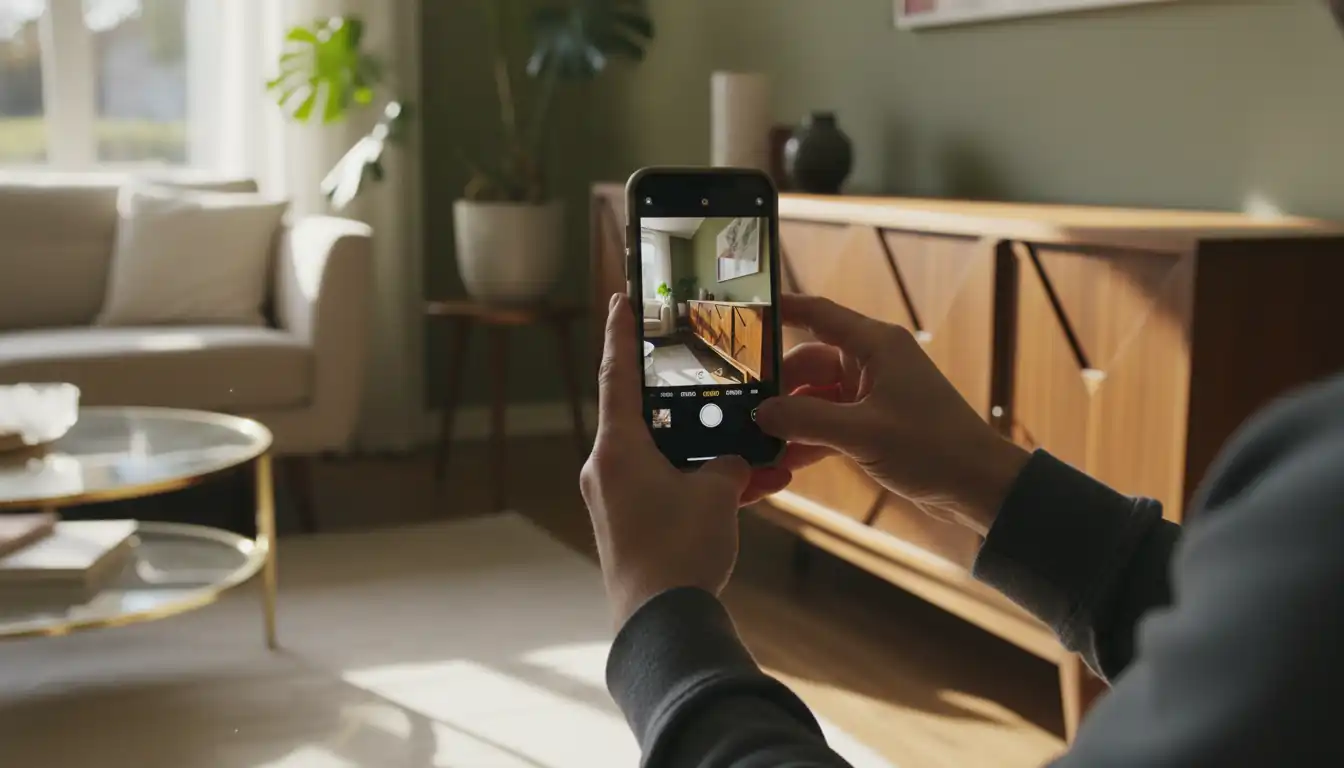
The process of identifying a piece of furniture used to be a tactile, slow-motion detective story. Appraisers would carry thick, dog-eared volumes of Miller’s Antiques Encyclopedia, cross-referencing the shape of a chair’s splat or the specific "c-scroll" of a carving against grainy black-and-white photographs. It was a world of intuition and memorization. If you didn't know the difference between a cabriole leg and a spade foot, you were essentially flying blind.
This manual era has been replaced by the rise of computer vision and machine learning. Think of computer vision as a digital brain that has "seen" millions of images of furniture. When you point your camera at a table, the software isn't just looking at a piece of wood. It is analyzing the geometric relationships of the object. It measures the ratio of the height to the width, the specific angle of the taper on a leg, and the repeating patterns in the wood grain that suggest a specific species like cherry or mahogany.
Visual Search and AI Recognition
How does a machine know the difference between a genuine Chippendale chair and a 1920s "Chippendale-style" reproduction? It comes down to the details that the human eye might overlook. AI models are trained on vast datasets of authenticated museum pieces and auction records. They look for "keypoints"—specific structural markers that define a period.
For example, an AI might identify the "ball and claw" foot of a chair. It then analyzes the "knuckles" of the claw. In an 18th-century original, those knuckles are often more pronounced and hand-carved with slight irregularities. A machine-made version from the 20th century will show a mathematical symmetry that the AI recognizes as a product of industrial manufacturing.
The Relic app is a primary example of this technological leap. Instead of forcing you to scroll through endless categories of "tables" or "chairs," Relic uses its advanced AI to perform a deep dive into the item's DNA. When you upload a photo, the app doesn't just return a generic name. It analyzes the silhouette and construction to provide a real appraisal, a detailed history, and the likely origin of the piece. It’s like having a curator from a major museum standing in your living room, explaining why your furniture looks the way it does.
Real Time Market Data Integration
Identification is only half of the battle. The other half is understanding what someone is actually willing to pay for an item today. In the past, prices were static, found in annual price guides that were often out of date by the time they were printed. Today, appraisal technology connects directly to live market feeds.
These systems aggregate data from thousands of realized auction results, private sales, and online marketplace listings. They account for "market temperature"—the reality that Mid-Century Modern might be soaring in value this month while Victorian oak is seeing a dip. By combining visual recognition with this flow of data, apps can provide a valuation that reflects the current economic reality, not just a historical guess.
Key Insight: Digital appraisal isn't just about finding a price; it's about uncovering the narrative of the object. A dresser is just furniture until you realize it was crafted in a specific Philadelphia workshop in 1790.
Top Free Apps for Instant Identification
When you are standing in a crowded thrift store or a dusty attic, you need a tool that works quickly and accurately. The market for identification apps has grown rapidly, but not all tools are created equal. Some focus on broad categories, while others are specialized for the nuances of antiques and vintage decor.
Relic for Historical Context and Appraisal
If you are looking for a comprehensive tool that handles the heavy lifting of research, Relic is the standout choice in the iOS ecosystem. The app is designed specifically for the needs of collectors and professional pickers who require more than just a "best guess."
The workflow is straightforward: you take a photo or upload one from your gallery. Relic’s AI then scans the image against a massive database of furniture styles, maker's marks, and historical periods. What sets it apart is the depth of the results. You receive:
- A Professional Appraisal: An estimated market value based on current trends.
- Historical Context: Information on the era, style (e.g., Federal, Art Deco, or Biedermeier), and the cultural significance of the piece.
- Origin Story: Insights into where the piece was likely manufactured and by whom.
With a 4.9-star rating from over 20,000 reviews, the app has built a reputation for accuracy among professionals like dealers and importers. It bridges the gap between a simple photo search and a formal, paid appraisal.
Curio and the Accuracy of Quick Estimates
Another name that frequently comes up in the search for valuation tools is Curio. Many users ask, "What is the free app to identify the value of items?" and Curio is often cited alongside Relic. While Relic leans heavily into the historical and professional appraisal side, Curio focuses on rapid-fire estimates for a wide variety of household goods.
However, a common question arises: "How accurate is the curio app?" The answer depends on the rarity of the item. Curio’s algorithm is excellent at identifying common vintage items—think mass-produced 1960s glassware or recognizable furniture brands like Ethan Allen. Because there is so much data for these items, the pricing is usually quite accurate.
For high-end antiques or "sleeper" pieces (items that look ordinary but are actually rare), Curio can sometimes struggle because its algorithm relies on volume. If there aren't thousands of similar items sold recently, the estimate might be wider than a specialist would like. For those unique finds, a more specialized AI like Relic’s, which looks at specific construction markers, tends to provide a more nuanced valuation.
| App Feature | Relic | Curio |
|---|---|---|
| Primary Strength | Historical Context & Professional Appraisal | Quick Estimates for Common Items |
| AI Depth | High (Analyzes joinery and period styles) | Medium (Focuses on visual similarity) |
| Market Data | Real-time auction & dealer records | Aggregated marketplace listings |
| Best For | Antiques, Fine Furniture, Professional Dealers | General Household Items, Vintage Decor |
Decoding Value Beyond the Digital Price Tag
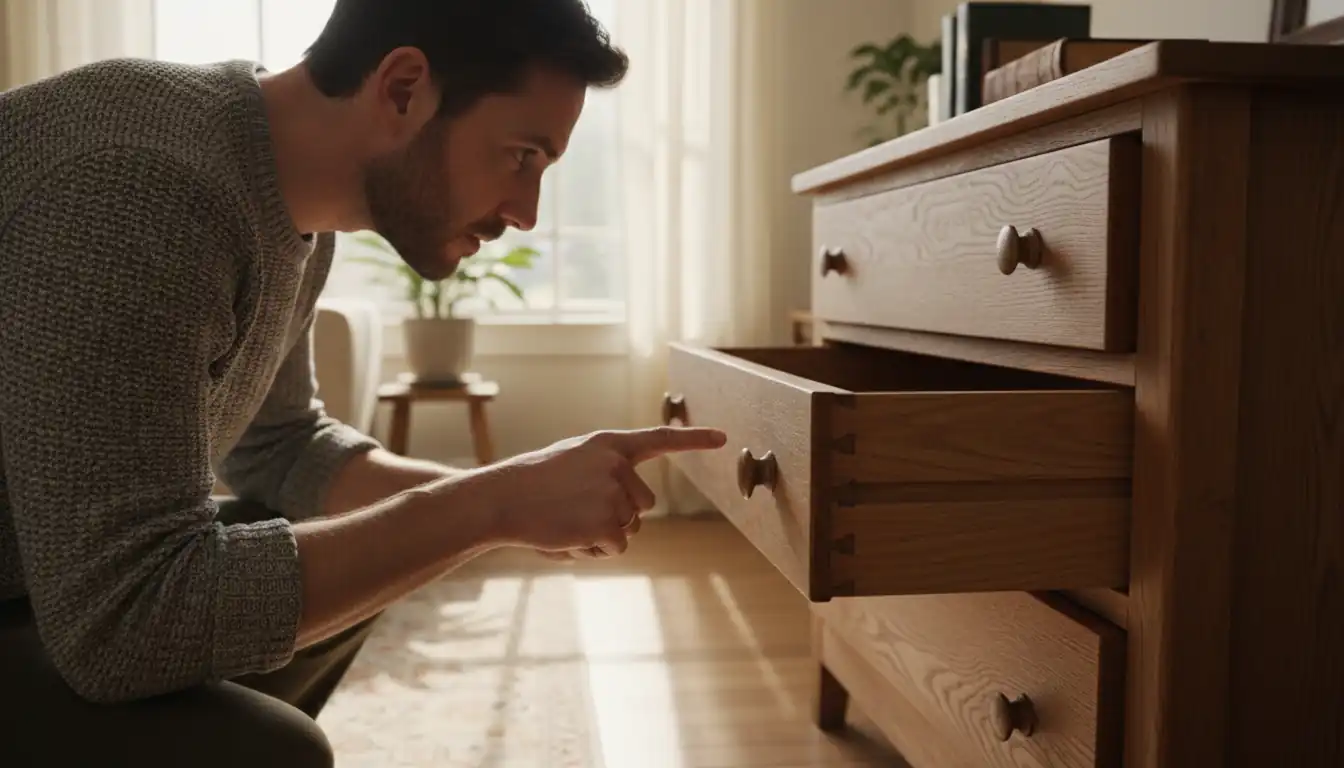
While an app provides a fantastic starting point, the most successful collectors use digital tools as a foundation for their own physical investigation. Think of the app as a compass; it points you in the right direction, but you still have to walk the path. Learning to verify an app's findings with your own eyes will prevent you from making costly mistakes.
Identifying Makers Marks and Joinery
One of the most exciting moments in furniture hunting is finding a "signature." This isn't always a literal name; it's often found in how the piece was put together. Relic’s historical data can often tell you exactly where to look for these clues based on the style it identifies.
- Dovetail Joints: Pull out a drawer and look at the side. If the "teeth" connecting the front to the side are slightly uneven and few in number, they were likely cut by hand (pre-1870). If they are perfectly uniform and small, they are machine-cut.
- The "Secondary" Wood: Look at the bottom of the drawer or the back of the cabinet. Makers often used expensive wood (mahogany) for the exterior and cheap wood (pine or poplar) for the parts no one saw. The type of secondary wood used can tell you if a piece was made in New England, the South, or Europe.
- Maker's Stamps: Check the underside of chair seats, the back of dressers, or the inside of drawer interiors. A faint ink stamp or a brass plate can increase the value of a piece by 500% instantly.
The Impact of Provenance on Resale
Provenance is simply the "history of ownership." While an app can identify the what, you are often responsible for the who. Did this chair belong to a local historical figure? Was it purchased at a famous estate sale?
Even if you don't have a paper trail, the physical condition of the piece tells a story. "Patina" is the thin layer of oxidation and wear that develops on the surface of wood and metal over decades. A piece with its original finish—even if it has some scratches—is almost always worth more than a piece that has been aggressively stripped and refinished. The AI in an app like Relic is trained to recognize the "glow" of an original finish, which is a key factor in its appraisal.
"A piece of furniture is a time capsule. Every scratch and every hand-cut joint is a record of the person who built it and the people who lived with it."
Common Pitfalls in Digital Furniture Valuation
The road to a big sale is paved with "almost-antiques." It is easy to get caught up in the excitement of a high digital valuation, but you must remain objective. There are two major traps that catch even experienced hobbyists.
The Trap of Sentimental Value
Psychologists call it the "endowment effect." This is the tendency to value an object more highly simply because you own it. When a dresser has been in your family for three generations, you don't just see wood and brass; you see your grandmother's bedroom.
This emotional attachment can lead you to ignore the data. If an app tells you the market value is $400, but you feel it "should" be $2,000 because of its history, you will likely never sell it. Use the objective data from your apps to ground your expectations. Remember, a buyer isn't buying your memories; they are buying a piece of decor.
Distinguishing Reproductions from Originals
This is the most common technical error. In the 1920s and again in the 1970s, there were massive "Colonial Revival" movements. Factories produced millions of pieces that looked exactly like 18th-century antiques. To the untrained eye—and sometimes to basic AI—they look identical.
How to spot a 1970s reproduction:
- Uniformity: Look at the carvings. Are they identical on both sides of the piece? If so, they were likely made by a CNC machine, not a human hand.
- Hardware: Remove a screw from a hinge. Is it a modern Phillips head or a flat-head screw? Is the metal shiny and bright, or does it have the dull, irregular look of hand-forged iron?
- The "Scent" Test: Old furniture has a specific, musty-but-clean smell of aged wood and old wax. Modern reproductions often retain a faint chemical scent of industrial lacquers or plywood glues.
Relic helps mitigate this risk by providing the "History and Origin" of the item. If the app identifies a piece as "Centennial Style," it is telling you that it’s a 19th-century tribute to an 18th-century style. This distinction is vital for accurate pricing.
Strategic Steps for Maximizing Resale Profit
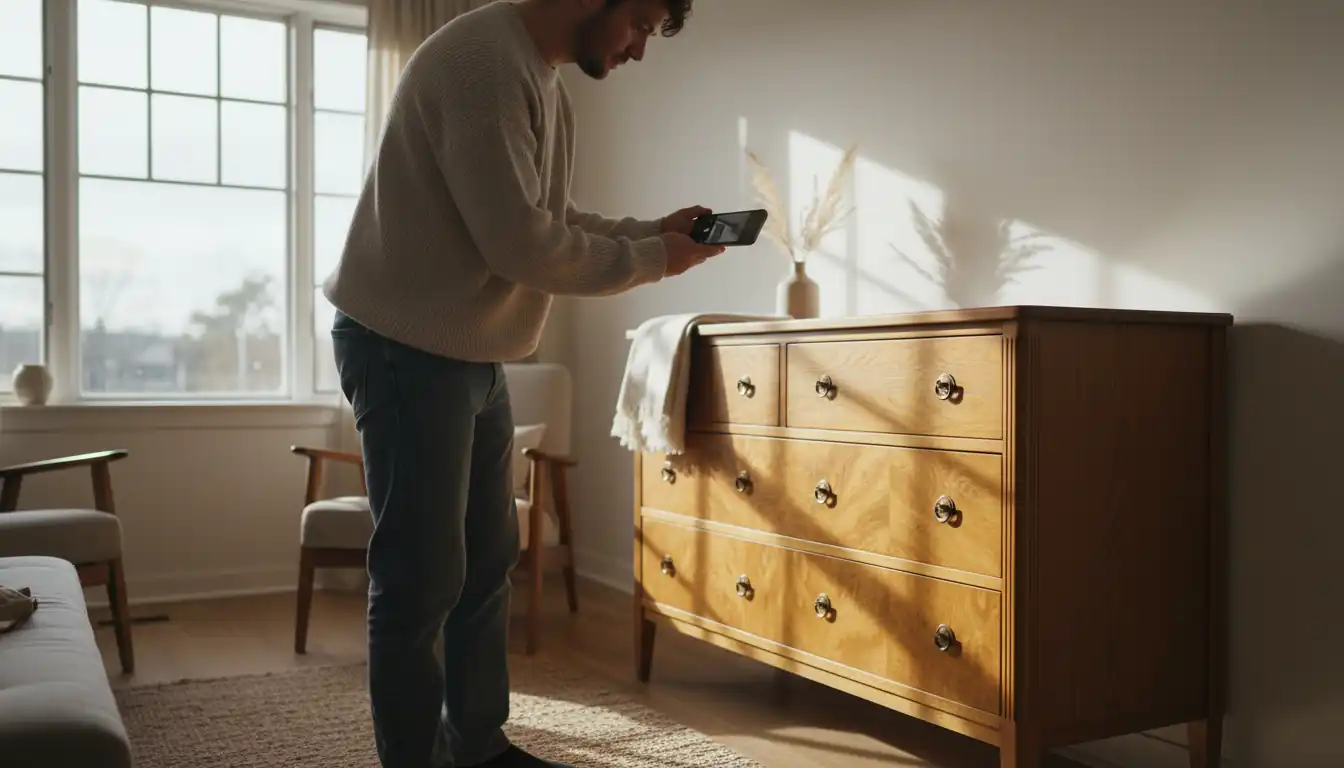
Once you have identified your furniture and confirmed its value through a mix of AI and physical inspection, it’s time to convert that knowledge into cash. Selling furniture is as much about presentation as it is about the item itself.
Platform Specific Pricing Strategies
Different buyers hang out in different digital neighborhoods. Where you list your item should depend on the data you gathered from your appraisal.
- Facebook Marketplace: Best for "good" furniture that isn't necessarily a high-end antique. Use the "Market Insights" from your app to set a price that is slightly higher than your bottom line to allow for the inevitable haggling.
- Chairish or 1stDibs: These platforms are for the "best" items. If your Relic appraisal suggests your piece is a genuine period antique or a designer Mid-Century item (like Eames or Knoll), these are the places to go. You can charge a premium here, but your photography must be professional.
- Local Auction Houses: If you have a piece that is difficult to ship but high in value, a local auction house can handle the logistics for a commission.
When writing your listing, use the specific terminology provided by the app. Instead of saying "Old Brown Table," use "George III Style Mahogany Tilt-Top Tea Table, circa 1890." This specific language attracts serious collectors and search engines alike.
The Role of Professional Appraisals for High Value Items
While apps are incredibly powerful for identification and market research, there is a ceiling to their utility. If an app suggests your item is worth more than $5,000, or if you need a valuation for insurance purposes after a loss, you need a "Certified Appraisal."
Organizations like the American Society of Appraisers or auction houses like Swann Auction Galleries provide legal documents that stand up in court and with insurance companies. An app like Relic is your "scout"—it tells you which items are worth the investment of a formal, paid appraisal.
- Replacement Value: What it would cost to buy the exact same item in a retail setting today (used for insurance).
- Fair Market Value: What a willing buyer would pay a willing seller (used for taxes and general sales).
- Liquidation Value: What you get if you have to sell it today (usually the lowest price).
Conclusion
The dresser in your spare room might be a hidden treasure, or it might just be a sturdy place to store blankets. Either way, the mystery is now optional. By using tools like Relic to bridge the gap between curiosity and expert knowledge, you can navigate the world of antiques with clarity.
You now have the framework to identify styles, verify joinery, avoid emotional pricing traps, and choose the right marketplace for a sale. The next step is simple: clear off the dust, grab your phone, and see what history is hiding in plain sight. Download an identification app today and scan that first piece of furniture—you might find that your "dusty dresser" is the start of a very profitable hobby.
Identify antiques instantly
Point your camera at any antique, collectible, or vintage item. Get valuations, history, and market insights in seconds.
Download for iPhone