Is That Old Spoon Solid Silver? Decoding the Hidden Symbols on Your Heirloom

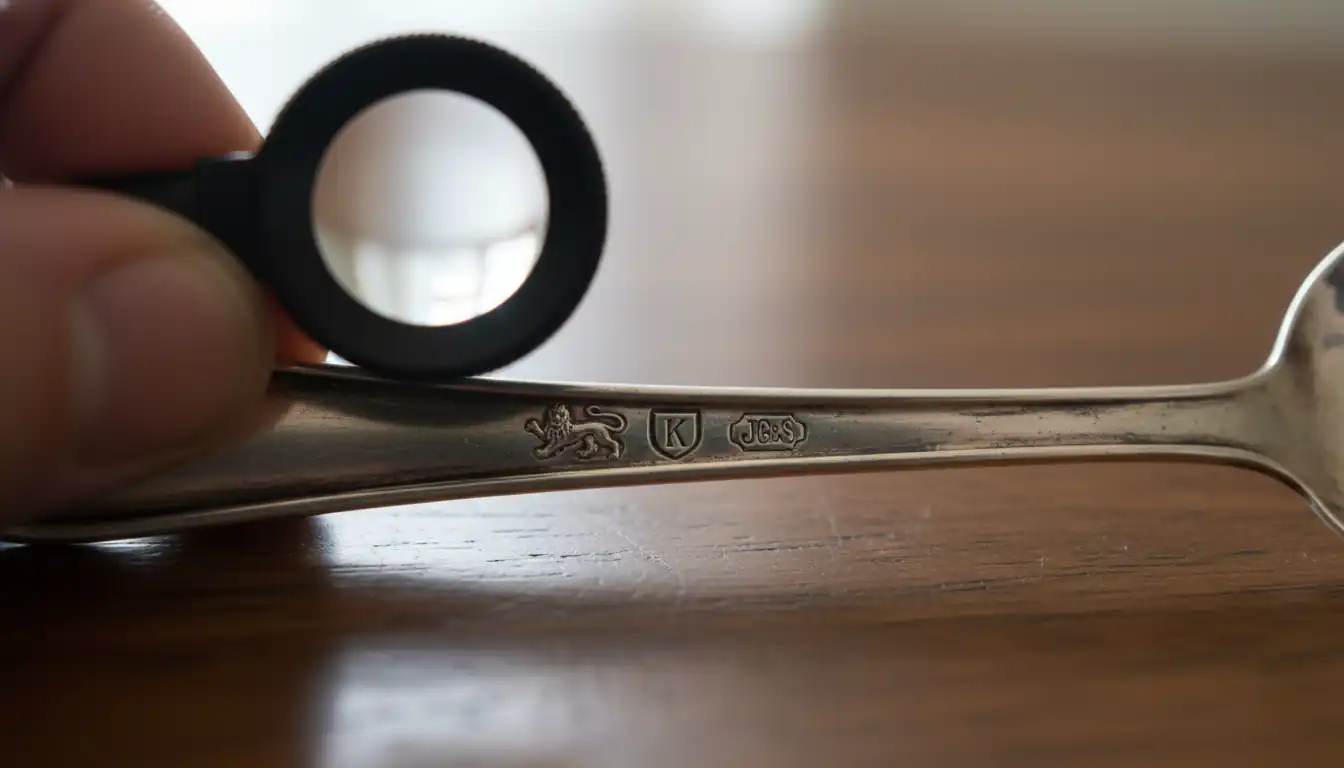
You are holding a heavy, tarnished spoon you found at the back of a kitchen drawer or perhaps at a weekend estate sale. It feels different than the stainless steel utensils you use every day. It has a certain warmth to the touch, a deeper luster beneath the grime, and a weight that suggests it wasn't mass-produced in a modern factory. You flip it over, squinting at the back of the handle, and see a row of tiny, mysterious symbols. Are they just decorative flourishes, or are they telling you that you’re holding a piece of history?
These marks are known as hallmarks, and they are far more than just "branding." They are a rigorous, centuries-old consumer protection system designed to guarantee the purity of precious metals. In a time before government regulations and lab testing, these stamps were the only way a buyer could be sure they weren't being cheated. Understanding how to read these symbols is like learning a secret language that reveals the exact year, city, and person who created your heirloom.
By the time you finish reading this guide, you will be able to look at those tiny stamps and map out the journey your silver has taken. We will break down the complex British system, explore how different countries marked their treasures, and show you how to use modern technology to identify even the most obscure symbols in seconds. Whether you are a casual collector or someone who just inherited a box of "old junk," this is how you decode the hidden story of your silver.
The Anatomy of a Hallmark
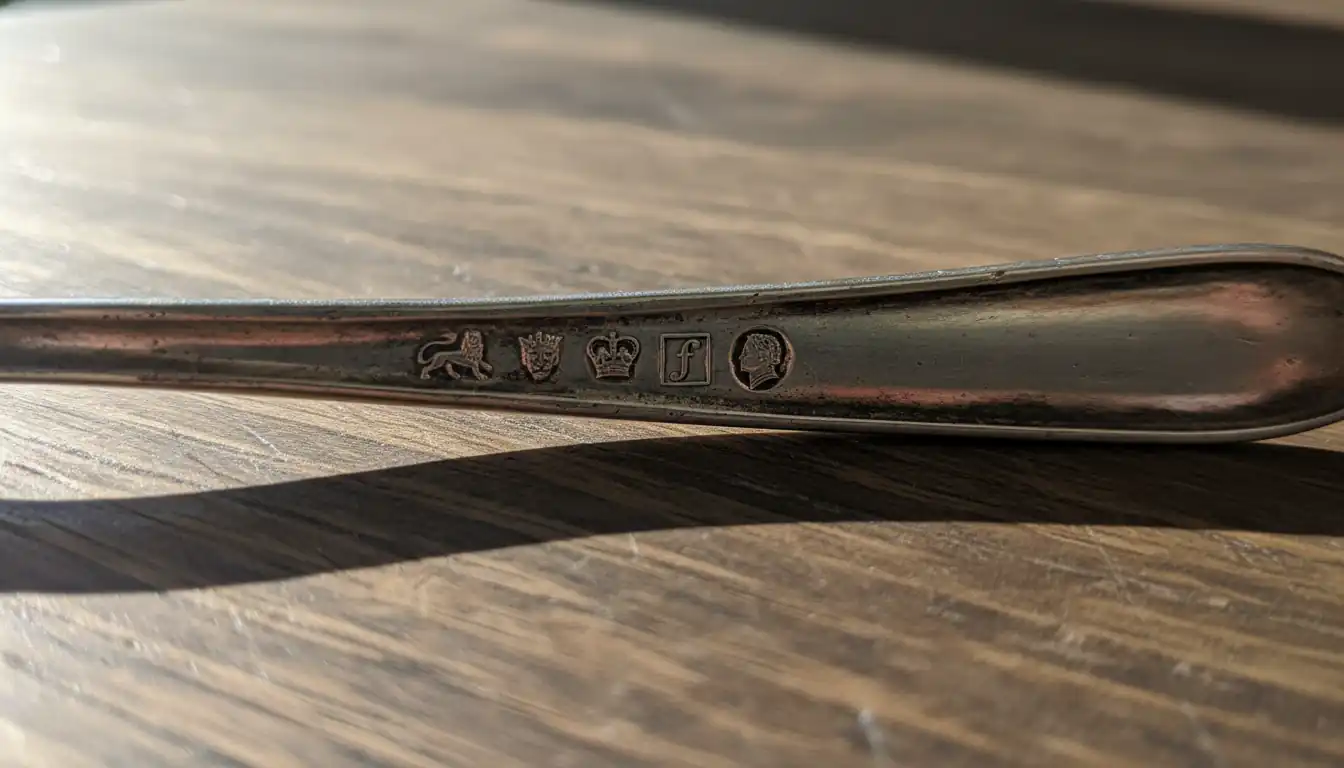
When you look at the back of a British silver spoon, you aren't just looking at one mark; you are looking at a sequence. This system is widely considered the most sophisticated and reliable in the world. Since the 1300s, British silversmiths have been required by law to have their work tested at an official Assay Office. If the metal met the strict requirements for "sterling" quality, it was struck with a series of stamps. Think of these marks as a physical passport for the item, proving its legitimacy at every border it crossed.
The Five Essential Stamps
To the untrained eye, these marks look like a jumble of microscopic pictures. However, they almost always follow a specific order. Each stamp provides a different piece of the puzzle, and missing even one can change the entire history of the piece.
- The Standard Mark: This is the most important stamp for determining value. It tells you the purity of the silver. The most famous is the "Lion Passant"—a lion walking to the left with one paw raised. This indicates the piece is Sterling Silver, which is 92.5% pure. If you see a seated figure of Britannia instead, you’ve found something even rarer: Britannia Silver, which is 95.8% pure.
- The Town Mark: This symbol tells you where the piece was tested and stamped. Each major city had its own unique icon. London used a leopard’s head, Birmingham used an anchor, and Sheffield used a crown (though this changed to a rose in later years). Seeing an anchor on a spoon tells you it originated in the heart of England's industrial metalworking hub.
- The Date Letter: This is a single letter of the alphabet that indicates the year the piece was hallmarked. To prevent forgery, the font style and the shape of the shield surrounding the letter changed every year. A "b" in a square shield means something entirely different than a "b" in an oval shield.
- The Duty Mark: Found on pieces made between 1784 and 1890, this mark shows the profile of the reigning monarch’s head. It proves that the appropriate tax had been paid to the crown. If you see the profile of King George III or Queen Victoria, you can immediately narrow down the era of your spoon.
- The Sponsor’s Mark: Also known as the Maker’s Mark, these are usually the initials of the silversmith or the company responsible for the piece. This is the "signature" of the artist. It allows you to trace the spoon back to a specific workshop, from small independent craftsmen to massive firms like Mappin & Webb.
Distinguishing Quality from Origin
It is easy to confuse a "maker's mark" with a "hallmark," but they serve very different purposes. A maker's mark is an internal identification used by the workshop. A hallmark is an external, third-party guarantee provided by the government or an official guild. The presence of a full set of British hallmarks means the piece has been independently verified for quality.
| Symbol | Meaning | Example |
|---|---|---|
| Lion Passant | Sterling Silver (92.5%) | A lion walking left |
| Leopard's Head | London Assay Office | A stylized cat face |
| Anchor | Birmingham Assay Office | A vertical ship's anchor |
| Crown | Sheffield Assay Office | A simple five-pointed crown |
| Sovereign's Head | Tax Paid (Duty Mark) | Profile of the King or Queen |
A hallmark is not just a decoration; it is a legal document struck into metal. It represents a chain of custody that has remained unbroken for over seven hundred years.
Regional Variations and Global Standards
While the British system is the most famous, other countries developed their own methods for marking silver. If your spoon doesn't have a lion or a leopard, it doesn't mean it isn't silver; it just means it has a different story to tell. Moving across the English Channel or the Atlantic Ocean changes the "visual vocabulary" of the stamps you need to look for.
Continental European Markings
France and Germany took very different approaches to hallmarking than the British. French silver is often considered some of the finest in the world, but its marking system can be confusing because the symbols are incredibly small and often placed in odd locations, like the edge of a spoon bowl.
- The Minerva Head: Since 1838, the primary standard mark for French silver has been the head of Minerva, the Roman goddess. If the head is in a shield with a clipped top, it is "First Standard" (.950 purity). If the shield is a simple circle, it is "Second Standard" (.800 purity).
- The Boar’s Head and Crab: For smaller items like spoons or jewelry, the French often used tiny symbols like a boar’s head (for Paris) or a crab (for the provinces) to indicate silver content.
- The German Crescent and Crown: In 1888, Germany unified its marking system. Look for a crescent moon facing a crown. This is almost always accompanied by a decimal number like "800" or "925," which explicitly states the silver content. Unlike the British system, German marks are often very clear and easy to read.
American Sterling and Coin Silver
The United States never had a national hallmarking law. This led to a "Wild West" of silver marking where silversmiths were largely on the honor system. Because there were no official assay offices, American silver relies heavily on text rather than symbols.
- Coin Silver: Before the mid-1800s, American silversmiths often melted down silver coins to make spoons. These pieces are usually marked with the word "COIN" or "PURE COIN." This silver is typically 90% pure, slightly lower than sterling.
- Sterling Text: Around the 1850s, led by companies like Tiffany & Co., the U.S. adopted the British sterling standard. Most American sterling is simply stamped with the word "STERLING." You might also see a manufacturer's symbol, like the Gorham lion-anchor-G mark, but the word "Sterling" is the legal guarantee of quality.
- Pseudo-Hallmarks: Some early American makers struck symbols that looked like British hallmarks (lions, heads, anchors) to make their work look more "official" or "imported." These are known as pseudo-hallmarks and can be very deceptive for new collectors.
Cracking the Date and Maker Code
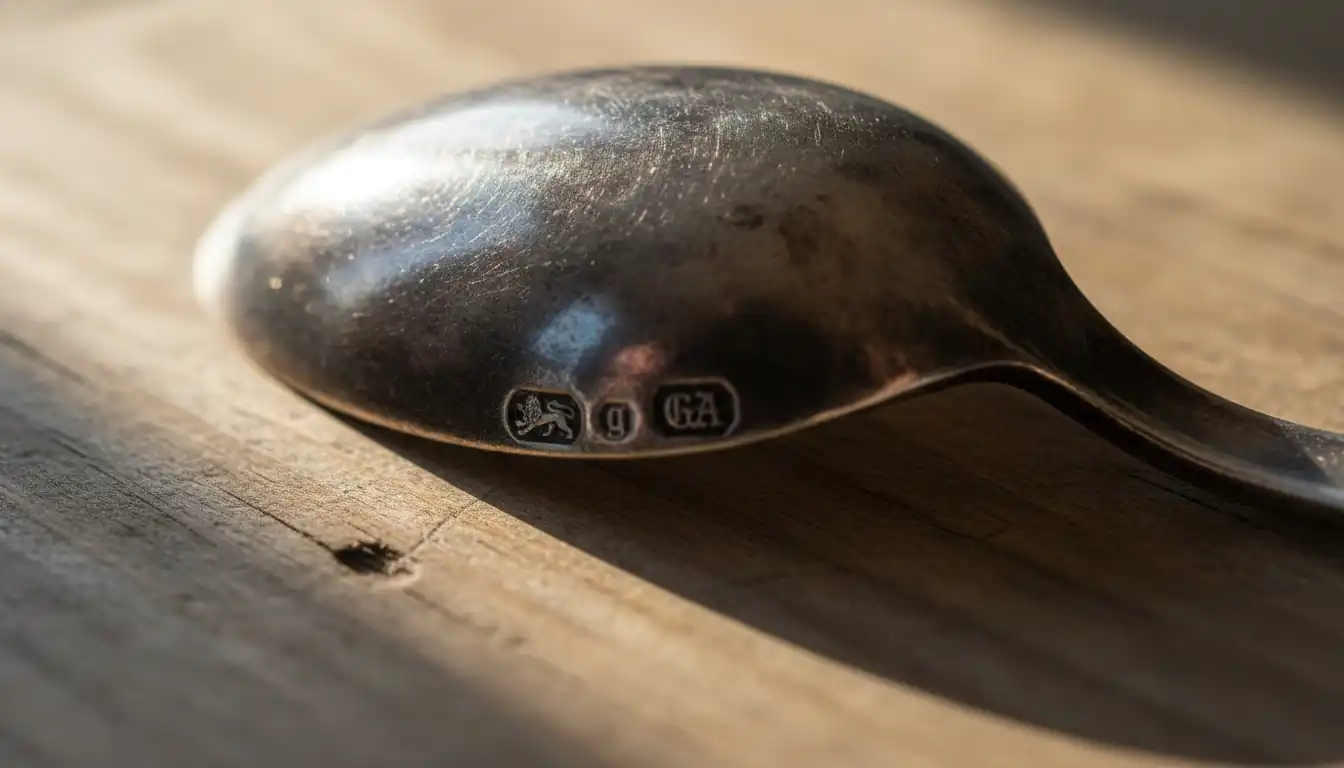
Once you have identified that your spoon is indeed silver and you know which country it came from, the real detective work begins. Dating a piece of silver and identifying the specific maker is where the history of the object truly comes alive. This process requires a keen eye for detail and an understanding of how styles evolved over centuries.
The Alphabet of Time
The British date letter system is a masterpiece of complexity. The Assay Offices used a 20-letter alphabet (usually skipping J, U, W, X, Y, and Z). Once they finished a cycle of 20 years, they would start again with the letter 'A,' but they would change the font and the shape of the shield.
For example, imagine you are looking at the letter "B."
- 1797: The "B" might be a Roman capital letter inside a shield with a pointed bottom.
- 1817: The "B" might be a lowercase Gothic script inside an oval.
- 1897: The "B" might be a bold Sans-Serif letter inside a shield with a three-lobed top.
Because of this, you cannot simply look at a chart of letters. You must match the letter, the font style, and the exact shape of the border. This is why a jeweler’s loupe is an essential tool. A mark that looks like a simple smudge to the naked eye often reveals a crisp, stylized letter under 10x magnification.
Identifying the Master Silversmith
The Sponsor’s Mark (or Maker’s Mark) is the fingerprint of the creator. In the early days, these were often pictorial—a tiny heart, a bird, or a star. By the 17th century, they transitioned to the initials of the smith. Identifying these marks can turn a $50 spoon into a $5,000 museum piece.
- Paul Storr: Known as the "King of Silversmiths" during the Regency era, his "PS" mark is highly coveted. His work is known for its incredible weight and neoclassical detail.
- Hester Bateman: One of the few famous female silversmiths of the 18th century. Her "HB" mark represents elegant, simple designs often featuring delicate "bright-cut" engraving.
- Tiffany & Co.: American pieces will often have the full company name. Look for additional letters like "M" or "C," which indicate the initial of the company's artistic director at the time, helping you narrow down the date even further.
If the marks are "rubbed"—meaning they have been worn down by decades of polishing—don't give up. Look at the edges of the mark. Often, the deepest part of the stamp survives even when the center is smooth. A raking light (shining a flashlight at a low angle across the surface) can help shadows pop, making a faint mark legible again.
Instant Identification with Modern AI
Manual research is a rite of passage for many collectors, but it can be incredibly frustrating. You might spend hours flipping through heavy reference books like Bradbury’s Book of Hallmarks, only to find that your specific mark is slightly different from the ones on the page. Or perhaps the mark is partially worn, and you can't tell if that's a leopard's head or a rose. This is where the gap between amateur and expert used to be widest—until now.
Why Manual Research Often Fails
The primary challenge with manual identification is the sheer volume of data. There are tens of thousands of maker's marks and date letter combinations across hundreds of years and dozens of countries. A slight variation in a shield shape can move the date of your spoon by fifty years. Furthermore, many marks are struck poorly or have "ghosting," where the stamp bounced and created a double image. For a human, this is a puzzle that requires years of experience to solve.
Using Relic for Real Time Appraisals
This is exactly where the Relic app changes the game for collectors and enthusiasts. Instead of squinting through a loupe and cross-referencing dusty catalogs, you can use your iPhone to get an instant answer. Relic uses advanced AI specifically trained on antique databases to recognize these tiny, complex symbols.
- Instant Identification: You simply take a clear photo of the hallmarks on your spoon. Relic’s AI analyzes the shapes, fonts, and symbols, cross-referencing them against thousands of known entries.
- Historical Context: It doesn't just tell you "Sterling." It provides the origin, the likely maker, and the historical period of the item.
- Professional-Grade Accuracy: With a 4.9-star rating from over 20,000 reviews, the app has become a go-to tool for dealers, pickers, and online sellers who need to make quick decisions at auctions or estate sales.
Using Relic feels like having a professional appraiser standing over your shoulder. It removes the guesswork, allowing you to identify a piece of silver in seconds. Whether you're trying to see if a spoon at a thrift store is worth the $2 asking price or you're cataloging a family collection for insurance, the app provides a level of certainty that used to take a lifetime of study to achieve.
Beyond the Stamp: Assessing Value and Condition
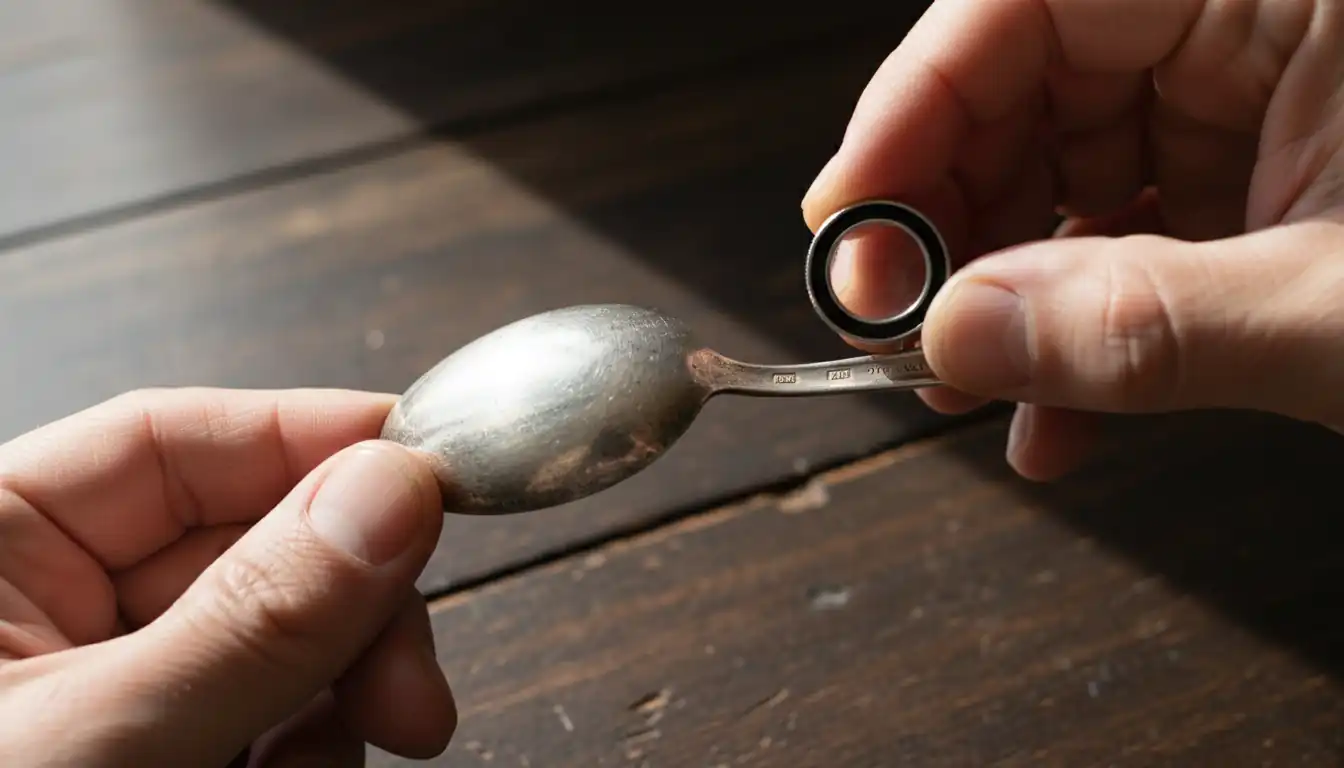
Once you have decoded the marks and know exactly what you have, the next question is always: "What is it worth?" Identification is the first step, but the market value of silver is determined by a combination of the metal's weight, the rarity of the maker, and the physical condition of the piece.
Wear Patterns and Fake Marks
Not every mark you see is honest. As silver became a major collectible in the 19th and 20th centuries, forgers began to find clever ways to trick buyers. One common trick is the "duty dodger" or a "transposed hallmark."
- Transposed Marks: A forger might cut a genuine hallmark out of a small, inexpensive item (like a broken spoon) and solder it into a larger, more valuable piece (like a coffee pot). If you look closely with a loupe and see a faint line or a change in the metal's texture around the marks, you might be looking at a fake.
- Strike Quality: Collectors look for a "crisp strike." This means the marks were hammered firmly and clearly. A piece with clear, deep marks is almost always more valuable than one where the marks are faint or "rubbed."
- Condition Issues: Check for "pitting" (tiny holes caused by salt corrosion) or "thinning" in the bowl of the spoon. If a spoon has been used to stir acidic foods for a hundred years, the metal can actually wear away.
The Impact of Provenance on Price
The marks tell you who made the item, but "provenance"—the history of who owned it—can skyrocket the value. A standard sterling spoon might be worth its weight in silver (the "melt value"), but a spoon with the maker's mark of Paul Revere or a crest belonging to a royal family is a different category of asset.
- Documenting for Insurance: Once you've used a tool like Relic to identify your silver, keep a digital record. High-resolution photos of the marks alongside the AI-provided history are essential for insurance appraisals.
- Market Trends: Currently, there is high demand for "unusual" marks—provincial Scottish or Irish marks, for example, often fetch a premium over standard London marks because fewer of them were produced.
Value is found at the intersection of purity, rarity, and clarity. A clear mark on a rare piece is the "holy grail" for silver collectors.
Conclusion
Decoding the symbols on an old spoon is a journey into the past. Those tiny stamps are a record of a craftsman's pride, a government's oversight, and a family's legacy. By understanding the anatomy of a British hallmark, recognizing regional variations from France to America, and knowing how to spot the "fingerprints" of master silversmiths, you transform a simple utensil into a historical document.
While the old way of identifying silver required a library of books and a lot of luck, you now have the advantage of modern technology. Tools like the Relic app allow you to bypass the frustration of manual research, giving you instant access to the history and value of your heirlooms.
The next time you find a piece of silver, don't just wonder about its origin. Take a photo, look for the lion or the anchor, and let the symbols tell you their story. You might just find that the "old spoon" in your drawer is the most valuable thing in your house.
Identify antiques instantly
Point your camera at any antique, collectible, or vintage item. Get valuations, history, and market insights in seconds.
Download for iPhone