Stop Getting Fooled: The Secret to Spotting High-End Fakes at Your Local Antique Mall

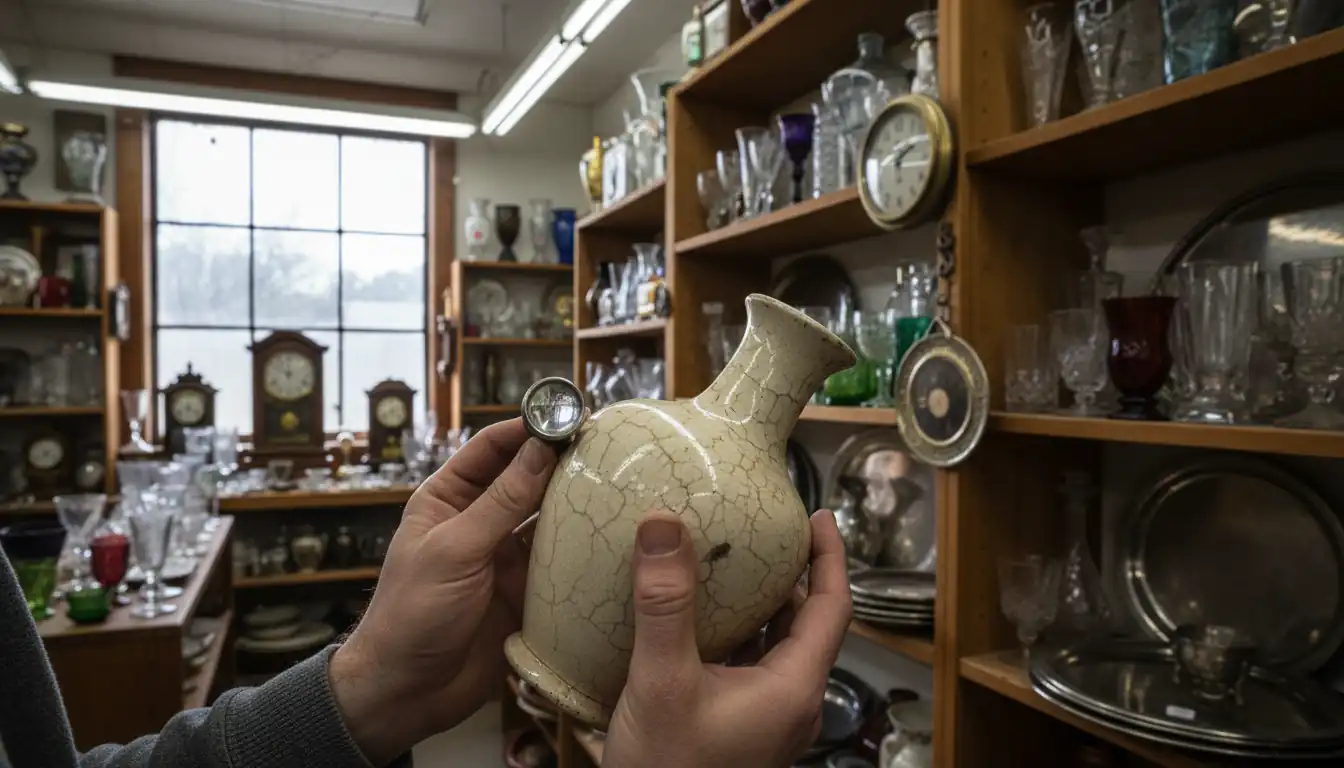
You walk into a local antique mall, and the air immediately changes. It smells of beeswax, old paper, and the faint, sweet scent of cedar. Your eyes dart from a mid-century teak sideboard to a heavy oak chest that looks like it survived the Victorian era. The price tag on the chest is steep, but the dealer’s note claims it’s an "authentic 18th-century primitive." You run your hand over the wood, feeling the grain, and wonder: is this a genuine piece of history, or a clever reproduction aged in a factory last Tuesday?
The thrill of the hunt is what draws us to these aisles, but the stakes are higher than ever. As the demand for "authentic" decor rises, so does the sophistication of high-end fakes. We aren't just talking about cheap plastic knockoffs; we are talking about "bench-made" reproductions that use reclaimed wood and period-correct hardware to fool even seasoned collectors. If you want to stop being the person who overpays for a lie, you need to look past the surface.
This guide will pull back the curtain on the industry’s best-kept secrets. You will learn how to read the "hidden" language of furniture construction, identify the rhythmic patterns of artificial aging, and use modern technology to verify a piece’s pedigree in seconds. By the time you reach the end of this article, you won't just be browsing; you will be inspecting with the clinical eye of an appraiser.
The Anatomy of Authenticity and the 100 Year Rule
When you hear the word "antique," what does it actually mean to you? In the world of professional collecting and customs law, the "100-year rule" is the gold standard. According to the 1930 Tariff Act, an item must be at least a century old to be legally classified as an antique. Anything younger is technically "vintage" or "collectible." But how do you verify a century of existence when there’s no birth certificate attached to a mahogany lowboy?
The answer lies in the transition from hand-craftsmanship to industrial mass production. Before the mid-19th century, furniture was built by humans using hand tools. After the Industrial Revolution, machines took over. To spot a true antique, you have to look for the "errors" that only a human hand can make.
Decoding Joinery and Hand Construction
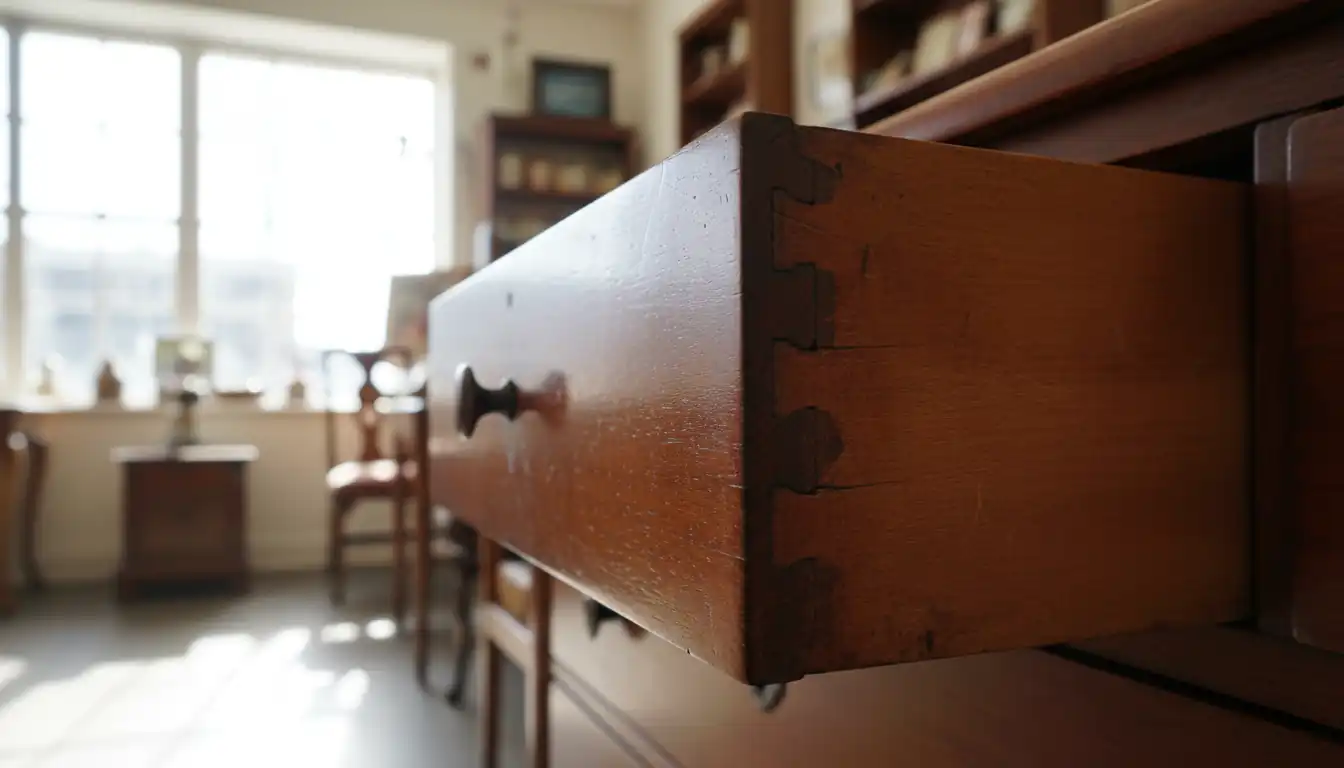
The most honest part of any piece of furniture is the joinery—specifically, the dovetail joints found on the sides of drawers. If you pull out a drawer and see perfectly uniform, narrow, machine-cut dovetails, you are likely looking at a piece made after 1860. While these are still "old," they aren't the 18th-century treasures they are often marketed to be.
True pre-industrial dovetails are irregular. Because a craftsman cut them with a hand saw and a chisel, the "tails" and "pins" will vary slightly in width and spacing. You might see small "over-cuts" where the saw blade went just a fraction of an inch too far into the wood. These aren't defects; they are the fingerprints of a living person.
Beyond the joints, look at the undersides and backs of the drawers. If you run your hand along the bottom of a drawer and feel a series of slight, rhythmic ridges, you’ve found hand-plane marks. Before the invention of the power planer, wood was smoothed by hand. No matter how skilled the craftsman, they could never achieve the glass-like, perfectly flat surface of a modern machine. If the hidden parts of the furniture are as smooth as the top, it’s a red flag.
The Science of Natural Patina and Oxidation
Wood is a biological material that never truly stops reacting to its environment. One of the hardest things for a faker to replicate is the slow, chemical process of oxidation. When wood is exposed to air over decades, it darkens and changes color. This is why the back of a high-boy or the underside of a table should look significantly different than the front.
If you are looking at a "150-year-old" cabinet, the backboards should be dark, almost grey or deep brown, depending on the wood type. This happens because the unfinished wood on the back has been "breathing" the air for over a century. If you turn a piece around and the back looks like fresh, light-colored pine, the piece is either a reproduction or it has been heavily (and often poorly) restored.
| Feature | Hand-Crafted (Pre-1850) | Machine-Made (Post-1860) |
|---|---|---|
| Dovetails | Irregular, wide, few in number | Uniform, narrow, many in number |
| Wood Surface | Hand-plane marks (slight ridges) | Perfectly smooth or circular saw marks |
| Screws | Hand-cut threads, off-center slots | Uniform threads, centered slots |
| Symmetry | Slight variations in dimensions | Perfect mathematical symmetry |
True age isn't found on the polished surfaces that the dealer wants you to see. It is hidden in the rough-sawn backs, the irregular joints, and the dark, oxidized corners where the duster never reaches.
Red Flags of Modern Mass Produced Reproductions
The market is currently flooded with "fake vintage"—items designed to look like mid-century modern classics or rustic primitives but manufactured in modern factories. These pieces are the "fast fashion" of the furniture world. They look great in a dimly lit booth, but they lack the soul and the structural integrity of the originals. To avoid these traps, you must train your eyes to spot the "uniformity trap."
Uniform Distressing and Artificial Aging
Fakers know that collectors look for wear and tear. To mimic this, they use "distressing" techniques. However, humans are creatures of habit, and machines are programmed for repetition. If you see a set of "antique" chairs and the "scratches" or "wormholes" are in the exact same spot on every chair, you are looking at a factory-made reproduction.
Natural wear happens where people actually touch the item. You should see thinning finish around the knobs of a dresser or worn-down rungs on a chair where generations of feet have rested. If the "wear" is in a place that makes no sense—like the middle of a vertical side panel—it was likely done with a chain or a hammer in a workshop.
Wormholes are another favorite for fakers. Real wood-boring beetles leave holes that go in at various angles and are often slightly oval. Fake wormholes are often perfectly round and go straight into the wood because they were made with a tiny drill bit or a specialized punch tool. If you see a cluster of "wormholes" that looks too perfect, it probably is.
Hardware Mismatches and Material Shortcuts
Hardware is the jewelry of furniture, and it’s often the first thing to give away a fake. Modern reproductions often use "antique-style" hardware that is held in place by Phillips head screws. Here is a simple rule: the Phillips head screw wasn't widely used until the 1930s. If a dealer claims a chest is from the 1800s but it’s held together with cross-slotted screws, something is wrong.
You should also look for material shortcuts like plywood or particle board. Even in the late 19th century, high-quality furniture used solid wood or thick veneers. If you look at the edge of a shelf and see the tell-tale layers of plywood, you are looking at a modern piece.
Traditional finishes like shellac, wax, or linseed oil soak into the wood fibers over time, creating a deep, "inner" glow. Modern finishes like polyurethane or nitrocellulose lacquer sit on top of the wood like a plastic film. If the finish feels "plasticky" or looks like it could be peeled off with a fingernail, it’s a modern coating designed for speed, not longevity.
- The "Scent" Test: Open the drawers. Old wood has a distinct, musty, but pleasant smell. New wood or modern stains often have a sharp, chemical odor that lingers for years.
- The Weight Factor: Modern "fast furniture" often uses lighter woods or composites. If a massive oak desk feels suspiciously easy to lift, it’s likely not solid oak.
- Staple Check: Look at the back panels. If the back is attached with staples or tiny modern brad nails, it’s a contemporary reproduction.
Using AI to Identify Hidden Value in Seconds
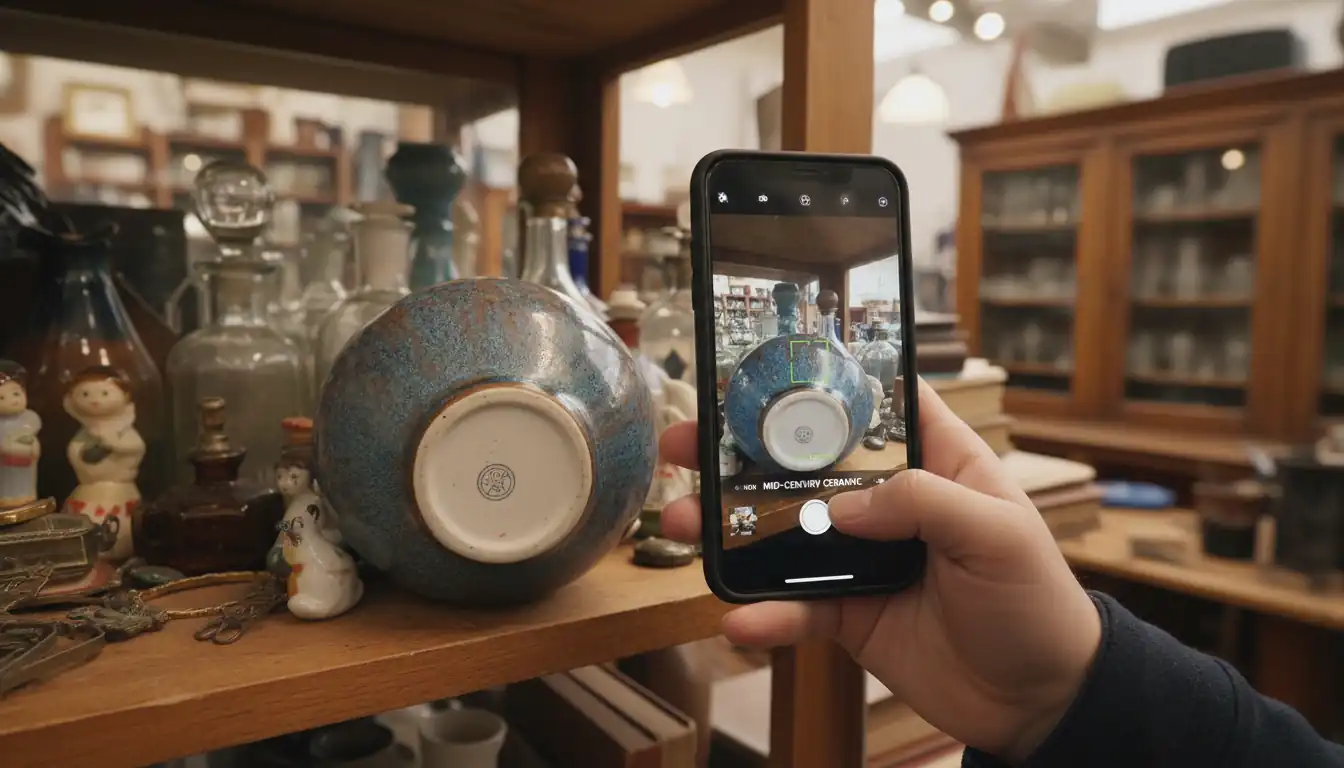
Even with all the knowledge in the world, the sheer volume of items in an antique mall can be overwhelming. You might find a vase with a strange mark on the bottom or a chair with a silhouette that looks familiar but you can't quite place. This is where the gap between a hobbyist and a professional collector is bridged by technology.
In the past, you would have to carry a library of "price guides" or spend hours on forums hoping an expert would reply to your photo. Today, you can use the Relic app to get those answers instantly. Relic is an antique identifier that uses advanced AI to analyze an item’s physical characteristics, maker’s marks, and overall style to provide a real-world appraisal and historical context.
Instant Appraisal with the Relic App
Imagine you find a piece of art pottery that looks like it could be Roseville or Rookwood, but the mark is smudged. Instead of guessing and potentially losing hundreds of dollars, you simply take a photo with Relic. The AI scans the silhouette, the glaze texture, and the remaining fragments of the mark. Within seconds, it pulls from a massive database to tell you exactly what you’re looking at, when it was made, and what it’s currently selling for at auction.
This isn't just about avoiding fakes; it’s about finding the "sleepers"—valuable items that the dealer has misidentified or underpriced. Because Relic provides a real appraisal based on current market data, you can negotiate with confidence. If the app shows that a "vintage" lamp is actually a rare designer piece worth three times the asking price, you’ve just paid for your mall trip and then some.
Analyzing Maker Marks and Silhouettes Digitally
One of the hardest skills to master is identifying maker’s marks. Some are stamped, some are hand-incised, and some are just tiny paper labels that have half-peeled away. Relic’s AI is trained to recognize these obscure stamps even when they are worn or partially obscured. It can distinguish between a genuine 19th-century hallmark and a modern "tribute" mark that was designed to deceive.
Furthermore, the app can analyze the silhouette of a piece. In furniture design, the curve of a leg or the "splat" of a chair back is as unique as a fingerprint. Relic can compare the proportions of a chair to thousands of known designs, helping you identify if that "Queen Anne" chair has the correct proportions of the period or if it’s a 1920s revival piece. This digital verification adds a layer of security to your purchase that your eyes alone can't provide.
Technology doesn't replace the intuition of a collector; it sharpens it. Using an app like Relic allows you to verify your "gut feeling" with hard data before you pull out your wallet.
Navigating the Antique Mall Layout for Authentic Finds
The way an antique mall is organized can tell you a lot about what you’re likely to find. Unlike a curated boutique, a mall is a collection of independent dealers, each with their own level of expertise and ethics. To find the real treasures, you have to learn how to "read" the booth before you even look at the price tags.
Identifying Marriage Pieces and Franken-Furniture
In the trade, a "marriage" is when two separate pieces of furniture are joined together to create something that looks more valuable. A common example is taking the top of a genuine but damaged secretary desk and placing it on a modern base. To the untrained eye, it looks like a complete, high-value antique.
To spot a marriage, look at the "seam" where the two parts meet. Do the wood grains match? Is the patina on the top half identical to the bottom? Check the backboards. If the back of the top section is made of hand-planed pine but the bottom section is made of machine-sawn oak, you’ve found a "Franken-furniture" piece. While these can be beautiful decorative items, they should never be priced as original, intact antiques.
The Psychology of Booth Curation and Lighting
Dealers are masters of atmosphere. They use warm, dim lighting to create a sense of "old world" charm. However, dim lighting is also excellent at hiding cloudy finishes, repaired cracks, and mismatched stains. If you are serious about a piece, ask the mall manager if you can bring it out into the aisle or near a window to see it in natural light. You’ll be surprised how many "flawless" finishes suddenly show their true age (or lack thereof) under the sun.
Also, pay attention to the "neighbors" in a booth. If a dealer has a "19th-century" farm table surrounded by five identical "antique" metal signs and a stack of brand-new "vintage-style" crates, they are likely a "decorator dealer." These booths focus on the look of antiques rather than the history. While there’s nothing wrong with buying reproductions for decor, you shouldn't pay antique prices for them.
| Dealer Type | What to Expect | Red Flags |
|---|---|---|
| The Specialist | Focuses on one era (e.g., MCM, Victorian) | Very few; usually highly knowledgeable |
| The Picker | A mix of "fresh" items, often uncleaned | Look for hidden damage or "marriages" |
| The Decorator | High-style, very clean, "shabby chic" | Lots of paint hiding repairs; many reproductions |
| The Generalist | A bit of everything | May misidentify items due to lack of niche knowledge |
The Final Verification Checklist Before You Buy
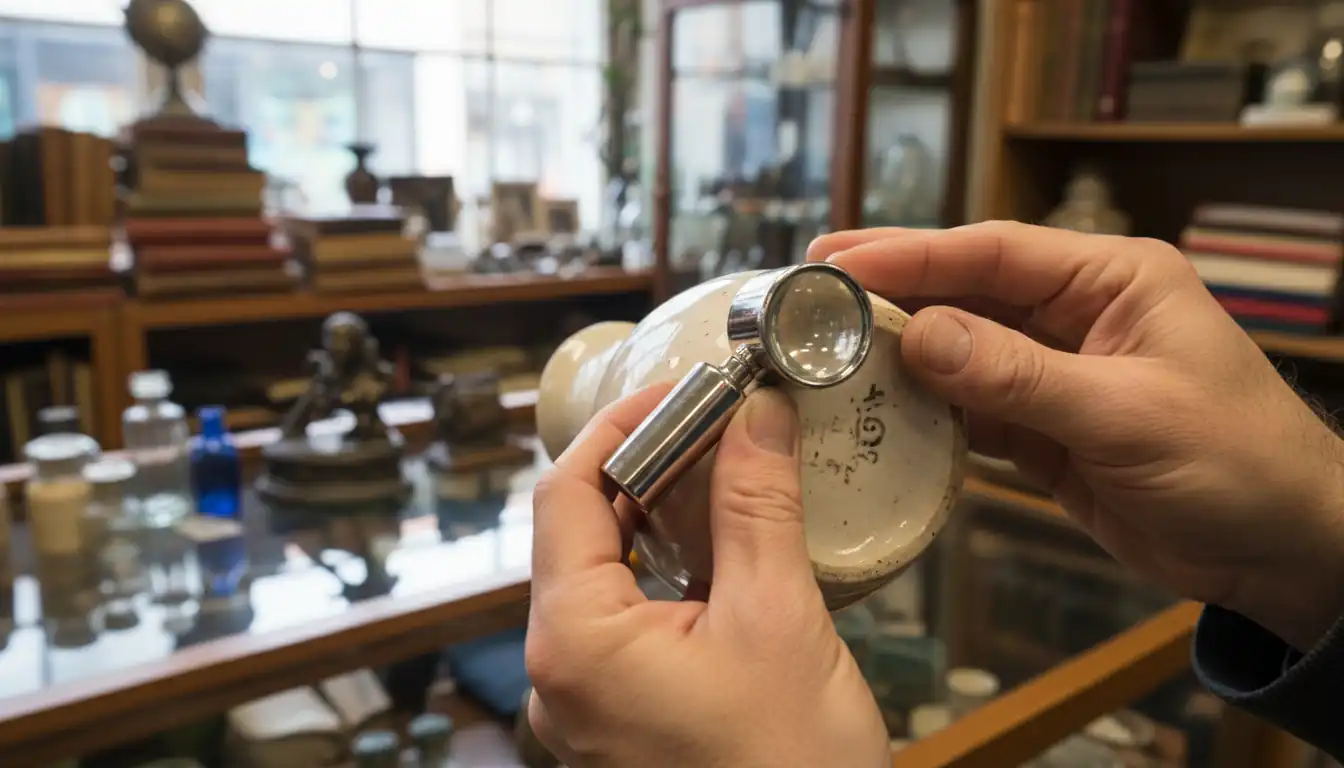
You’ve checked the joinery, you’ve scanned the item with Relic, and you’ve inspected the booth for red flags. You are almost ready to make the purchase. But before you head to the register, run through this final checklist to ensure you are getting a truly valuable antique.
Five Signs of a Truly Valuable Antique
- Rarity: Is this a common mass-produced item from the late 1800s, or is it a unique, hand-crafted piece? Rarity often trumps condition in terms of value.
- Provenance: Does the item have a story? A paper trail, an old auction tag, or even a signature from a previous owner can significantly increase value.
- Condition: While some wear is expected, "structural" damage like cracked frames or missing original components can drop the value by 50% or more.
- Material Quality: Is it made of "primary" woods like mahogany, walnut, or cherry? High-quality materials were expensive then and remain expensive now.
- Aesthetic Appeal: Beyond the history, is it a beautiful object? The most valuable antiques are those that still fit into a modern aesthetic.
Questions Every Smart Collector Asks the Dealer
Since the dealer isn't always present at an antique mall, you can ask the mall manager to call them or leave a note. Don't be afraid to be direct.
- "Has this piece been refinished or over-painted?" A piece with its original "first finish" is almost always more valuable than a refinished one.
- "Are the pulls and hinges original to the piece?" Replaced hardware is common, but it should be reflected in the price. Look for "ghost marks"—faint outlines of the original, larger hardware that was once there.
- "Is there any history or provenance available for this item?" Sometimes the dealer has a file in the back with old photos or receipts they didn't want to leave out in the booth.
- "What is your best price for a cash sale?" Many dealers are willing to offer a 10-15% discount if you are a serious buyer ready to pay immediately.
Conclusion
The world of antiques is a beautiful, complex maze where history and commerce collide. Spotting a high-end fake isn't about being cynical; it's about being an informed steward of history. By understanding the 100-year rule, recognizing the rhythmic patterns of machine manufacturing, and utilizing tools like the Relic app, you transform from a casual shopper into a savvy collector.
The next time you find yourself in an antique mall, don't just look at the price tag. Look at the dovetails. Feel for the hand-plane marks. Check the back for oxidation. And when you find that one-in-a-million piece that checks all the boxes, you can buy it with the absolute confidence that you aren't just buying furniture—you are buying a genuine piece of the past. Happy hunting.
Identify antiques instantly
Point your camera at any antique, collectible, or vintage item. Get valuations, history, and market insights in seconds.
Download for iPhone