Stop Guessing: How to Spot a Hand-Carved Masterpiece in the Wild

You are standing in a crowded estate sale, surrounded by the scent of lemon oil and old dust. Your eyes land on a mahogany side table tucked into a corner. The legs are curved, the edges are ornate, and the price tag suggests it might be a hidden treasure. But is it a genuine 18th-century masterpiece or a clever factory reproduction from the 1990s?
The difference between a mass-produced piece and a hand-carved original isn't just about the price. It is about the soul of the wood and the physical evidence left behind by a craftsman who lived centuries ago. Learning to spot these signs turns a casual hobby into a high-stakes hunt for history.
By the time you finish reading this, you will have the "detective eyes" necessary to look past the polish. You will know how to read the grain, identify specific tool marks, and understand the biological changes wood undergoes over a hundred years. You won't have to guess anymore; you will be able to prove what you’ve found.
The Imperfection Test for Hand-Carved Authenticity
When you first approach a piece of furniture, your instinct is to look for beauty. To find a hand-carved masterpiece, you must look for flaws. Machines are designed for perfection and repetition. A computer-controlled router can churn out a thousand identical chair backs without a single variation. A human being, no matter how skilled, cannot.
Symmetrical Flaws and Chisel Marks
The easiest way to tell if furniture is hand carved is to compare two "identical" elements. Look at the left side of a carved headboard and then the right. In a hand-carved piece, a leaf motif on one side will have a slightly different curve than its counterpart. One might be a fraction of a millimeter wider, or the veins in the leaf might sit at a slightly different angle.
These tiny discrepancies are the fingerprints of the artisan. If you find two carvings that are mathematically perfect mirrors of each other, you are likely looking at a machine-cut piece. Machines use templates to ensure every cut is identical, whereas a carver works by eye and feel.
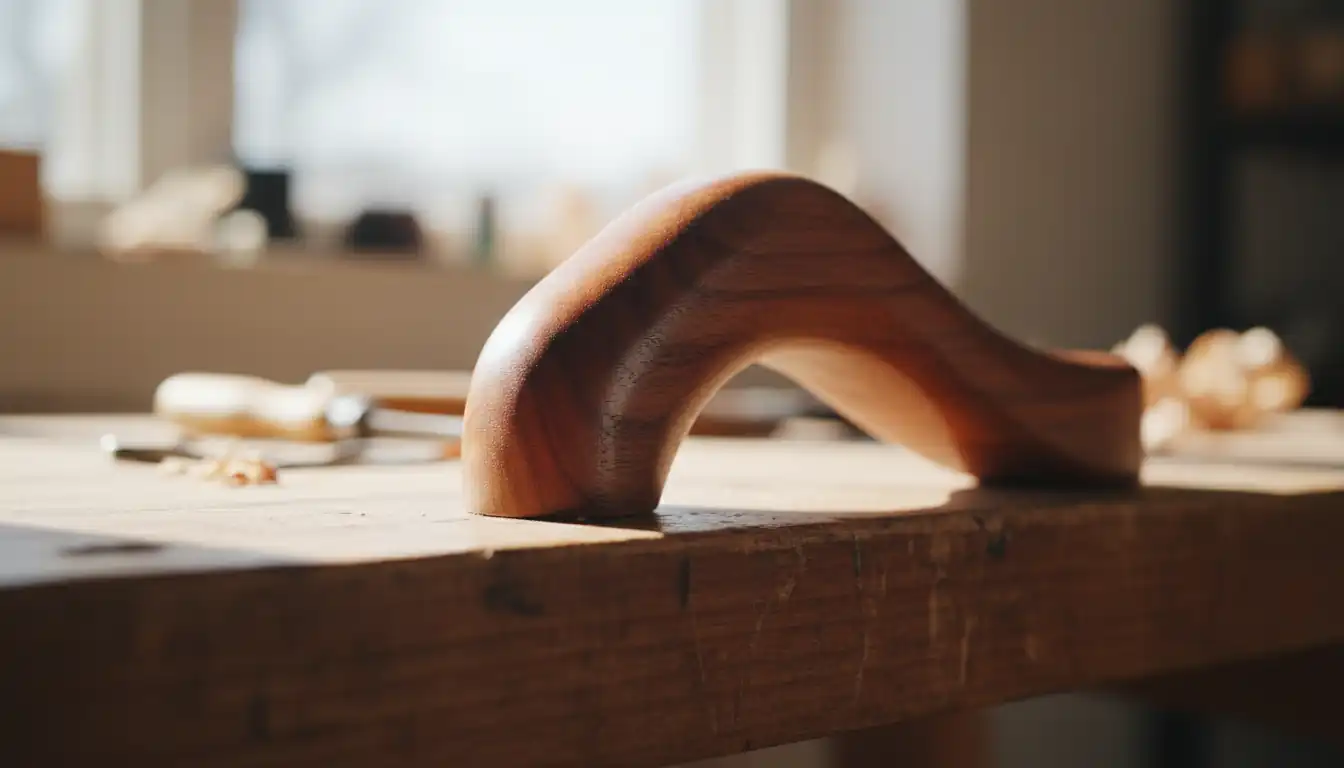
Beyond symmetry, you should look for "chisel chatter." When a carver uses a gouge or a chisel, the tool leaves behind microscopic ridges. Even after a piece has been sanded, these subtle facets remain visible under a raking light.
- The Gouge Mark: Look for tiny, concave nicks in the deep recesses of a carving where a sanding block couldn't reach.
- Surface Texture: Run your fingers over the carved area. A hand-carved surface feels slightly rhythmic and uneven, while a machine-cut piece feels unnaturally smooth or "fuzzy" from high-speed friction.
- The Undercut: Hand carvers can reach behind a leaf or a vine to create a "floating" effect. Machines generally cannot carve behind an object without leaving tell-tale mechanical marks.
The 100 Year Rule and Wood Shrinkage
In the world of antiques, the "100-year rule" is often cited as the legal definition of an antique for customs and tax purposes. However, for a collector, this rule is more about biology than law. Wood is an organic material that never truly stops moving. Over a century, wood loses moisture and shrinks, but it doesn't shrink evenly.
Wood shrinks across the grain, not along its length. This means that a perfectly circular carved ornament from 1820 will no longer be a circle today. It will have become a slight oval. If you find a "round" patera or a circular medallion on a piece of furniture, take a measurement. If it is perfectly round to the millimeter, it was likely made recently. If it is slightly distorted, you are looking at the result of a hundred years of natural seasoning.
This shrinkage also affects joints. In a hand-carved chair, the joints where the rails meet the legs might have opened slightly over time. You might see a tiny gap where the wood has pulled away from itself. This isn't a sign of poor quality; it’s a sign of age.
"True authenticity is found in the struggle between the craftsman's tool and the natural movement of the wood over time."
Decoding Classic Motifs from Acanthus to Cabochon
Once you have determined that a piece was carved by hand, the next step is to identify what was carved. Specific motifs act as a visual language, telling you exactly when and where a piece was made. An art historian doesn't just see a "leaf"; they see a specific cultural marker.
Foliage and Floral Patterns
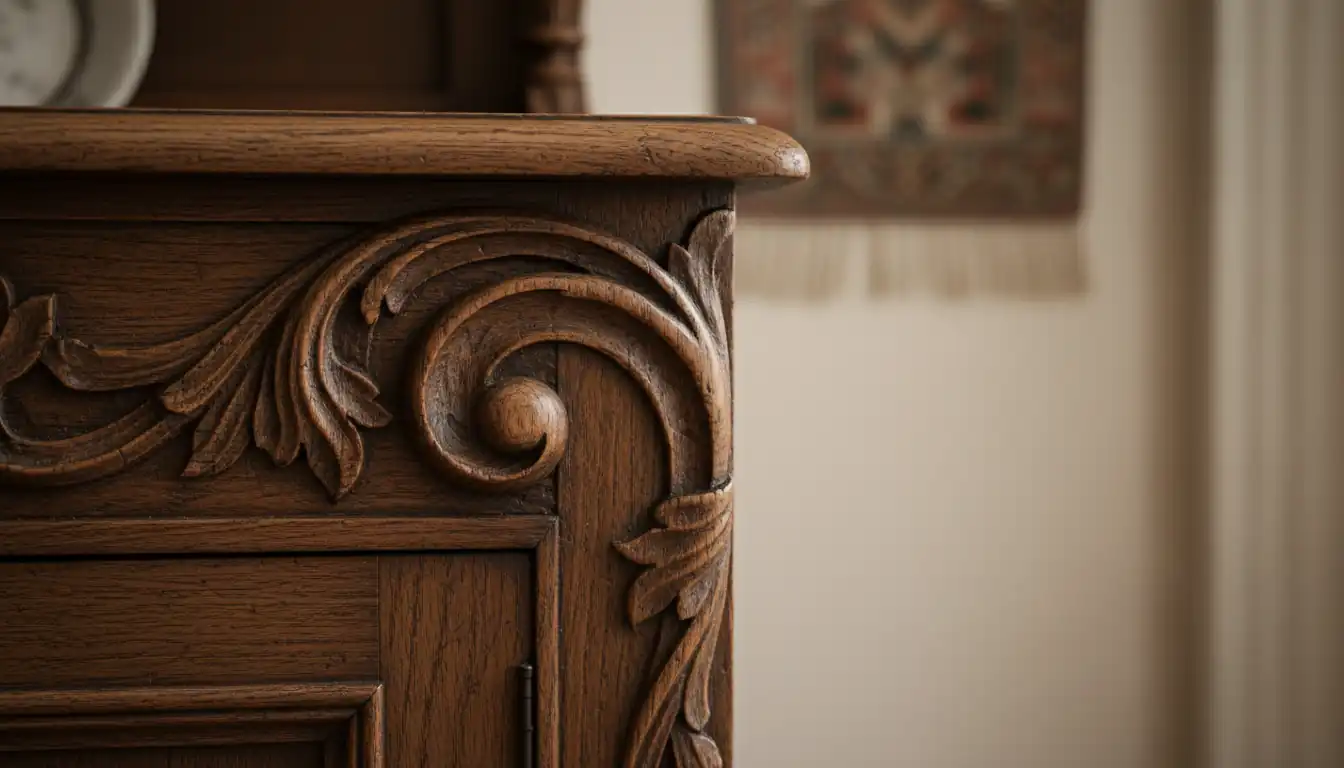
The most ubiquitous motif in antique furniture is the Acanthus leaf. Originating in Greek architecture, this stylized leaf became the hallmark of the Rococo and Neoclassical periods. In the mid-18th century, Acanthus leaves were carved with deep, flowing "C" and "S" curves, reflecting the drama of the era. By the late 18th century, under the influence of designers like Thomas Chippendale, the carving became more delicate and refined.
Another common element is the Cabochon. This is a smooth, convex, egg-shaped ornament. It is almost always surrounded by "surround" carving, such as acanthus leaves or scrolls. The Cabochon was a favorite of the George II period and is often found on the "knees" of chair legs.
| Motif Name | Visual Description | Common Era |
|---|---|---|
| Acanthus | Stylized, jagged leaf with deep veins | 18th & 19th Century |
| Cabochon | Smooth, polished "stone" look surrounded by foliage | Mid-1700s (Rococo) |
| Gadrooning | A series of convex curves or "reeds" along an edge | Late 17th - Early 19th Century |
| Patera | A circular or oval ornament, often resembling a flower | Neoclassical (Late 1700s) |
| Fleur-de-lis | A stylized lily with three petals | French-influenced pieces |
Architectural Elements and Geometric Patera
During the Neoclassical revival (think Robert Adam or Hepplewhite), furniture makers moved away from the wild, asymmetrical carvings of the Rococo. They turned instead to the symmetry of ancient Rome and Greece. This is where you will find the Patera.
A Patera is a circular or oval carving that often looks like a stylized sunflower or a series of radiating petals. These were frequently used to hide the points where different structural elements of a piece met. If you see a Patera that is deeply undercut and shows individual petal tips, it is a high-quality hand-carved piece.
Gadrooning is another key feature to look for. This is a decorative edge consisting of repeated, parallel convex ridges. It looks somewhat like a rope or a series of thumbprints pressed into the wood. On a hand-carved piece, each "bead" of the gadrooning will vary slightly in width. On a machine-made piece, they will be identical.
Structural Clues in Legs and Supports
While surface carvings are beautiful, the "bones" of the furniture—the legs and feet—provide the most reliable evidence of a piece's origin. Carving a complex leg is a feat of engineering as much as art. It requires the craftsman to remove a massive amount of wood from a single solid block.
The Evolution of the Cabriole Leg
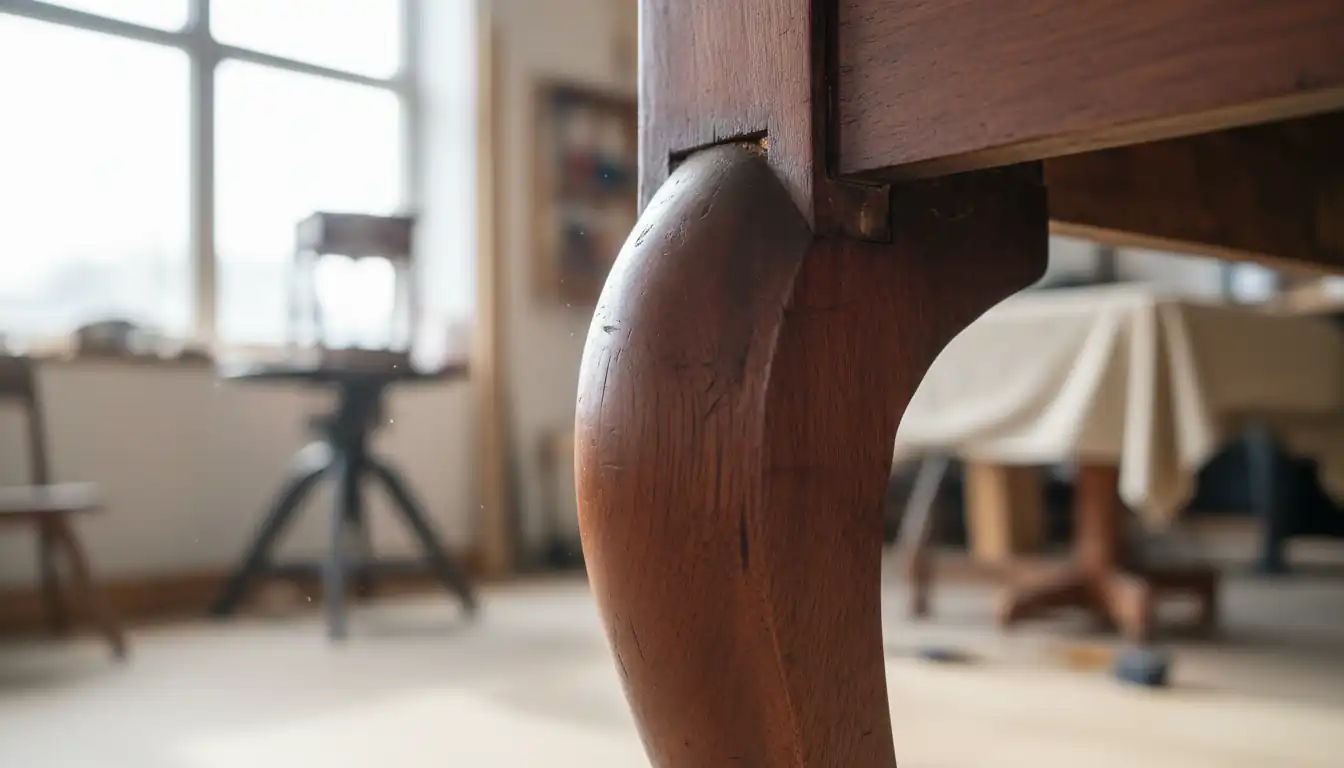
The Cabriole leg is perhaps the most famous silhouette in furniture history. It features a double curve: the upper part (the knee) bulges outward, while the lower part (the ankle) curves inward, ending in a decorative foot.
To identify an original 18th-century Cabriole leg, look at the flow of the wood grain. A master carver would select a block of wood where the grain followed the curve of the leg as much as possible to ensure strength. In 1920s mass-produced reproductions, you will often see the grain running straight through the curves, which makes the leg brittle.
Furthermore, look at the "knee" of the leg. On an original piece, the carving—whether it’s an Acanthus leaf or a shell—will be integrated into the structure of the leg. On cheaper reproductions, the carving is sometimes a separate piece of wood or molded plastic glued onto a plain leg.
Ball and Claw vs. Bracket Feet
The foot of the chair or table is where the carver really showed off. The Ball and Claw foot is a classic example. It is meant to represent a dragon’s claw (Chinese influence) or an eagle’s talon (English influence) clutching a stone.
- The Talon Detail: In a high-quality hand-carved piece, you can see the "tension" in the talons. You might even see the knuckles and the scales of the skin.
- The Space Between: Look for daylight between the claw and the ball. A machine cannot easily hollow out the space behind the talons, but a hand carver using a small gouge can.
- The Bracket Foot: Common on chests and desks, these are simpler, L-shaped feet. Even here, look for the "scroll" at the base. If the scroll is sharp and crisp, it was likely cut with a hand saw and finished with a chisel.
The way a piece stands on the floor tells you its age. Early 18th-century pieces often have a lower center of gravity and "heavier" feet, while later Neoclassical pieces stand on delicate, tapered "spade" feet.
If the talons on a Ball and Claw foot look like they are merely "resting" on the ball rather than gripping it, you are likely looking at a later, less skilled reproduction.
Modern Shortcuts for Instant Identification
Even for seasoned collectors, the sheer variety of regional styles and "revival" periods can be overwhelming. You might find a piece that has the tool marks of a hand-carved item but a motif that doesn't seem to match the wood type. This is where the traditional world of antiquing meets the precision of modern technology.
While your eyes are your first tool, they don't have to be your only one. You no longer need to carry a library of reference books to every auction. Advanced tools can now verify your hunches in real-time, bridging the gap between a "good feeling" and a confirmed investment.
Using AI to Map Carving Origins
The Relic app has changed how enthusiasts approach the "wild" hunt for antiques. Instead of spending hours scrolling through forums to identify a specific Patera or a unique gadrooned edge, you can simply take a photo. Relic uses advanced AI to analyze the carving style, the wood grain, and the structural silhouette of the item.
The app cross-references your photo with a massive database of historical entries. It can distinguish between a genuine 18th-century French Rococo chair and a 19th-century "Louis Style" reproduction made in a factory. This is particularly helpful when you are dealing with "transitional" pieces that blend two different eras.
Getting a Digital Appraisal with Relic
One of the biggest hurdles in buying antiques is the valuation. Is the seller asking a fair price? Relic doesn't just identify the item; it provides a real appraisal and historical context. By scanning the item with your phone camera, you get access to market insights and recent auction results for similar pieces.
For a modern collector, this is a safety net. It allows you to confirm that the "hand-carved" marks you're seeing are consistent with the known output of a specific region or period. With a 4.9-star rating from over 20,000 users, it has become a standard tool for dealers and pickers who need to make split-second decisions in the field.
- Instant Identification: Take a photo of a carving or a leg style to get an immediate name and era.
- Historical Context: Learn the "why" behind the design—was it made for a merchant's home or a royal palace?
- Professional Appraisal: Get a valuation based on current market data so you never overpay.
Hidden Markers of Value Beyond the Surface
To be a true expert, you must look where the casual buyer doesn't. The exterior of a piece is designed to impress, but the interior and the underside are where the truth is hidden. A master craftsman in 1750 wouldn't waste expensive mahogany on the parts of a dresser that no one would see.
Secondary Woods and Interior Carvings
Open the drawers of a chest or look at the underside of a table. You should see a different type of wood. This is known as "secondary wood." In American antiques, this is often white pine, poplar, or cedar. In English pieces, it might be oak or deal.
If the entire piece—inside and out—is made of the same high-grade mahogany or walnut, be suspicious. This is often a sign of a modern reproduction where the manufacturer used the same bulk-lumber for the whole unit.
Furthermore, look at the "underside" of the carvings. If you reach under a carved table edge, the wood should feel rough and unfinished. A hand carver only polished the parts that were visible. If the underside is as smooth as the top, it was likely finished by a wide-belt sanding machine in a factory.
Hardware Alignment and Hand-Cut Dovetails
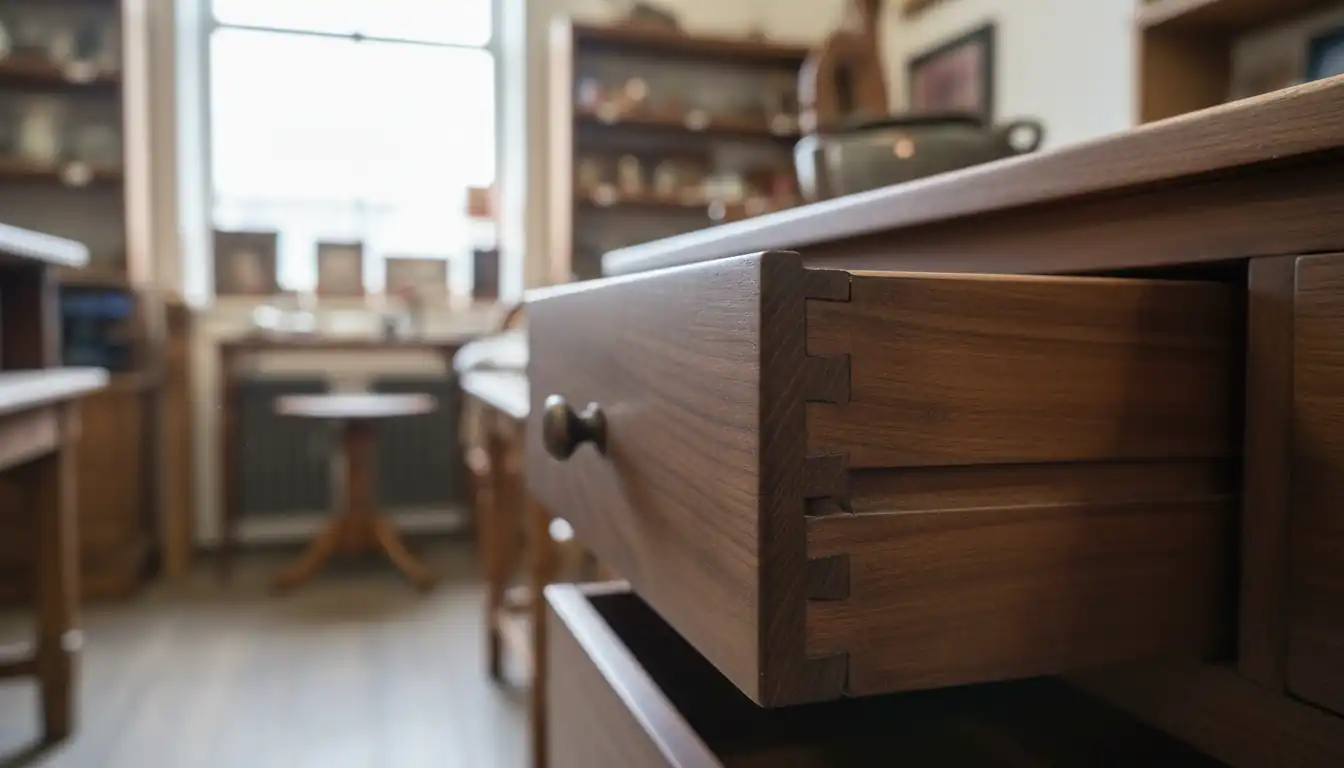
The way a piece is put together is just as important as the carving on its face. Check the dovetail joints on the drawers.
- Hand-Cut Dovetails: These will be thin, slightly irregular, and may have small "over-cut" marks from a hand saw. There will usually only be two or three large dovetails on a drawer side.
- Machine-Cut Dovetails: These are perfectly uniform, rounded at the ends, and spaced exactly the same distance apart. These became common after 1860.
Finally, look for "ghost marks." These are faint outlines or different-colored wood patches where the original hardware (handles or hinges) used to be. Over a hundred years, many pieces have had their hardware replaced to match changing fashions. Seeing a ghost mark of an older, larger brass plate is a fantastic sign of genuine age. It shows the piece has lived through multiple eras.
| Feature | Hand-Carved Antique | Modern Reproduction |
|---|---|---|
| Symmetry | Slightly asymmetrical; human touch | Mathematically perfect; mirrored |
| Tool Marks | Microscopic chisel facets and nicks | Uniformly smooth or "fuzzy" edges |
| Wood Shape | Ovals/Distortion (100-year rule) | Perfect circles and squares |
| Secondary Wood | Pine, Poplar, or Oak interiors | Same wood used throughout |
| Dovetails | Thin, irregular, hand-sawn | Thick, uniform, machine-rounded |
Conclusion
Spotting a hand-carved masterpiece is a skill that combines the eye of an artist with the logic of a scientist. You now know to look for the "chisel chatter" that proves a human hand was at work. You understand that the 100-year rule isn't just a date—it’s a physical transformation of the wood itself. From the curve of a Cabriole leg to the hidden secondary woods inside a drawer, the clues are there if you know where to look.
The next time you find yourself at a gallery or a garage sale, don't just look at the price tag. Look at the grain. Look at the "knees" of the legs. Look for the tiny imperfections that tell a story of a craftsman from another century.
If you find something that piques your interest but you want to be 100% sure before you reach for your wallet, use the tools available to you. Open the Relic app, snap a photo of that intricate Acanthus leaf, and let the AI confirm the history and value of your find. Whether you are building a professional collection or just looking for a single statement piece, you now have the knowledge to stop guessing and start collecting with confidence.
Identify antiques instantly
Point your camera at any antique, collectible, or vintage item. Get valuations, history, and market insights in seconds.
Download for iPhone