Stop Selling Your Antiques for Pennies: The Modern Way to Value Your Finds

You walk into a dusty estate sale or a crowded thrift shop and see it: a heavy, tarnished silver bowl tucked behind a stack of chipped dinner plates. Your gut tells you it’s special. You pick it up, feeling the surprising weight and the cool temperature of the metal, but then the doubt creeps in. Is this a genuine 19th-century masterpiece worth thousands, or just a clever mid-century reproduction destined for the $5 bin?
Most people put the item back because they don't have the time to spend hours researching at a library or the money to hire a professional appraiser for every potential find. This hesitation is exactly why so many treasures end up in landfills or sold for pennies at garage sales. You are likely walking past a small fortune every month simply because the barrier to entry for antique expertise feels too high.
The following guide will bridge that gap. You will learn the rigid rules that define the market, the physical "tells" that reveal an object’s true age, and how modern technology is finally leveling the playing field for everyday collectors. By the time you finish reading, you’ll have the framework to stop guessing and start valuing your finds with the precision of a seasoned dealer.
Defining the Century Rule and Current Market Trends
To navigate the market effectively, you first need to understand the vocabulary used by professionals. The term "antique" is often thrown around loosely, but in the eyes of customs officials and serious collectors, it has a very specific definition. Generally, an item must be at least 100 years old to be classified as a true antique. This isn't just a tradition; it’s a standard established by the 1930 Smoot-Hawley Tariff Act to determine which items could be imported duty-free as works of art or objects of historical value.
If an item is younger than 100 years but older than 20, it typically falls into the "vintage" or "collectible" category. While this might seem like a demotion, the market value doesn't always follow the calendar. A 150-year-old Victorian chair might sell for $200, while a 60-year-old "vintage" lounge chair by a famous designer could fetch $6,000. Understanding this distinction helps you manage your expectations and focus your energy on the categories that are currently seeing the most growth.
The 100 Year Standard vs Vintage
The 100-year rule acts as a filter for quality and scarcity. Items made before the 1920s were often produced using manual labor, solid woods, and natural pigments that are rarely seen in modern mass production. When you hold a true antique, you are holding a piece of history that survived wars, moves, and changing fashions.
- Antique (100+ Years): These items are valued for their craftsmanship, historical significance, and the fact that they cannot be easily replicated.
- Vintage (20-99 Years): These pieces are often bought for their aesthetic appeal or "retro" vibe. They represent the popular culture of a specific era, like the 1950s or 1980s.
- Collectibles: These are items that may not be old at all but are produced in limited quantities, such as modern art toys or specific trading cards.
Why Mid-Century Modern and Art Deco Are Dominating Today
If you’re wondering what antiques are popular right now, look toward the 20th century. While the 100-year rule still applies to "fine" antiques, the current market is being driven by younger collectors who prioritize clean lines and functional beauty. This has led to a massive surge in demand for Art Deco and Mid-Century Modern (MCM) pieces.
Art Deco, which peaked in the 1920s and 30s, is characterized by geometric shapes, bold colors, and lavish ornamentation. It feels sophisticated and architectural. On the other hand, Mid-Century Modern furniture from the 1940s through the 1960s focuses on organic curves and "form follows function." Younger buyers are moving away from the heavy, dark, ornate furniture of the Victorian era because it doesn't fit into smaller, modern apartments. They want pieces that feel light, airy, and timeless.
The market is no longer dictated solely by age; it is dictated by how well a piece integrates into a modern lifestyle.
Hidden Marks and Maker Signatures You Might Be Missing
Once you understand the broad categories, you have to get your hands dirty. Identifying an antique is a lot like being a forensic investigator. You aren't just looking at the object; you are looking for the "fingerprints" left behind by the person who made it. These marks are often hidden in places you wouldn't think to look, such as the underside of a chair rail or the very bottom of a ceramic vase.
Learning to read these marks is the difference between owning a piece of "old junk" and owning a signed piece of history. When you find a signature or a hallmark, you aren't just finding a name; you are finding a timestamp and a location.
Decoding Hallmarks on Silver and China
Silver and porcelain are among the most common items found at estate sales, yet they are also the most frequently misidentified. If you find a piece of silver, the first thing you should do is look for a tiny stamp. In England, for example, a lion passant (a walking lion) indicates that the piece is sterling silver. Other marks will tell you the city it was made in and the exact year it was assayed.
Porcelain and pottery use "backstamps." These are logos or names printed or impressed on the bottom of the piece. A famous example is the Meissen "crossed swords" mark, which has been used in various forms since the early 1700s. However, you have to be careful—many 19th-century manufacturers created "tribute" marks that look similar to famous brands to trick unsuspecting buyers.
- Silver Hallmarks: Look for a series of 3 to 5 small stamps. They usually include a purity mark (like "925"), a town mark, and a date letter.
- Porcelain Backstamps: Check for underglaze marks (applied before the final firing) or overglaze marks. If the mark feels raised or looks like a sticker, it might be a modern reproduction.
- Maker’s Marks: These are the specific signatures of the artist or factory. A Tiffany & Co. stamp on jewelry or hollowware immediately changes the valuation from "scrap metal" to "luxury collectible."
Identifying Wood Joinery and Construction Techniques
Furniture is harder to mark than silver, so you have to look at how it was built. Before the mid-19th century, furniture was made by hand. This means the pieces won't be perfectly symmetrical. If you pull out a drawer and the "dovetail" joints (the interlocking teeth holding the drawer together) are slightly uneven and chunky, you’re likely looking at a hand-cut joint from the early 1800s or earlier.
You should also look at the hardware. Are the nails square or round? Square nails were common until the late 1800s when wire nails became the industry standard. Does the wood show circular saw marks or straight hand-saw marks? These tiny physical clues tell a story that a coat of paint can't hide.
| Feature | Hand-Crafted (Pre-1850) | Mass-Produced (Post-1880) |
|---|---|---|
| Dovetails | Few, wide, and slightly irregular | Many, thin, and perfectly uniform |
| Nails | Square-headed and forged | Round-headed and uniform |
| Wood | Solid planks, often very wide | Veneers and narrower strips |
| Symmetry | Slight variations in carvings | Perfectly identical mirrored parts |
Instant Appraisals in Your Pocket with AI Technology

The manual "detective work" described above is rewarding, but it is also incredibly slow. You could spend three hours in a library trying to match a specific porcelain mark only to find out it’s a common 1950s reproduction. In a fast-moving auction or a busy flea market, you don't have three hours. You have about thirty seconds before someone else picks up the item.
This is where the traditional world of antiquing meets the future. Instead of carrying a stack of reference books or hoping your cell service is good enough to scroll through endless Google Image results, you can now use artificial intelligence to do the heavy lifting. The Relic app is designed specifically for this moment of uncertainty.
How Relic Analyzes Origin and History from a Single Photo
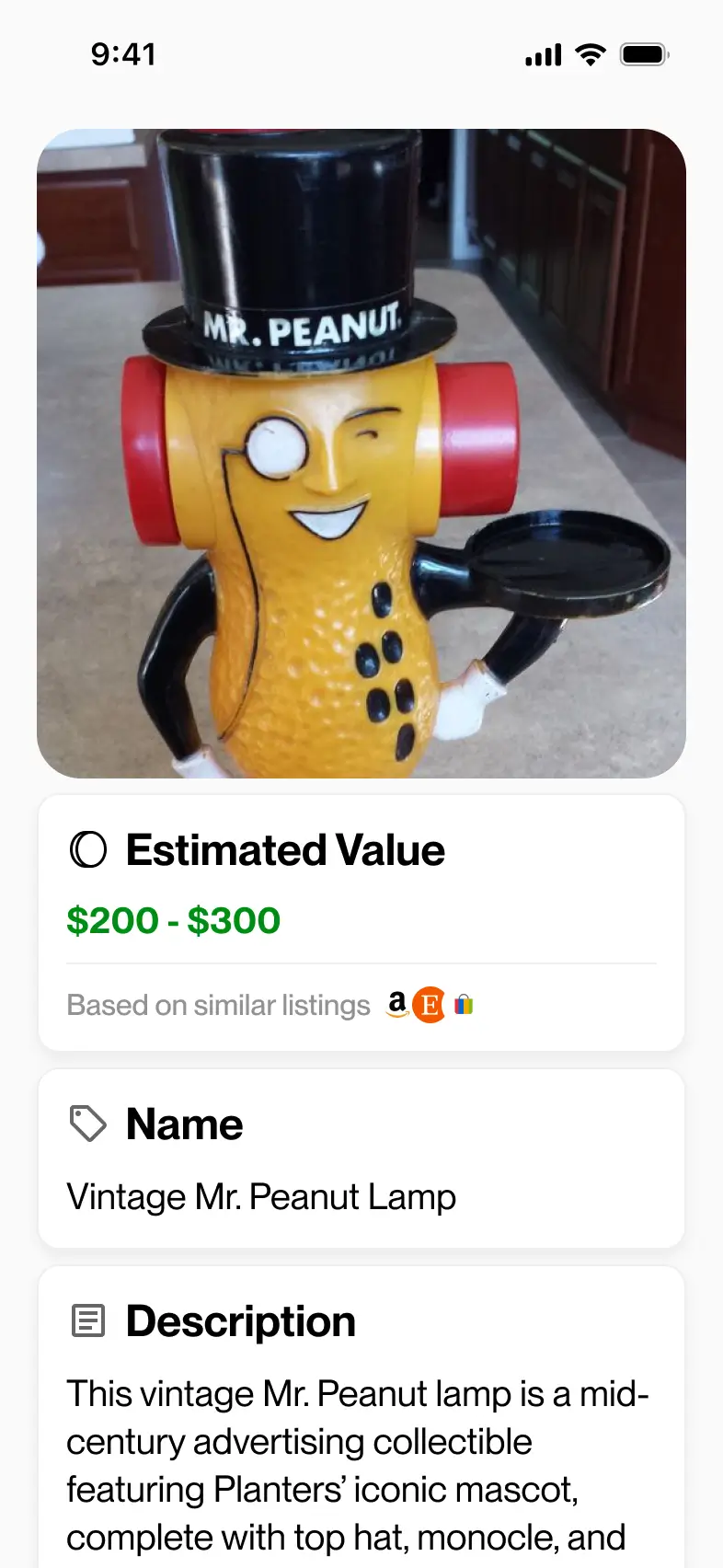
When you encounter an item you can't identify, you simply open the Relic app and take a photo. The AI doesn't just look for a visual match; it analyzes the patterns, materials, and stylistic markers that define specific eras and makers. It’s like having a professional appraiser standing over your shoulder, whispering the history of the item into your ear.
If you find a vase with a faint, blurry mark on the bottom, Relic can cross-reference that mark against a massive database of historical signatures. It provides you with the origin, the likely date of manufacture, and a real-world appraisal value based on current market data. This removes the "guesswork" that leads to selling items for pennies.
Moving Beyond Manual Research to Real-Time Valuation
The real power of an app like Relic is the speed of valuation. In the past, if you wanted a professional appraisal, you had to take photos, send them to an auction house, and wait weeks for a response—often paying a fee for the privilege. Now, you can get that same level of insight in seconds.
Imagine you’re at a garage sale and see an unmarked, heavy glass bowl. To the untrained eye, it looks like something from a modern department store. But after a quick scan with Relic, you discover it’s actually a rare piece of mid-century Murano glass from Italy, worth $800. Without the app, you would have walked away. With it, you’ve just made a significant profit. This technology is a tool for professionals like dealers and pickers who need to make split-second bidding decisions.
With over 20,000 reviews and a 4.9-star rating, Relic has become the go-to resource for anyone serious about finding hidden value in the wild.
High-Value Categories from Fine Art to Rare Furniture
Not all antiques are created equal. While a 100-year-old button might be an antique, it’s unlikely to fund your retirement. To truly succeed in the market, you need to focus on "investment-grade" categories. These are items that don't just hold their value but tend to appreciate over time.
The three heavy hitters in the antique world are Furniture, Fine Art, and China/Ceramics. These categories have established secondary markets, dedicated auction houses, and a global pool of collectors. However, the difference between a decorative piece and an investment piece often comes down to one word: provenance.
Investing in Blue Chip Antiques and Rare Collectibles
"Blue chip" antiques are the gold standard. These are pieces by known makers or from highly desirable periods that have a documented history of selling well. For example, a piece of furniture by Thomas Chippendale or a painting by a listed Hudson River School artist is almost guaranteed to have value.
When looking at these high-value categories, pay attention to the following:
- Condition: For furniture, original finishes are almost always more valuable than refinished ones. For china, a single hairline crack can drop the value by 50% or more.
- Rarity: Was this a mass-produced pattern, or was it a custom commission for a wealthy family?
- Authenticity: This is where your detective skills and AI tools come together. You must be certain the item isn't a "marriage" (two different pieces joined together to look like one).
The Impact of Provenance on Final Sale Prices
Provenance is the documented history of an item's ownership. Think of it as the object's resume. If you have a 19th-century desk, it might be worth $1,000. If you have that same desk and a letter proving it sat in the office of a former President, that price could jump to $50,000.
Provenance can take many forms:
- Original Receipts: The holy grail of documentation.
- Auction Tags: Old stickers from famous auction houses like Sotheby’s or Christie’s.
- Exhibition Labels: Proof that the item was displayed in a museum.
- Family Records: Letters or wills that mention the specific item passing through generations.
Always check the back of paintings for gallery labels or the inside of drawers for old shipping manifests. These small scraps of paper are often worth more than the item itself because they provide the "story" that collectors are willing to pay a premium for.
Navigating the Digital Marketplace and Auction Circuits
The way we buy and sell antiques has changed more in the last ten years than it did in the previous hundred. We are no longer limited to local antique malls or the classified ads in the newspaper. The market is now global, digital, and data-driven. To stay ahead, you have to understand how to use these new tools to your advantage.
Modern collecting is about spotting trends before they become mainstream. While everyone else is fighting over Mid-Century Modern chairs, savvy collectors are looking at what’s next. This requires a blend of historical knowledge and real-time market data.
Using Data to Predict Future Antique Trends
We are currently seeing the rise of what some call "New Antiques." These are high-quality items from the 1980s and 1990s that are beginning to gain "vintage" status. Post-modern furniture, early digital technology, and even certain "fast fashion" collaborations from twenty years ago are starting to appear at high-end auctions.
By using apps like Relic, you can track which items are being scanned and searched for most frequently. This data acts as a leading indicator of market demand. If you notice a sudden spike in interest for 1990s Memphis Group-style ceramics, you know to start hunting for those pieces before the prices skyrocket.
- Watch the "40-Year Cycle": People generally start collecting the items they remember from their childhood once they reach their peak earning years.
- Monitor Online Auctions: Sites like LiveAuctioneers or 1stDibs show you what people are actually paying, not just what sellers are asking.
- Follow Interior Design Trends: Antiques often follow fashion. If "Grandmillennial" style is trending in magazines, expect 19th-century floral china to go up in price.
Ethical Sourcing and the Sustainability of Antique Collecting
One of the most compelling reasons to enter the antique market today has nothing to do with money. It’s about sustainability. The furniture industry is one of the largest contributors to landfill waste, driven by "fast furniture" that is designed to last only a few years.
Antiques are the ultimate "green" product. When you buy an antique, you are participating in a circular economy. You are saving a high-quality item from a landfill and preventing the carbon emissions associated with manufacturing a new, inferior replacement.
- Durability: An antique table has already lasted 100 years; it will likely last another 100.
- Carbon Footprint: The "embodied energy" of an antique was spent a century ago.
- Non-Toxic: Older furniture was made with natural materials like solid wood, wool, and cotton, rather than the formaldehyde-laden particle board found in many modern pieces.
By positioning yourself as a modern collector, you aren't just a hobbyist; you are an ethical consumer. You are using technology to preserve history and protect the environment, all while building a collection that has real, tangible value.
Conclusion
The world of antiques is no longer a closed circle reserved for wealthy scholars and elite auctioneers. The "Century Rule" gives you a framework, your eyes and hands give you the clues, and AI technology gives you the answers. Whether you are looking to flip items for a profit or build a home filled with pieces that have a soul, the tools are now in your hands.
Stop leaving your success to chance. The next time you see an interesting object at a flea market, don't just wonder about its history—verify it. Use the physical signs of craftsmanship to narrow down the era, and then use the Relic app to get a professional-grade appraisal on the spot.
The difference between a $5 mistake and a $5,000 discovery is often just a single photo. Start looking closer at the marks, the joints, and the stories hidden in the objects around you. Your next great find is out there, waiting for someone with the right tools to recognize it.
Identify antiques instantly
Point your camera at any antique, collectible, or vintage item. Get valuations, history, and market insights in seconds.
Download for iPhone