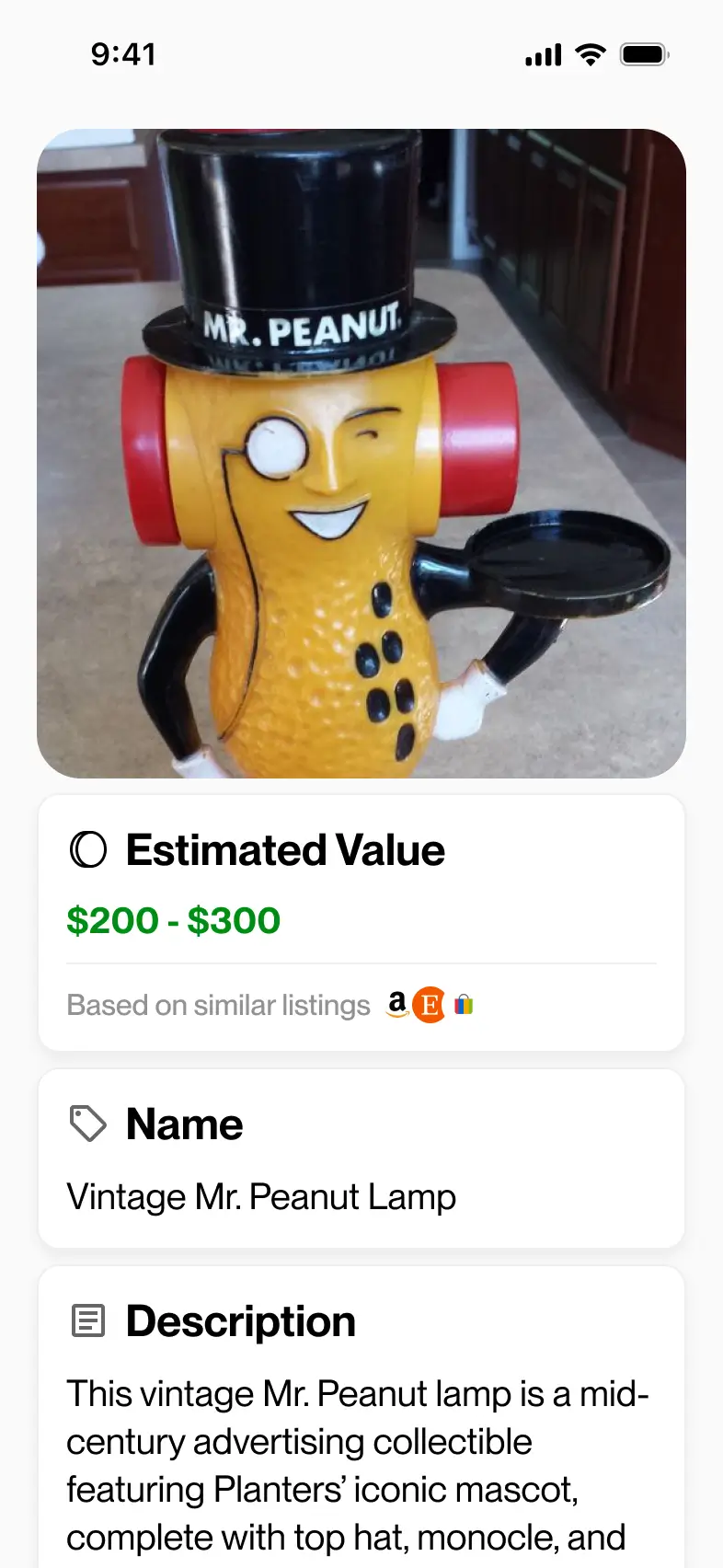
That Dusty Lamp Might Pay Your Mortgage: The New Way to Price Antiques Instantly

You might be sitting on a small fortune without even realizing it. That heavy, tarnished silver bowl your grandmother left you, or the strange geometric lamp you found at a garage sale for five dollars, could be the key to a significant financial windfall. For decades, the barrier between "clutter" and "currency" was a massive wall of specialized knowledge that took years, if not decades, to acquire.
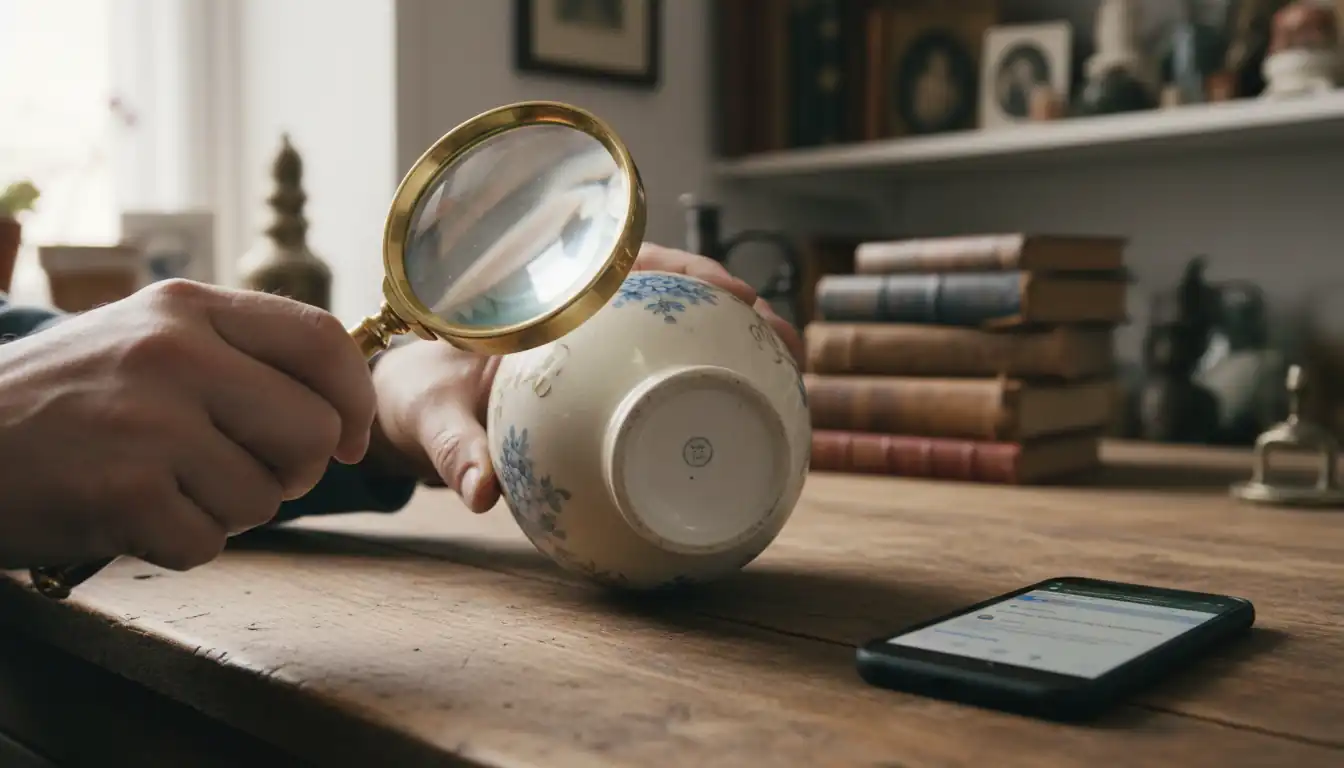
The traditional path to valuing an antique involved heavy price guides, expensive consultations with auction houses, or hours spent squinting at tiny hallmarks through a jeweler's loupe. Most people simply gave up, letting valuable pieces gather dust or, worse, selling them for pennies on the dollar at a yard sale. But the gatekeepers of the antique world have lost their monopoly on information.
Your smartphone has become the most powerful tool in the history of picking and collecting. By combining high-resolution optics with sophisticated artificial intelligence, you can now identify, date, and price items in the time it takes to send a text message. This shift isn't just about convenience; it is about democratizing the high-stakes world of art and history, ensuring that the true value of an object stays in the hands of the person who owns it.
Turning Your Smartphone into a Professional Appraiser
The way we identify old objects has undergone a radical transformation. If you grew up in a house with a collector, you probably remember the "Kovels" era. This was a time defined by thick, paper-bound price guides that were outdated the moment they left the printing press. To find an item, you had to already know what it was called—a catch-22 that left many beginners stranded. If you didn't know the difference between "Flow Blue" and "Delftware," you couldn't even begin to look up a price.
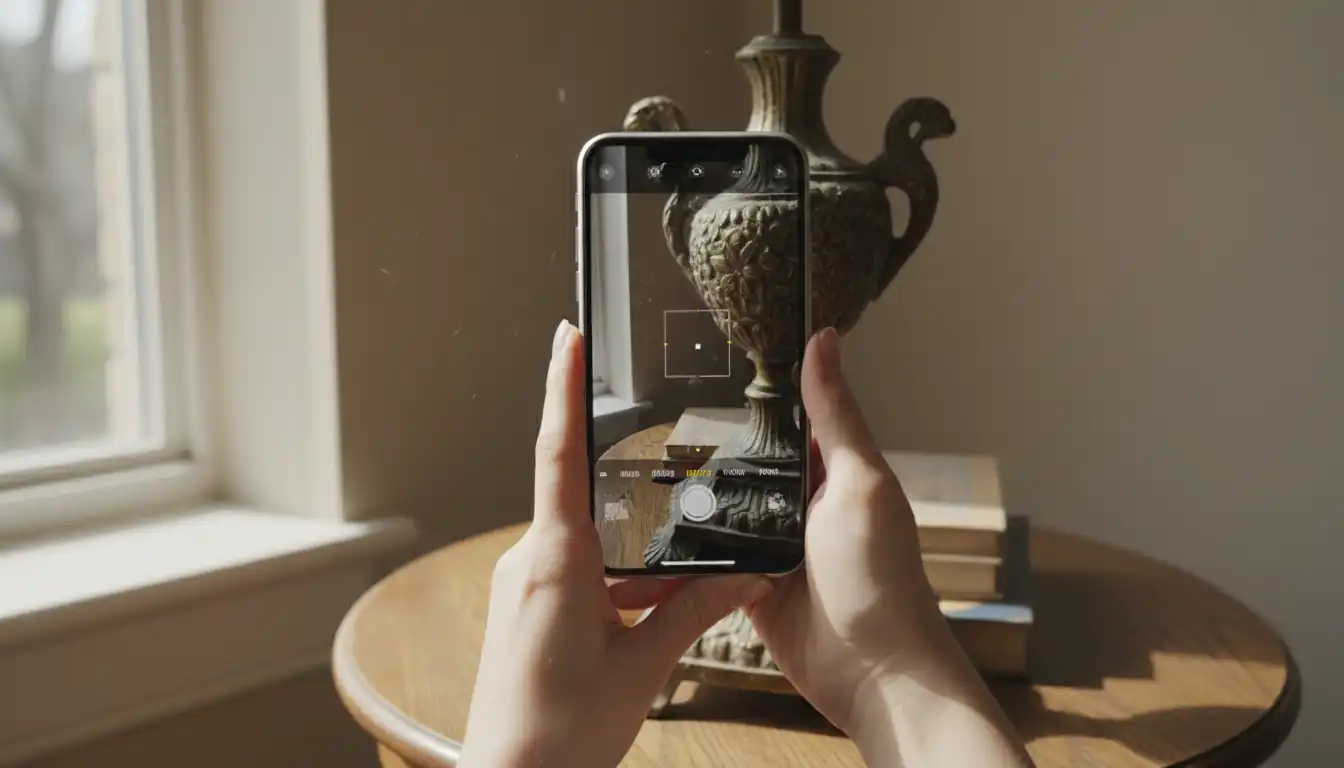
Today, the process is visual and instantaneous. When you encounter a mysterious object, the primary hurdle is no longer "How much is this worth?" but rather "What is this?" This is where modern technology bridges the gap. By using an app that identifies antiques by picture, you bypass the need for a specialized vocabulary. You don't need to know that a chair has "cabriole legs" or a "splat back" to get an answer; the AI recognizes those features for you.
The Shift from Heavy Price Guides to Instant AI
The transition from physical books to digital intelligence has changed the "speed of discovery." In the past, a "picker" would spend years memorizing patterns, makers' marks, and wood grains. They were human databases. While that expertise is still valuable, the average person can now access a similar level of insight in seconds.
Modern tools like Relic have replaced the guesswork of manual searching. Instead of flipping through a thousand pages of glassware patterns, you simply point your camera. Relic uses advanced AI to analyze the shape, texture, and markings of an item, providing a real appraisal and historical context almost instantly. This allows you to make split-second decisions at estate sales or thrift stores where the best items are often gone within minutes.
Why Visual Search Beats Manual Keyword Hunting
Keyword searching is notoriously difficult for antiques because descriptions are subjective. One person might call a vase "Art Deco," while another calls it "Mid-Century Modern." If you type the wrong terms into a search engine, you’ll get the wrong prices. Visual search removes this human error.
- Pattern Recognition: AI can identify specific porcelain patterns or lace weaves that are nearly impossible to describe in words.
- Hallmark Identification: Tiny stamps on the bottom of silver or gold items are often too small to see clearly, but a macro photo can be analyzed against a massive database of maker's marks.
- Contextual Clues: Visual tools look at the "whole" of an object, including its construction methods and patina, which are often left out of text-based descriptions.
The greatest advantage of visual identification is that it doesn't require you to be an expert to find an expert answer.
Decoding the Real Value of Your Hidden Treasures
Once you know what an item is, the next logical question is: "How do I find out how much my antique is worth?" This is where many amateur collectors stumble. There is a massive difference between what someone asks for an item and what someone actually pays for it. If you look at a listing on a popular auction site, you might see a vintage clock listed for $1,000. However, if ten identical clocks sold last week for $200, the $1,000 figure is a fantasy.
To find the real value, you have to look at "realized prices." These are the confirmed sales figures from auction houses and verified marketplaces. A professional appraisal takes these data points and adjusts them based on the specific condition and provenance of your item.
Understanding the Difference Between Asking Price and Realized Value
The "asking price" is often driven by emotion or a lack of market knowledge. Sellers often overvalue items because of sentimental attachment or because they saw a similar item on a television show. Realized value, on the other hand, is the cold, hard truth of the market.
| Value Type | Definition | Reliability |
|---|---|---|
| Asking Price | The amount a seller hopes to get. | Low - Often inflated. |
| Realized Price | The amount a buyer actually paid at the end of an auction. | High - Reflects true market demand. |
| Insurance Value | The cost to replace the item with a similar one quickly. | Moderate - Usually higher than market value. |
| Wholesale Value | What a dealer will pay you (usually 30-50% of retail). | High - For quick liquidity. |
How Relic Analyzes Origin and History to Determine Worth
Relic doesn't just give you a random number based on a single photo. It looks deeper into the history and origin of the piece. For example, two wooden chairs might look identical to the untrained eye. However, one might be a mass-produced reproduction from the 1970s, while the other is an original piece from a specific 18th-century workshop.
The AI analyzes the "DNA" of the object—the specific way joints are constructed, the type of screws used, and the wear patterns on the base. By cross-referencing these visual cues with historical records, Relic provides a comprehensive report. This includes where the item was likely made, the era it belongs to, and its historical significance. This level of detail is what transforms a simple "price check" into a professional-grade appraisal.
Navigating the World of Free and Paid Identification Tools
If you are just starting out, you might wonder how to check antique value for free. There are several ways to do this, but they often come with a "hidden cost" in the form of inaccuracy or incomplete data. Google Lens, for instance, is a fantastic free tool for identifying general objects, but it often struggles with the nuances of antiques. It might tell you that you have a "blue plate," but it won't tell you if that plate was made by a master potter in 1820 or a factory in 2010.
When you rely solely on free tools, you risk the "cost of being wrong." Missing a rare maker's mark or misidentifying a signature can mean the difference between a $20 sale and a $2,000 windfall.
The Limitations of Free Online Databases
Free databases and forums are excellent for community building, but they are often slow and prone to misinformation. You might post a photo on a forum and wait three days for a response, only to have three different "experts" give you three different opinions.
- Inconsistent Data: Free tools often pull from current listings rather than historical sales data.
- Lack of Depth: You rarely get the "why" behind a price with a free tool.
- Privacy Concerns: Public forums require you to share photos of your valuables with the entire internet, which isn't always wise.
When to Invest in a Professional AI Appraisal App
There comes a point where the value of your time and the potential value of your items justify a more robust solution. This is where Relic shines. With a 4.9-star rating from over 20,000 reviews, the app has built a reputation for accuracy that free tools simply can't match.
Investing in a professional tool is about securing your "ROI" (Return on Investment). If you are at an estate sale and see a painting for $50, spending a few moments with a professional app allows you to verify its authenticity before you spend your money. Relic provides a searchable catalog of your scanned items, making it a permanent resource for your collecting journey rather than a one-off search engine.
Using a professional tool is like having an appraiser in your pocket 24/7. It removes the anxiety of the "unknown" and replaces it with data-driven confidence.
Protecting Your Collection in the Digital Age
Identifying and pricing your antiques is only half the battle. Once you realize you own something of significant value, you have to think about protection. This isn't just about physical security; it’s about digital security and asset management.
Many people make the mistake of keeping their "inventory" in their heads. They know they have a valuable vase, but they don't have a record of its condition, its appraised value, or its history. If a fire or theft occurs, proving the value of that item to an insurance company becomes an uphill battle.
Ensuring Data Safety and Digital Privacy for Your Assets
When you use an app to identify valuables, you are essentially creating a map of the wealth inside your home. It is vital to use a platform that prioritizes data safety. A professional app like Relic ensures that your photos and location data are secure. You want to avoid "leaking" information about your collection to the public until you are ready to sell.
- Private Inventories: Keep your scanned items in a private, encrypted catalog.
- Secure Uploads: Ensure your photos aren't being used for public training data without your consent.
- Location Privacy: Be wary of apps that require constant GPS tracking when you are just trying to price a lamp in your living room.
Creating a Digital Inventory for Insurance and Estate Planning
One of the most overlooked benefits of using an appraisal app is the ability to create an instant digital inventory. This is a lifesaver for insurance purposes and estate planning. Instead of a spreadsheet that you have to update manually, you have a visual catalog of every valuable item you own, complete with its current market value and historical report.
- Insurance Documentation: If you need to file a claim, you have a time-stamped photo and a professional appraisal ready to go.
- Estate Planning: Make it easy for your heirs to know what is valuable and what isn't, preventing them from accidentally donating a masterpiece to a local charity shop.
- Market Tracking: As the market for certain antiques fluctuates, you can easily re-appraise items in your catalog to see how your "net worth" in antiques is changing.
Maximizing Your Profit After the Identification

Once you have identified your item and confirmed its value with Relic, the final step is turning that knowledge into profit. The antique market is not a monolith; different categories heat up and cool down at different times. Knowing when to sell is just as important as knowing what you have.
For example, Mid-Century Modern (MCM) furniture and decor have seen a massive surge in value over the last decade. A simple teak side table that would have sold for $20 in the 1990s might now fetch $600. Conversely, heavy Victorian "brown furniture" has seen a dip in demand as younger buyers favor cleaner lines.
Timing the Market for Specific Antique Categories
To get the highest price, you need to understand the current "vibe" of the market. Use the history and origin report from your appraisal to highlight the features that are currently in demand.
- Mid-Century Modern: Focus on the designer's name and the "minimalist" aesthetic.
- Industrial Antiques: Highlight the "raw" materials like iron and reclaimed wood.
- Vintage Tech: Early computers, gaming consoles, and even high-quality 1970s audio gear are currently skyrocketing in value.
- Art Deco: Emphasize the geometric patterns and "luxury" materials like chrome and glass.
Avoiding Common Scams When Selling High-Value Items
The moment you list a high-value antique online, you may become a target for scammers. They often use high-pressure tactics or "overpayment" schemes. Having a professional appraisal in hand is your best defense. It gives you a firm "floor" for your price, so you don't get talked down by "lowballers" who claim your item is a fake.
When selling, choose the venue that matches the value. If Relic tells you your item is worth $100, a local marketplace or eBay is perfect. If the appraisal comes back at $5,000, it might be time to contact a specialized auction house. These houses will use the same historical data provided by your app to market the item to high-end collectors.
Conclusion
The "dusty lamp" in your attic is no longer a mystery. With the advent of AI-driven tools like Relic, the power to identify and value history has shifted from a small group of experts to anyone with a smartphone. By moving away from outdated price guides and embracing visual identification, you can uncover the hidden wealth in your own home.
Remember that the journey doesn't end at identification. Understanding the difference between asking prices and realized values, maintaining a secure digital inventory for insurance, and timing the market are all essential steps in becoming a successful modern collector.
If you're ready to see what your treasures are actually worth, your next step is simple. Download Relic, take a clear photo of that mysterious item, and let the AI do the heavy lifting. You might find that your mortgage payment is sitting right there on your end table, waiting to be discovered.
Identify antiques instantly
Point your camera at any antique, collectible, or vintage item. Get valuations, history, and market insights in seconds.
Download for iPhone