Turn Your Smartphone Into a Gemologist: The Secret to Identifying Vintage Jewelry by Photo

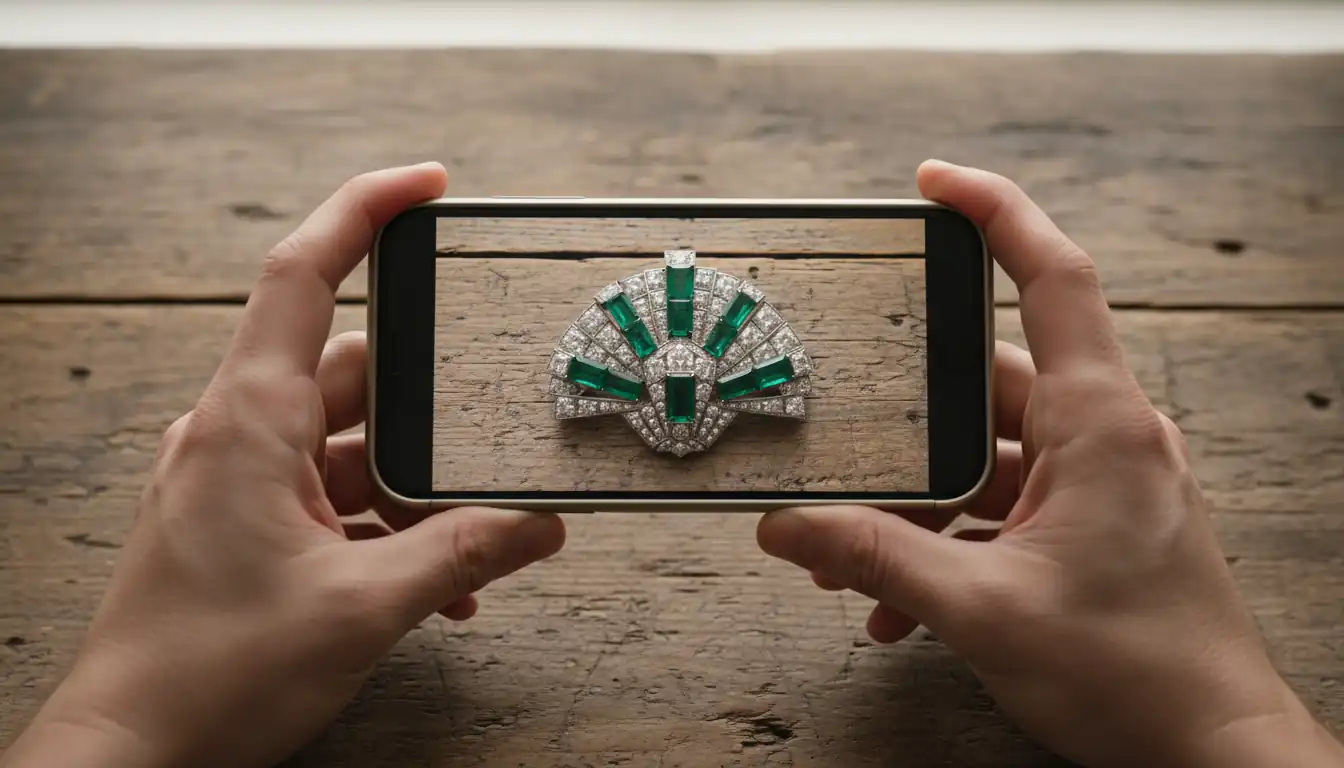
You are standing at a crowded estate sale, your eyes scanning a velvet-lined tray of tangled chains and tarnished brooches. One particular piece catches the light—a heavy, geometric ring with a deep blue stone that looks far too sophisticated for the five-dollar price tag. You suspect it might be Art Deco, but without a loupe or a decade of gemological training, you are essentially guessing. In the past, this moment would end in one of two ways: you either take a risky gamble on a piece of glass, or you walk away and spend the rest of the day wondering if you just left a four-figure masterpiece on a dusty card table.
The barrier between a casual hobbyist and a professional appraiser has always been access to information. Identifying vintage jewelry used to require a massive library of reference books, an intimate knowledge of obscure European hallmarks, and the ability to recognize the subtle difference between a hand-cut diamond and a mass-produced imitation. Most people simply don't have the time to memorize the evolution of clasp designs from 1850 to 1950. However, the camera in your pocket has quietly become the most powerful tool in the history of antiquing, capable of bridging that knowledge gap in a matter of seconds.
By the time you finish reading this, you will understand how to use your smartphone to decode the hidden history of any piece of jewelry you encounter. We will explore the mechanics of visual search, the specific photography techniques that reveal hidden maker’s marks, and how to interpret the complex data that modern AI provides. Whether you are clearing out an attic or hunting for treasures at a local market, you are about to turn your phone into a professional-grade gemologist.
The Evolution of Visual Search for Antiques
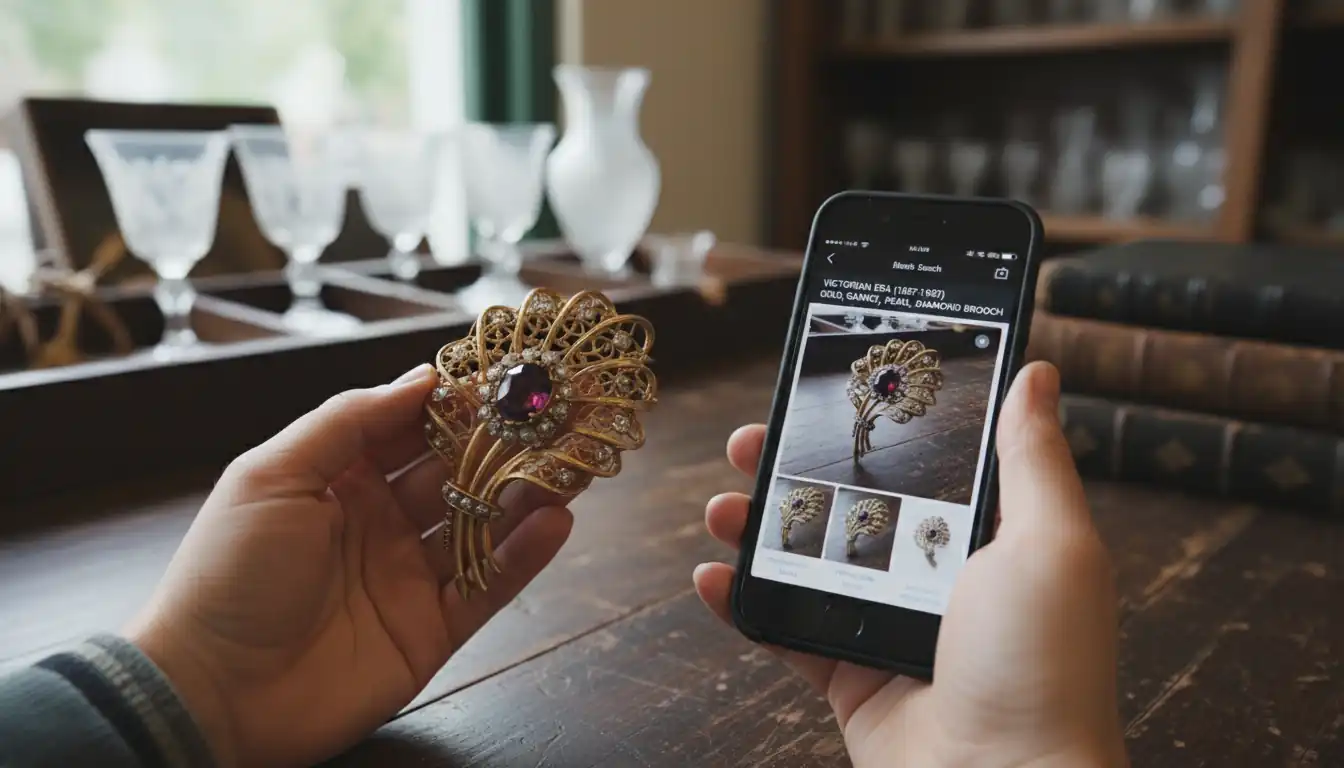
For decades, identifying a mystery piece of jewelry was a grueling exercise in creative writing. You would sit at a computer and type phrases like "gold brooch with blue stone and floral pattern" into a search engine, only to be met with three million irrelevant results. The problem is that language is subjective. What you call "sky blue," a jeweler might call "cornflower," and what you describe as "floral," an appraiser might identify as a specific "Edwardian garland motif." Text-based searching relies on the hope that the person who cataloged an item used the exact same words you are using to find it.
Visual search has flipped this dynamic on its head. Instead of trying to describe a shape, you are now providing the computer with the shape itself. This shift represents a move from keyword matching to pattern recognition. When you upload a photo of a ring, the software isn't looking for the word "ring." It is measuring the ratio of the shank to the setting, identifying the specific geometry of the stone’s facets, and analyzing the texture of the metal.
AI Recognition vs Traditional Keyword Search
Traditional search engines work like a library index, matching words to other words. AI-driven visual search works more like a human brain, but with a much larger memory. When you ask, "Can AI identify a piece of jewelry?" the answer lies in neural networks. These are complex mathematical models trained on millions of high-resolution images from auction houses, museum archives, and private collections.
When the AI "looks" at your photo, it breaks the image down into thousands of tiny data points. It identifies the "visual signature" of the piece. For example, a Victorian-era ring has specific structural characteristics—like a low profile and a "gypsy" setting—that are mathematically distinct from a modern reproduction. The AI can detect these patterns even if the piece is tarnished or the photo is slightly off-center. It compares your item against a vast database of known authentic pieces to find a match based on physical reality rather than descriptive labels.
How Modern Algorithms Decode Jewelry Design
Modern algorithms have become incredibly adept at recognizing the "DNA" of specific design eras. They don't just see a gold circle; they see the way the gold was worked. An algorithm can distinguish between the sharp, machine-cut edges of a modern piece and the slightly irregular, hand-finished edges of a piece from the early 19th century.
- Geometric Analysis: The AI calculates the angles of the stone cuts. A "Mine Cut" diamond has a different geometric footprint than a modern "Brilliant Cut," and the AI can tell them apart instantly.
- Texture Mapping: Algorithms analyze the "grain" of the metal. They can identify the specific look of "rolled gold" versus solid 14k gold by how the light reflects off the surface.
- Symmetry and Proportion: Vintage eras had strict rules about proportion. Art Deco pieces emphasize verticality and symmetry, while Art Nouveau pieces are defined by asymmetrical, flowing lines. The AI uses these "design rules" to narrow down the era of your find.
| Feature | Traditional Search | AI Visual Search |
|---|---|---|
| Input Method | Descriptive Keywords | High-Resolution Image |
| Accuracy | Low (Subjective) | High (Mathematical) |
| Speed | Slow (Manual Filtering) | Instant (Automated Matching) |
| Context | Limited to Text | Includes Era, Origin, and Style |
Master the Art of the Jewelry Snapshot
The most advanced AI in the world is only as good as the data you give it. If you provide a blurry, dark photo of a ring, the algorithm will struggle to find the "visual signature" we discussed earlier. To get an accurate identification, you need to think like a forensic photographer. You aren't trying to take a "pretty" picture for social media; you are trying to capture the technical details that prove what the item is.
If you are wondering how to find jewelry from a picture with high accuracy, the secret is in the "macro" details. Most people take a photo from too far away, fearing the camera won't focus. This results in a clear picture of the table, but a blurry blob where the jewelry should be. To fix this, you need to master your phone's focus and lighting settings.
Lighting and Macro Photography Essentials
The biggest enemy of jewelry photography is the camera flash. When a flash hits polished gold or a faceted gemstone, it creates "hot spots"—bright white flares that hide the actual color and texture of the piece. Instead of using a flash, find a window with indirect sunlight. This "soft" light fills in the shadows without creating harsh reflections.
- The Neutral Background Rule: Place your jewelry on a plain, non-reflective surface. A matte grey or white piece of cardstock is perfect. Avoid wooden tables with heavy grain or patterned fabrics, as these can confuse the AI's edge-detection software.
- Focus Lock: Tap and hold your finger on the jewelry on your phone screen until you see "AE/AF Lock." This prevents the camera from refocusing on the background. Once locked, you can slightly move the phone in or out to find the perfect point of clarity.
- Stability is Key: Even the slightest hand tremor can blur the tiny details of a gemstone. Prop your elbows on the table or use a small tripod to ensure the image is tack-sharp.
Capturing Hallmarks and Maker Marks
The "smoking gun" of jewelry identification is the hallmark. These are the tiny stamps usually found on the inside of a ring band, the back of a pendant, or the tongue of a clasp. These marks tell you the metal purity, the year it was made, and the person who made it. However, they are often smaller than a grain of rice.
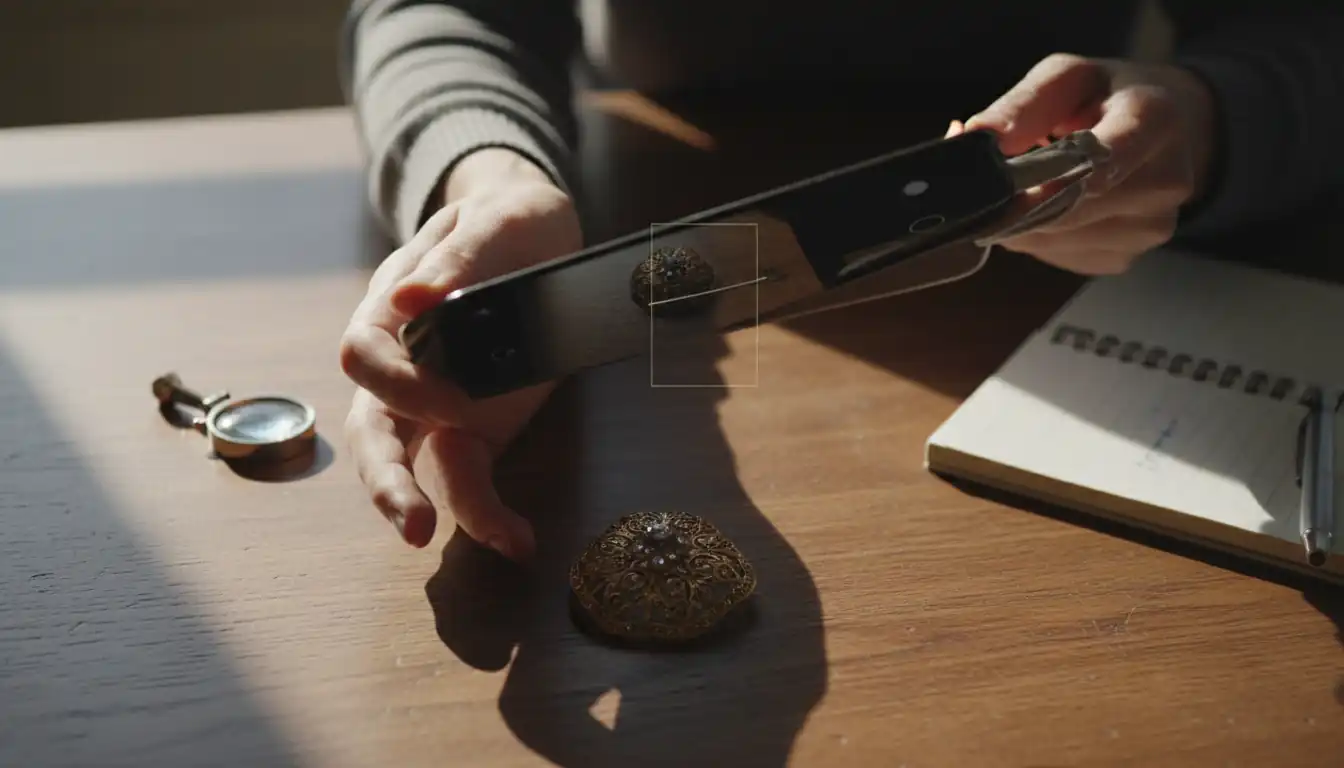
To capture these, you must use your phone’s macro mode. If your phone doesn't have a dedicated macro lens, you can use a clip-on macro attachment or simply take the photo from about four inches away and crop the image later. The AI needs to see the specific shape of the stamp—whether it’s a tiny lion (indicating British sterling silver) or a specific number like "585" (indicating 14k gold). If the mark is worn down, try side-lighting it with a small flashlight to create shadows within the indentation, making the mark "pop" for the camera.
A clear photo of a hallmark is often worth more than ten photos of the front of the piece. It is the signature that turns a "pretty ring" into a "documented antique."
Instant Appraisals with Relic and AI Tools
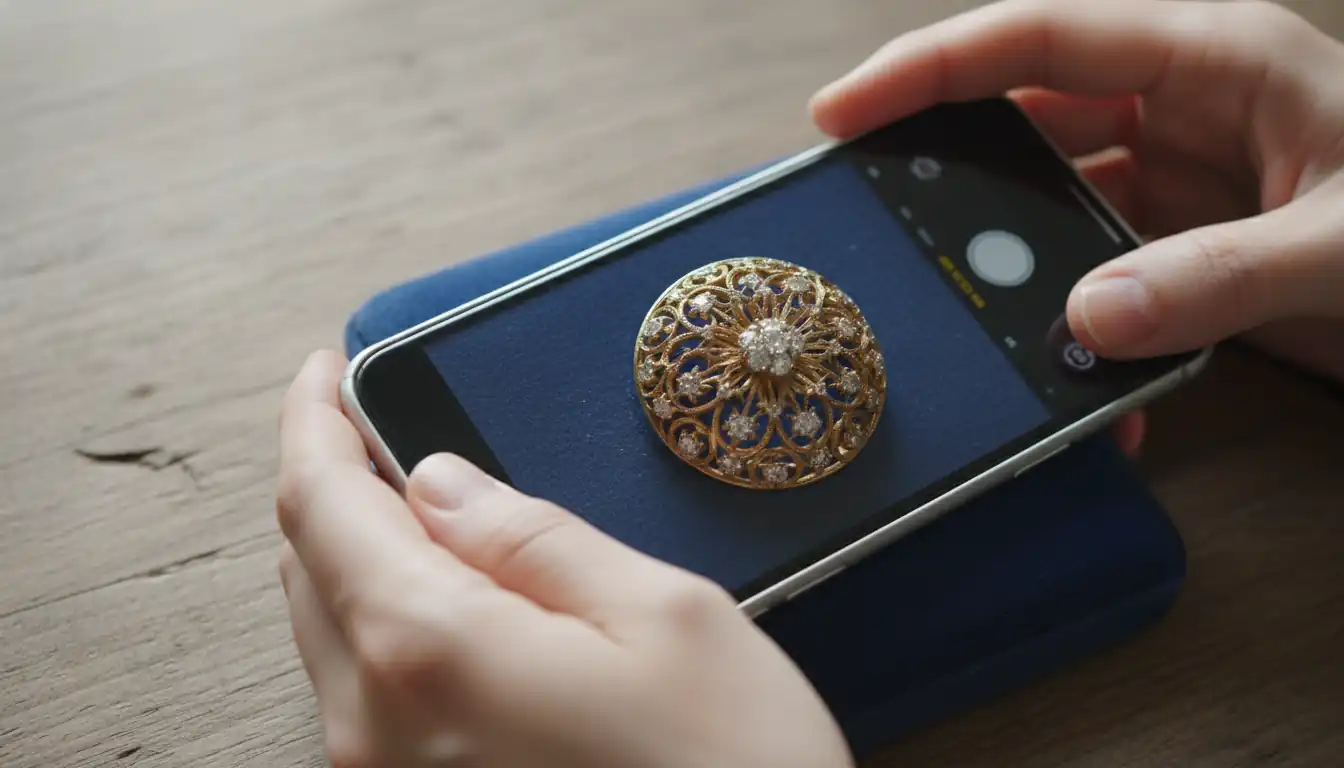
Once you have a high-quality photo, the next step is putting it to work. While generic tools like Google Lens are great for finding where to buy a pair of shoes, they often fall short when it comes to the nuances of the antique market. A generic search might show you five similar-looking rings for sale on eBay, but it won't tell you if your specific ring is a rare 1920s original or a 1980s reproduction. This is where specialized tools become essential.
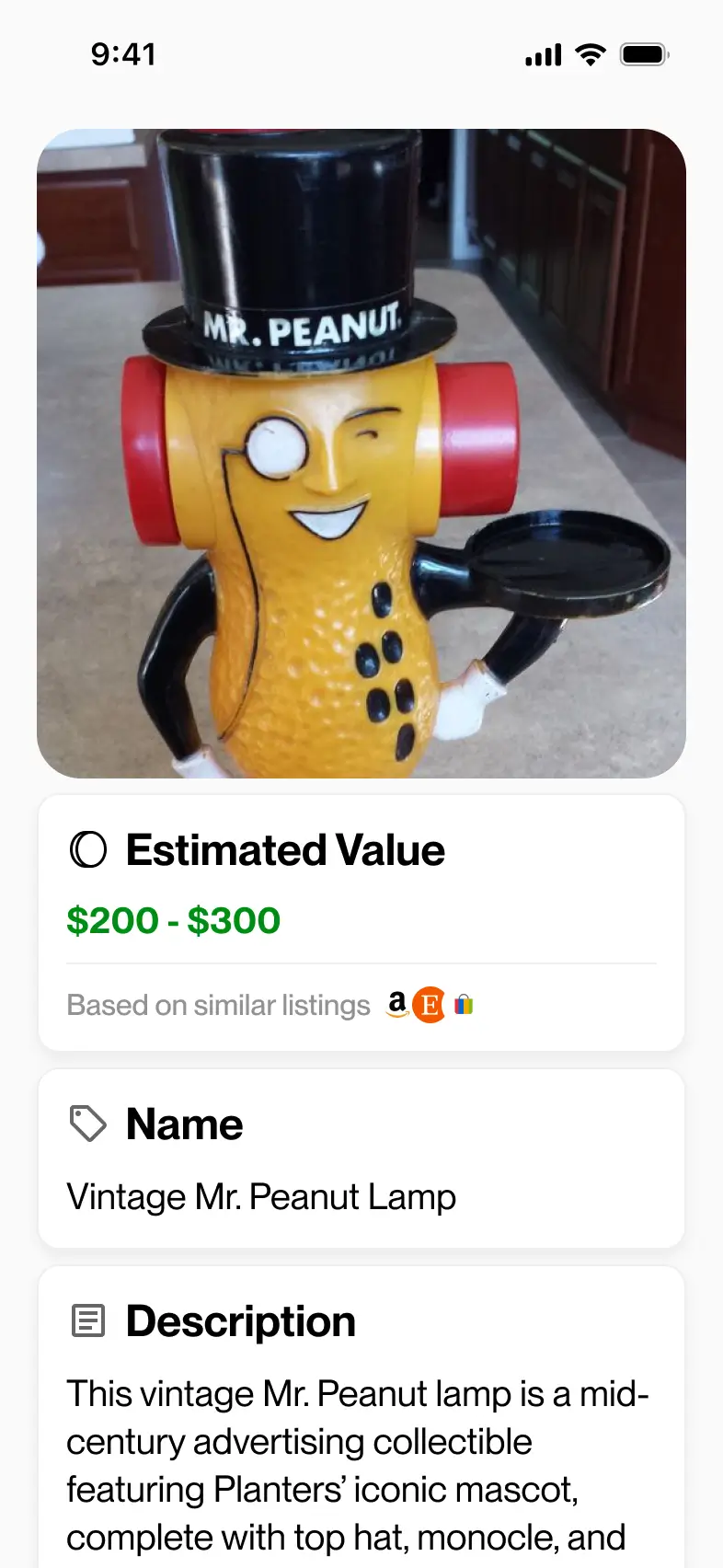
The Relic app was built specifically to solve this problem. Unlike general image search engines, Relic is an antique identifier that uses advanced AI to provide a real appraisal, history, and origin of the item. When you upload a photo to Relic, the system doesn't just look for "matches"; it performs a deep-dive analysis of the piece's characteristics. It looks at the construction methods, the stone settings, and the hallmarks to give you a comprehensive story of the item.
Beyond Basic Image Matching
Most people ask, "What is the app that identifies jewelry by picture?" because they want more than just a price tag. They want to know the "why" behind the piece. Relic distinguishes itself from competitors like Vintiq or Histora by focusing on the narrative and the data-driven valuation. While other apps might give you a broad category, Relic’s AI is trained to pinpoint specific eras, such as the transition from the flowing lines of Art Nouveau to the rigid geometry of the Edwardian period.
- Historical Context: Relic provides the "story" of the piece. If you scan a brooch, the app might identify it as "Mourning Jewelry" from the mid-Victorian era, explaining the cultural significance of the black enamel work.
- Real Appraisals: Instead of just showing you current "asking prices" (which can be wildly inaccurate), the app analyzes historical auction data and realized sales to provide a realistic market value.
- Searchable Catalog: For professionals like pickers or estate sale flippers, the app allows you to maintain a digital catalog of everything you’ve scanned, making it easy to track your inventory and its fluctuating value.
Getting History and Origin in Seconds
The speed of modern AI is perhaps its most impressive feature. In the time it takes to walk from one side of an antique booth to the other, Relic can process your photo and return a detailed report. This is a massive advantage for professional dealers and importers who need to make split-second decisions on high-value items.
With over 20,000 reviews and a 4.9-star rating, the app has become a staple for those who need professional-grade tools without the professional-grade price tag. It removes the "guesswork" from the equation. You no longer have to wonder if a piece of silver is from a famous workshop in Taxco, Mexico, or a mass-produced factory in the Midwest; the AI recognizes the specific "hand" of the maker and the regional hallmarks associated with the origin.
| Feature | Generic Image Search | Relic App |
|---|---|---|
| Primary Goal | Shopping/Product Matching | Identification & Appraisal |
| Data Source | General Web Crawl | Auction Records & Expert Databases |
| Historical Context | None | Detailed Era & Origin Reports |
| Valuation | Asking Prices | Realized Market Value |
Decoding the Results of Your Visual Search
Once the AI returns its findings, you need to know how to read between the lines. The AI might tell you a piece is "Art Deco style," but your job is to use that information to look closer. Understanding the "visual tells" of jewelry construction will help you verify the AI's findings and gain a deeper appreciation for the craftsmanship of your find.
One of the most important distinctions the AI helps you make is the difference between "fine" jewelry and "costume" jewelry. While some vintage costume jewelry (like pieces by Chanel or Trifari) can be very valuable, fine jewelry made of precious metals and stones usually holds a higher baseline value. The AI looks for specific construction methods that are difficult to replicate in mass production.
Differentiating Between Costume and Fine Jewelry
The way a stone is held in place is a major clue. In high-end vintage jewelry, stones are almost always "prong-set" or "bezel-set," meaning the metal is physically folded over the stone to secure it. In cheaper costume jewelry, stones are often "pasted" or glued into place.
- Prong-Set Stones: Look for tiny metal claws holding the stone. If you see these, it’s a sign of higher quality.
- The "Open Back" Test: High-quality gemstones are usually set with an open back to allow light to pass through. Costume jewelry often has a closed metal back, sometimes with a foil lining to make the glass look shinier.
- Weight and Feel: While a photo can't capture weight, the AI can identify the "thickness" of the metal. Fine jewelry tends to have a more substantial, balanced construction compared to the thin, stamped metal of low-end pieces.
Identifying Period Specific Design Elements
Every era has its own "design language." When the AI identifies a piece as being from the 1920s, it is likely picking up on "milgrain" or "filigree" work.
Milgrain refers to the tiny, beaded edges found on the borders of jewelry. It looks like a row of microscopic pearls made of metal. This was a hallmark of the Art Deco period and required immense skill to execute by hand. Filigree involves twisting thin threads of precious metal into intricate, lace-like patterns. If the AI detects these elements, you are likely looking at a piece from the early 20th century.
- Victorian (1837-1901): Often features nature motifs—snakes, birds, and flowers. Look for "rose cut" diamonds and colorful gemstones like garnets.
- Art Nouveau (1890-1910): Defined by "whiplash" curves and depictions of the female form with flowing hair. Use of enamel (plique-à-jour) is common.
- Art Deco (1920-1935): Characterized by bold, geometric shapes and high-contrast colors (like black onyx paired with white diamonds).
Learning to recognize milgrain and filigree is like learning a secret language. Once you see it, you can never un-see it, and it instantly tells you the age of a piece.
Advanced Search Techniques for Global Markets
The vintage jewelry market is truly global. A piece you find at a garage sale in Ohio might have originated in a small workshop in Jaipur, India, or a silver-smithing community in North Africa. Identifying these pieces can be challenging because they often lack the standard "14k" or "925" marks we are used to seeing in the West. This is where the power of visual search really shines, as it can recognize regional styles and non-Western hallmarks that would baffle a general collector.
Navigating International Hallmarks
Many countries use unique symbols instead of numbers to denote metal purity. For example, French jewelry often uses a "Eagle's Head" for 18k gold and a "Dog's Head" for platinum. In many parts of the Middle East and India, jewelry is made of much higher purity gold (22k or 24k) and may carry stamps in Arabic or Devanagari script.
Visual search tools can translate these symbols instantly. If you take a clear photo of a mysterious bird-shaped stamp, the AI can cross-reference it against a global database of hallmarks to tell you that it’s actually a 19th-century Egyptian mark for silver. This prevents you from accidentally dismissing a high-value international piece just because you don't recognize the stamp.
- Kundan Jewelry (India): This style uses 24k gold foil set between the stones and the mount. It has a very distinct, "heavy" look that AI can identify by the way the gold appears to "flow" around the gems.
- Tuareg Silver (Africa): Known for its geometric engravings and the use of ebony wood inlays. The AI recognizes these specific tribal patterns, which are often passed down through generations.
- Taxco Silver (Mexico): Often marked with a "Spread Eagle" or a specific "TM" (Taxco Maker) code. The AI can help you identify which specific workshop produced the piece.
Using Visual Search to Track Market Value
Once you have identified the origin and era of your jewelry, you can use that data to find its true market value. The "valuation" provided by an app like Relic is a fantastic starting point, but a savvy collector will use that information to look at "sold" listings on international auction sites.
Prices for vintage jewelry can vary wildly depending on the market. A piece of Victorian coral jewelry might sell for a modest price in the United States but command a premium at a specialized auction in London or Rome. By using the specific terminology provided by your visual search—terms like "Intaglio," "Repoussé," or "Camaieu"—you can search global databases to see what buyers are actually paying. This transitions you from a casual searcher to a global collector who understands the financial potential of every find.
| Region | Common Style/Material | Key Visual Identifier |
|---|---|---|
| India | Kundan / Meenakari | 24k Gold Foil / Vibrant Enamel |
| North Africa | Tuareg Silver | Geometric Etching / Ebony Inlay |
| France | Art Nouveau | Plique-à-jour (Transparent Enamel) |
| Mexico | Taxco Silver | Heavy Gauge / Specific Maker Marks |
Conclusion
The world of vintage jewelry is no longer a closed book reserved for those with expensive degrees. Your smartphone, equipped with the right tools and techniques, has effectively democratized the art of gemology. By understanding the shift from keyword searches to AI-driven visual recognition, you can now identify pieces with a level of precision that was impossible just a decade ago.
The secret lies in the combination of high-quality input and sophisticated analysis. When you master the art of the jewelry snapshot—focusing on lighting, macro details, and hallmarks—you provide the AI with the data it needs to succeed. Tools like the Relic app then take that data and turn it into a professional appraisal, offering you the history, origin, and value of your finds in seconds. This doesn't just save you time; it gives you the confidence to navigate estate sales, auctions, and markets with the eye of an expert.
As you continue your journey into the world of antiques, remember that every piece of jewelry has a story to tell. Some stories are written in gold hallmarks, others in the geometry of a diamond cut, and others in the cultural motifs of a distant land. You now have the key to unlock those stories. The next time you see a glimmer of gold in a bargain bin, don't just wonder what it is. Take out your phone, capture the detail, and let the technology reveal the treasure hidden in plain sight. Your next great find is only a photo away.
Identify antiques instantly
Point your camera at any antique, collectible, or vintage item. Get valuations, history, and market insights in seconds.
Download for iPhone