Turn Your Weekend Hobby Into a Gold Mine: The Secret to Spotting $1,000 Treasures at Local Yard Sales

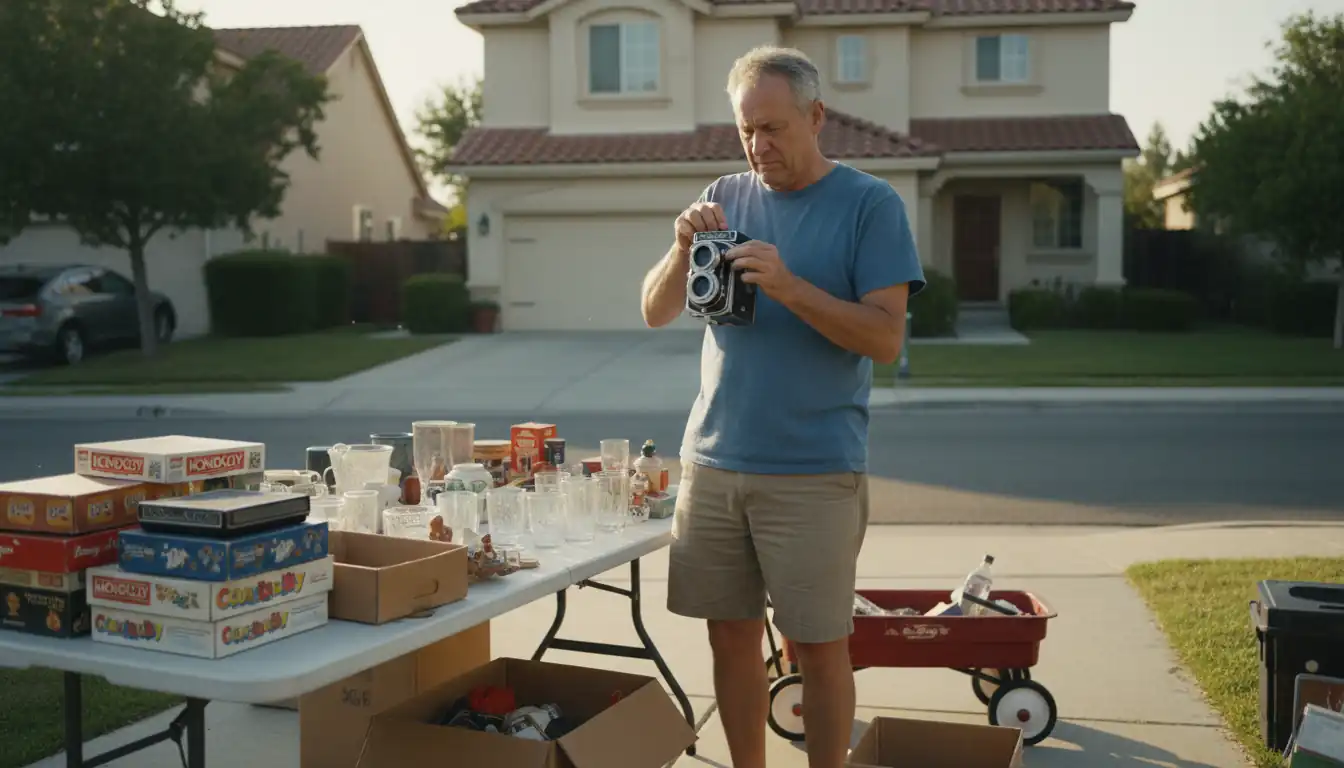
Imagine standing on a sun-drenched driveway at 7:00 AM, surrounded by cardboard boxes and folding tables. To the untrained eye, it looks like a pile of unwanted clutter—outdated kitchenware, dusty electronics, and bins of old toys. But to the professional picker, this isn't a graveyard of junk; it is a treasure map. Somewhere between the rusted garden tools and the stack of paperbacks lies a $1,000 profit waiting for someone with the vision to claim it.
Turning a weekend hobby into a high-yield business requires more than just luck. It demands a shift in perspective, moving away from the "bargain hunter" mindset and toward the "strategic scout" mentality. You aren't looking for things you need; you are looking for things the world has forgotten it wants. This transition is where the real money is made, transforming a casual Saturday morning stroll into a high-stakes hunt for undervalued assets.
By the time you finish reading this, the way you look at a neighborhood garage sale will be fundamentally altered. You will learn how to identify the most profitable neighborhoods before you leave your driveway, which unassuming items hold the highest resale value, and how to use modern technology to validate your finds in real-time. The secret to spotting four-figure treasures isn't magic—it’s a combination of preparation, observation, and the right tools.
The Scout's Strategy for High-Yield Neighborhoods

Success in the world of picking begins long before you pull into a driveway. If you spend your morning driving aimlessly, you are burning daylight and gasoline while other hunters are already loading their trunks. You need a flight plan. Think of yourself as a venture capitalist scouting for undervalued startups; you want to go where the assets are high-quality but the owners are motivated to liquidate quickly.
Mapping Wealthy Zip Codes and Estate Sale Crossovers
The first rule of high-yield scouting is to follow the "Old Money" trail. While new developments might have plenty of sales, they often contain modern mass-produced items from big-box retailers that hold very little resale value. You are looking for neighborhoods with a high density of long-term residents. These are the "honey holes" where items have sat in attics and basements for thirty, forty, or fifty years.
Look for zip codes where the median home value is high, but the average length of residency exceeds fifteen years. These demographics suggest that the items coming out of the house aren't just last year's Amazon purchases. Instead, you’re likely to find high-quality furniture, heirloom jewelry, and vintage collectibles that the owners have simply outgrown or forgotten.
Estate sales are the gold standard for this strategy. Unlike a standard yard sale where a family is just "cleaning out the garage," an estate sale often involves the liquidation of an entire lifetime of possessions. When an estate sale overlaps with a neighborhood-wide garage sale event, the potential for profit skyrockets. Professional estate companies often price items closer to market value, but family-run estate sales are where the $1,000 treasures hide in plain sight.
The Professional Picker's Essential Toolkit
You wouldn't go into a dark cave without a flashlight, and you shouldn't go to a yard sale without the proper physical tools. Being prepared allows you to verify the quality of an item on the spot, preventing you from wasting money on "fakes" or broken goods.
- High-Powered Jeweler’s Loupe: A 10x or 30x magnification loupe is non-negotiable. It allows you to see hallmarks on silver, gold karats on jewelry, and the "dot pattern" on prints to determine if a piece of art is an original or a reproduction.
- Neodymium Magnet: This is your best friend for testing metals. If a "silver" tray sticks to the magnet, it’s just silver-plated steel. If it doesn't stick, you might be looking at solid sterling silver or high-quality brass.
- Portable Power Bank and Universal Cables: Never buy an electronic item without testing it. A "vintage" receiver is worth $500 if it works and $50 if it’s a "parts only" unit. Having your own power source ensures you aren't relying on the seller's word.
- Measuring Tape: If you find a piece of Mid-Century Modern furniture, you need to know if it will fit in your vehicle—and more importantly, if it fits the standard dimensions collectors are looking for.
| Tool | Primary Use | Why It Matters |
|---|---|---|
| Jeweler's Loupe | Identifying hallmarks and signatures | Confirms authenticity and material quality |
| Magnet | Testing for ferrous metals | Distinguishes between solid precious metals and plated junk |
| LED Flashlight | Inspecting dark corners and basements | Helps spot cracks, repairs, or hidden maker's marks |
| Multi-bit Screwdriver | Opening battery compartments | Checks for corrosion that could ruin electronics |
Identifying the Unassuming Winners in the Chaos
One of the most common questions new pickers ask is: What items sell the most at a garage sale? The answer isn't always the biggest or most obvious antique. In fact, the most profitable items are often the ones that look like everyday household objects to the untrained eye. To find the $1,000 treasures, you have to look past the "clutter" and recognize the specific niches that have high collector demand.
High-Margin Categories Beyond the Obvious Antiques
The "hidden gems" of the modern market often fall into categories that sellers view as "outdated" rather than "vintage." This disconnect between the seller's perception and the buyer's demand is where your profit margin lives.
Mid-Century Modern (MCM) Decor: This style remains incredibly popular. Look for "tapered legs" on furniture, atomic-era patterns on glassware, and anything made of solid teak or rosewood. Even small items, like a set of "Georges Briard" signed highball glasses or a "bittersweet" orange Viking Glass floor vase, can fetch hundreds of dollars from the right collector.
Vintage Technology and Gaming: Don't walk past the box of old "computer junk." Early mechanical keyboards, original Sony Walkmans (especially the professional series), and 1980s video game consoles are in high demand. A sealed or even a well-preserved box for an original Nintendo game can sometimes be worth more than the game itself.
Specific Toy Brands: This is a massive market. While many people look for 1960s Barbies, the real money is often in 1980s action figures like Kenner Star Wars, Hasbro GI Joe, or early Transformers. Look for "stiff joints" and original accessories. Even "unassuming" kitchen toys, like certain patterns of vintage Pyrex, have a cult following.
Pro Tip: If you see a Pyrex dish with the "Pink Gooseberry" or "Lucky in Love" pattern, buy it immediately. These specific designs can sell for hundreds, and in some cases, thousands of dollars to dedicated kitchenware collectors.
Spotting Quality Indicators in Art and Jewelry
When it comes to how to spot valuable items at estate sales, you must train your eyes to look for "quality indicators" rather than just beauty. A beautiful painting might be a mass-produced hotel decoration, while an ugly, abstract sketch could be a signed lithograph by a renowned artist.
- Check the "Shoulders" of Furniture: Look at how drawers are constructed. "Dovetail" joints (where the wood interlocks like fingers) are a sign of high-quality craftsmanship. Stapled or glued joints usually indicate cheap, modern mass-production.
- Feel the Weight of Glass and Ceramics: High-quality crystal has a higher lead content and will feel significantly heavier than standard glass. It will also produce a clear "ring" when tapped gently with a fingernail, rather than a dull "thud."
- Search for Hidden Signatures: On pottery, flip the piece over and look for "incised" marks or stamps. On jewelry, check the clasp or the inside of a ring band for tiny numbers like 750 (18k gold), 585 (14k gold), or 925 (sterling silver).
The Digital Edge in Real-Time Valuation
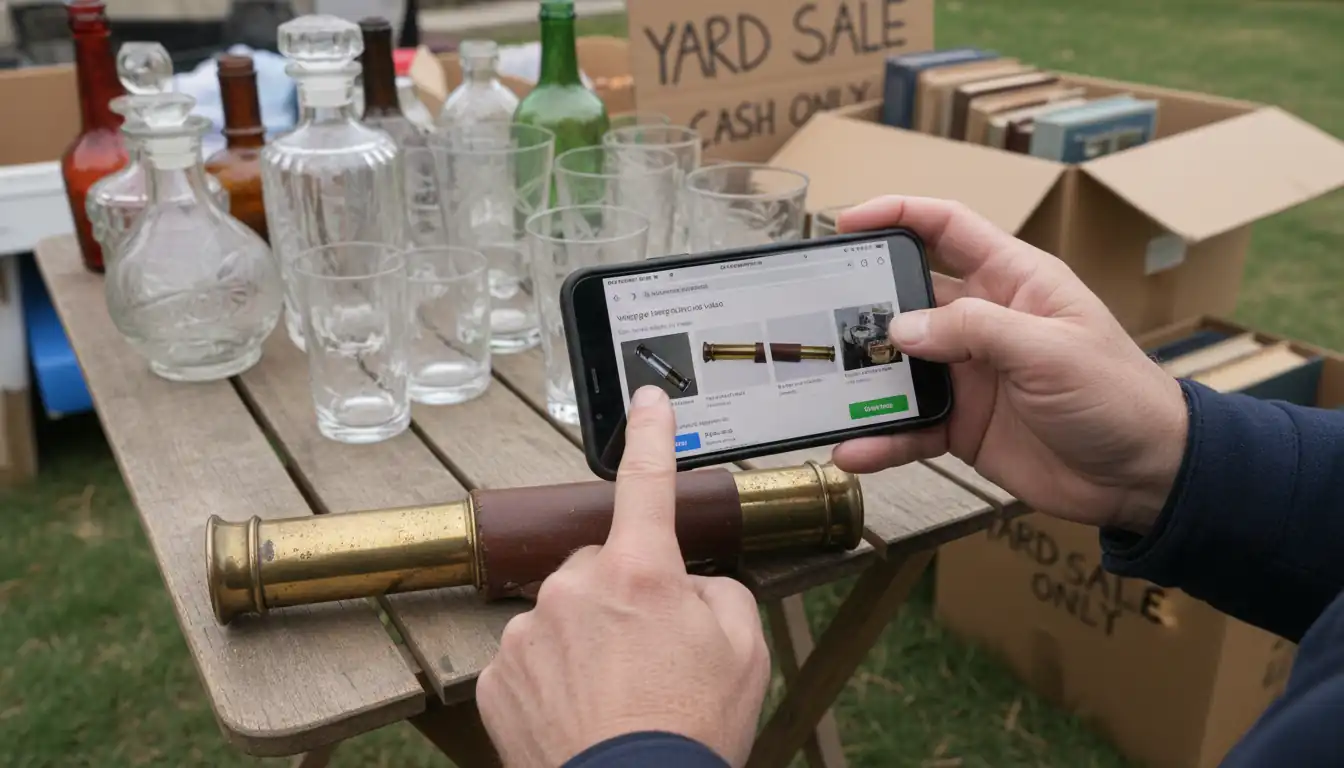
In the past, pickers had to rely entirely on their memory or thick reference books that were outdated the moment they were printed. Today, the advantage goes to the person who can process information the fastest. When you are standing in a crowded garage with three other people eyeing the same shelf, you don't have time to scroll through pages of irrelevant search results.
Using AI to Outsmart the Competition
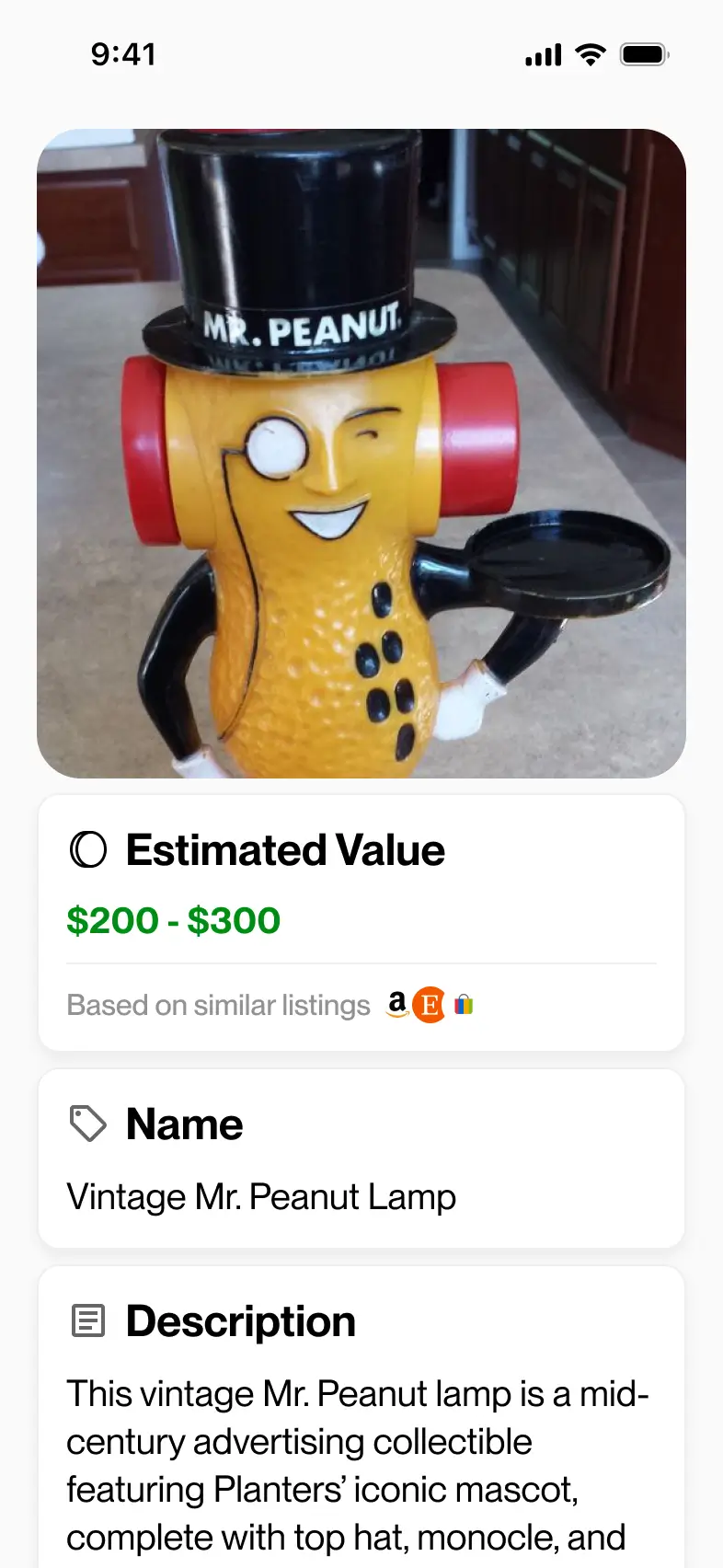
This is where technology bridges the gap between a "hunch" and a "guaranteed profit." The Relic app has changed the workflow for professional pickers by providing an instant, AI-driven identification system. Instead of typing vague descriptions like "blue floral vase" into a search engine and hoping for the best, you can simply take a photo.
Relic uses advanced image recognition to analyze the shape, pattern, and maker's marks of an item. Within seconds, it provides a real appraisal, historical context, and the origin of the piece. This speed is vital. It allows you to confirm a find while the item is still in your hand, giving you the confidence to pay $20 for something you now know is worth $400.
Validating History and Origin in Seconds
Imagine you find a strange, heavy bronze statue of a bird at a local yard sale. It’s covered in dust and the seller wants $15 for it. To most people, it’s a paperweight. You open the Relic app, snap a quick photo, and the AI identifies it as an authentic mid-century piece by a specific Scandinavian designer.
The app doesn't just give you a price; it gives you the "why" behind the value. It might show you that this specific artist only produced a limited run of these bronzes in 1955. Armed with this historical data, you aren't just guessing—you are making an informed investment. This level of professional-grade insight, once reserved for high-end auction house experts, is now available on your iPhone, allowing you to scan items with one touch and build a searchable catalog of your finds.
| Feature | Manual Search (Google/eBay) | Relic App |
|---|---|---|
| Speed | Slow (requires typing/filtering) | Instant (photo-based) |
| Accuracy | Variable (depends on keywords) | High (AI-driven visual matching) |
| Context | Limited to current listings | Deep historical and origin data |
| Ease of Use | Requires expertise to filter results | One-touch scanning for anyone |
Psychological Tactics for the Art of the Deal
Finding the item is only half the battle. The other half is securing it at a price that leaves room for a massive return on investment. Negotiation at a yard sale is a delicate dance. You want to be respectful to the seller while also protecting your margins. This requires a blend of social engineering and emotional control.
Building Rapport Without Giving Away the Secret
The moment you pick up an item and your eyes widen, you’ve lost your leverage. The seller might not know why the item is valuable, but they can see that you think it is. This is the "poker face" of picking. You must remain calm, even if you’ve just discovered a rare piece of pottery worth a month's rent.
Start by engaging the seller in a casual conversation. Ask about the history of the items or how long they’ve lived in the neighborhood. People are more likely to give a better price to someone they like. However, avoid being an "expert" in front of them. If you start explaining the rarity of a mark on the bottom of a plate, the price will go up instantly. Your goal is to be a "casual enthusiast," not a professional dealer.
The Power of the Bundle and the Walk-Away
One of the most effective ways to lower the price of a high-value item is the "bundling" technique. If you find a $500 item priced at $50, don't just negotiate on that one piece. Pick up three or four other low-value items—a $2 book, a $5 kitchen gadget, and a $3 picture frame.
Ask the seller, "Would you take $40 for this whole pile?"
By grouping the items, you shift the seller's focus from the individual value of the "treasure" to the goal of clearing out space. They see a pile of junk leaving their driveway and are more likely to agree to a lower lump sum.
If the seller is firm on a price that is too high, don't be afraid to use the "walk-away."
- The Soft Exit: "It’s a beautiful piece, but it’s a bit more than I wanted to spend today. I’m going to walk around and think about it."
- The Anchor: Leave them with your "best offer" before you go. "If you change your mind and want to let it go for $30, let me know before I head out."
Often, the sight of a buyer walking away with cash in their pocket is enough to make a seller reconsider. They would rather have $30 now than have to carry that heavy item back into their garage at the end of the day.
Maximizing ROI After the Purchase

The profit isn't real until the item is sold and the money is in your account. Once you get your treasures home, the "preservation and presentation" phase begins. How you handle the item in the first 24 hours after purchase can determine whether you sell it for $100 or $1,000.
Authentication and Preservation Basics
Before you list an item, it must be clean—but be extremely careful. For antiques, "cleaning" can sometimes be synonymous with "ruining."
- The Patina Rule: Never polish old silver or brass to a mirror finish unless you are certain it won't hurt the value. Many collectors prefer the "patina" (the natural oxidation) as it proves the item's age.
- Gentle Cleaning: Use a soft microfiber cloth and, if necessary, a very mild soap. Avoid harsh chemicals on wood or ceramics, as they can strip original glazes or finishes.
- Professional Authentication: If you believe you have a high-end piece of art or a rare designer handbag, it may be worth paying for a professional COA (Certificate of Authenticity). This small upfront cost can double or triple your final sale price by giving the buyer peace of mind.
Choosing the Right Marketplace for Your Find
Not every item belongs on eBay. Choosing the right platform is about matching the item to the specific audience that will pay the most for it.
High-End Furniture and Fine Art: Platforms like 1stDibs or Chairish cater to interior designers and wealthy collectors. They take a higher commission, but the sale prices are significantly higher than what you would find on local marketplaces.
Niche Collectibles: For vintage toys, coins, or stamps, look for specialized auction houses or dedicated Facebook groups. These communities have "hyper-focused" buyers who understand the nuances of rarity.
General Vintage and Mid-Range Items: eBay remains the king for most items. Its global reach ensures that even the most obscure collectible will find a buyer.
When writing your listing, use the data you gathered from the Relic app. Don't just say "Old Vase." Use the historical context, the designer's name, and the specific origin details provided by the AI. A listing that says "1954 Hand-Blown Murano Glass Vase by Flavio Poli" will always outsell a listing that just says "Blue Glass Bottle." By providing the history and origin, you are selling a story, not just an object.
Conclusion
The transition from a casual yard sale browser to a professional picker is a journey of education and execution. It starts with the strategic selection of neighborhoods, moves through the disciplined identification of high-value niches, and is powered by the real-time data provided by tools like the Relic app.
Remember, the treasures are out there. They are sitting on folding tables and in cardboard boxes in every zip code in the country. The only difference between a "gold mine" and a "pile of junk" is the knowledge of the person looking at it.
Your next step is simple: assemble your toolkit, download the Relic app to your iPhone, and set your alarm for Saturday morning. The $1,000 treasure is waiting for you to find it. Will you be the one to spot it, or will you leave it for the next person in line? The hunt begins now.
Identify antiques instantly
Point your camera at any antique, collectible, or vintage item. Get valuations, history, and market insights in seconds.
Download for iPhone