Turn Your Weekend Into a Gold Mine: The Modern Hunter’s Guide to Local Estate Sales


Imagine walking into a house where time has stood still since 1964. The air carries the faint scent of cedar and old paper, and every surface is crowded with the artifacts of a life well-lived. To the casual observer, this is a cluttered Saturday morning chore. To you, it is a high-stakes environment where the right information translates directly into profit. The difference between the person who leaves with a $500 profit and the person who leaves with a dusty box of kitchen utensils isn't luck; it is the system they used before they even stepped onto the porch.
Estate sales are the last true frontier of the secondary market. Unlike thrift stores, which are often picked over by staff, or online marketplaces where algorithms dictate prices, estate sales offer a raw, uncurated look at high-value inventory. But the "modern hunter" knows that the game has changed. You are no longer competing with just the neighbors; you are competing with professional dealers who have decades of experience. To win, you need to move faster, identify value more accurately, and use technology to bridge the gap between amateur interest and professional expertise.
This guide will show you how to build a passive lead-generation system, decode the hidden signals in sale listings, and use professional-grade tools to value items in seconds. By the time you finish reading, you will have a repeatable framework for turning your weekends into a consistent source of income or a way to build a world-class collection on a budget.
Digital Hunting Grounds for High-Value Sales

The most successful estate sale hunters have already won the weekend by Thursday night. They don't drive around looking for neon-colored cardboard signs taped to telephone poles. Instead, they use a digital-first approach to ensure they are only visiting houses with the highest probability of a "score." The goal is to create a system that filters out the noise so you can focus on the signal.
Automated Alerts and Free Notifications
Your first step is to stop searching manually. You want the sales to come to you. Major estate sale aggregators like EstateSales.net and EstateSales.org are the industry standards. These platforms allow you to register as a user and set up geographic perimeters. Instead of checking the site every morning, you should configure your account to send "Daily Digest" emails. These emails compile every new listing within a 20, 50, or 100-mile radius of your zip code.
Push notifications are even more critical. Many high-end estate sale companies offer "pre-sales" or early-access sign-up sheets via their own apps or websites. By enabling push alerts on your phone, you can be among the first to know when a "Garden District" or "Historic Estate" listing goes live. This gives you a head start on studying the photos and planning your route.
Pro Tip: Create a dedicated email folder for estate sale alerts. This keeps your primary inbox clean while allowing you to quickly scan through dozens of listings in one sitting during your "scouting" time.
Filtering for Hidden Gems
Not all sales are created equal. A "moving sale" is often just a glorified garage sale, while a "full estate liquidation" implies that everything, from the fine china to the contents of the attic, is up for grabs. To save time, you must use advanced filters to bypass low-value opportunities.
| Filter Criteria | Why It Matters |
|---|---|
| Photo Count | A sale with 200+ photos shows the company is professional and the inventory is deep. Avoid sales with fewer than 20 photos. |
| Zip Code Wealth | Target sales in historically affluent neighborhoods. "Old money" estates often contain higher-quality materials like solid wood, sterling silver, and original art. |
| Keyword Exclusions | If you aren't looking for baby clothes or modern IKEA furniture, use exclusion filters to hide listings containing those terms. |
| Company Reputation | Follow specific liquidation companies known for fair pricing and organized houses. |
By setting these parameters, you transform a chaotic search into a streamlined workflow. You aren't just looking for a sale; you are looking for a specific type of inventory that matches your expertise or resale goals.
Decoding the Language of Estate Listings
Estate sale descriptions are written to attract the general public, but they contain "code words" that signal the quality of the items inside. Learning to read between the lines allows you to prioritize your Saturday morning route. If two sales are starting at 9:00 AM on opposite sides of town, the vocabulary in the ad will tell you which one to visit first.
Spotting the 1960s Time Capsule
When you see the phrase "1960s-70s Time Capsule," your pulse should quicken. This isn't just a catchy title; it’s a technical description. It means the home has likely not been updated or "purged" in decades. These sales are the holy grail for fans of Mid-Century Modern (MCM) design.
In a time capsule sale, you aren't just looking for furniture. You are looking for the lifestyle of that era. This includes:
- Barware: Smoked glass, atomic-age patterns, and chrome shakers.
- Textiles: Original barkcloth curtains or shag rugs in pristine condition.
- Electronics: Tube radios or early hi-fi systems that collectors crave.
The term "MCM" is often overused by sellers to drive traffic, but in a true time capsule, you will find authentic pieces by Herman Miller, Knoll, or Danish designers that haven't seen the light of day in fifty years.
Identifying Curated Inventories and Specialty Sales
A "Curated Inventory" is a signal that the deceased was a serious collector. These sales are different from standard liquidations because the items were chosen with intention. Look for phrases like "Lifetime Collection of Original Art" or "Handmade Quilt Archive."
- Garden District Estate Sale: This keyword usually points to high-end, traditional luxury. Expect to find heavy mahogany furniture, sterling silver flatware, and oil paintings. These sales are often managed by top-tier firms and may have stricter entry requirements.
- Specialty Sales: If a listing mentions a specific hobby—such as "Professional Seamstress Estate" or "Avid Amateur Photographer"—it means there is a high concentration of professional-grade equipment. These are often more profitable than general furniture sales because the buyers are a niche, dedicated group.
When a listing mentions "original art" or "signed pottery," it’s an invitation to do your homework. Use the photos provided in the listing to zoom in on signatures or manufacturer marks. If you can identify a piece of Roseville pottery or a listed artist from a grainy thumbnail, you’ve already secured your lead before the doors open.
Real Time Valuation on the Sales Floor

The moment the doors open, the atmosphere changes. It’s a high-pressure environment where dozens of people are moving through narrow hallways, grabbing items, and heading for the checkout. In this setting, you don't have the luxury of sitting on a sofa and spending twenty minutes researching an item on Google. If you hesitate, the person behind you will take it.
This is where the "Relic" advantage comes into play. To compete with professional dealers who have spent thirty years memorizing hallmarks and signatures, you need a tool that provides instant clarity.
Using AI to Identify Signed Pottery and Art
Pottery and fine art are notoriously difficult to value on the fly. A vase might look like a cheap reproduction, or it could be a rare piece of mid-century studio pottery worth thousands. The signature on the bottom is often a cryptic squiggle that is impossible to type into a search engine.
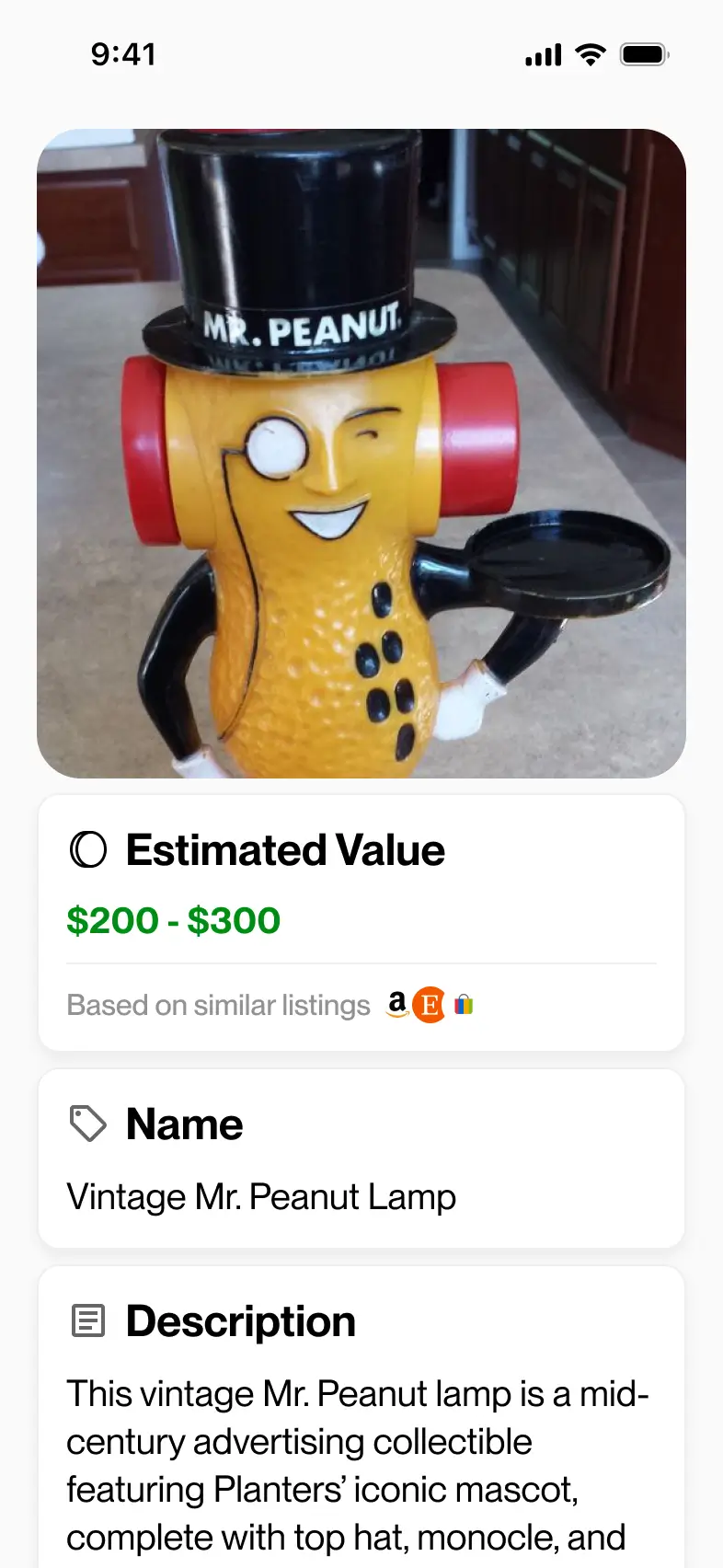
With the Relic app, you can simply point your iPhone camera at the item or the signature. Relic uses advanced AI to analyze the object, providing a real appraisal, history, and origin in seconds.
- Identify Makers: Instantly distinguish between a common McCoy planter and a rare Teco piece.
- Decipher Signatures: Relic can recognize artist signatures on oil paintings that would take a human hours to track down.
- Historical Context: Knowing that a piece of pottery was produced during a specific "short run" in the 1920s can be the difference between offering $20 or $200.
Instant Appraisals for High Stakes Finds
The challenge of the estate sale floor is the "Is it worth it?" calculation. If a painting is priced at $150, is there enough room for profit? Or is it already priced at retail?
Using Relic allows you to bypass the guesswork. By getting an instant appraisal based on current market data, you can make an informed decision in the time it takes to snap a photo. This speed allows you to cover more ground. While other buyers are squinting at their screens trying to describe a "blue vase with flowers" to a search engine, you’ve already appraised the item, verified its origin, and moved on to the next room.
The Relic Strategy: Use the app to verify the "Curated Art" mentioned in the listing. If the ad promised original oils, use Relic to confirm they aren't high-quality prints or "decor paintings" mass-produced for furniture stores.
Sourcing Value in Tools and Industrial Equipment
While many hunters flock to the dining room for silver or the bedroom for vintage clothes, the real money is often hiding in the garage or the basement workshop. These areas are frequently overlooked by casual shoppers who find them "dirty" or "intimidating." However, industrial items and specialized tools often have the highest profit margins and the fastest resale turnover.
Navigating the Tool Shop and Reloading Sale
If you see a listing mentioning "D. Burns Tool Shop" or "Heavy Machinery," prioritize it. Professional-grade tools hold their value remarkably well. Unlike furniture, which is subject to the whims of interior design trends, a high-quality lathe or a vintage Bridgeport mill is always in demand.
- Precision Instruments: Look for brands like Starrett or Mitutoyo. These calipers, micrometers, and gauges are essential for machinists and can fetch hundreds of dollars even if they are decades old.
- Reloading Equipment: This is a massive "hidden" market. Items like Dillon Precision presses, RCBS dies, and high-end scales are recession-proof. Shooters are always looking for quality reloading gear, and these items are heavy, durable, and easy to ship.
- Power Tools: Focus on "old iron." Vintage Delta or Powermatic saws from the 1950s are often built better than anything you can buy at a big-box store today. Woodworkers will pay a premium for these well-maintained machines.
The Man Cave Madness Strategy
The "Man Cave" or "Den" is another high-value zone. These areas often contain items that were the "toys" of the previous owner—items they spent significant disposable income on.
- Optics: Look for binoculars, spotting scopes, or rangefinders. Brands like Leica, Zeiss, and Swarovski are the gold standard. Even older models maintain significant value because the glass quality is timeless.
- Targets and Accessories: While you can't buy firearms at most estate sales, you can find everything else. Look for high-end gun cases, cleaning kits, and vintage targets.
- Industrial Decor: Items like old metal lockers, factory stools, and workbench lamps are highly sought after by interior designers for the "industrial chic" look.
The key to the garage is looking for "specialization." If you see a tool you don't recognize, it’s likely a specialized instrument for a specific trade. These are almost always more valuable than a standard hammer or screwdriver.
The Virtual Estate Sale Revolution

The industry is currently undergoing a massive shift. While the traditional "walk-through" sale is still common, more companies are moving toward online-only liquidations. This allows them to reach a global audience and avoids the wear and tear of hundreds of people walking through a private home.
Shipping Logistics for Remote Treasures
Shopping from home opens up a world of possibilities. You can bid on a sale in Maine while sitting in your living room in California. However, the biggest hurdle is shipping. Many online estate auctions are "local pickup only," which keeps prices low because the buyer pool is limited.
If you find a high-value item—like a Faberge egg or a vintage Louis Vuitton trunk—in a remote sale, you must investigate the shipping policy before bidding.
- In-House Shipping: Some companies will pack and ship items for a fee. This is the most convenient but can be expensive.
- Third-Party Shippers: You may need to coordinate with a local UPS Store or a specialized art handler to pick up your item.
- "As-Is" Clauses: Online sales are almost always final. You are bidding based on photos and descriptions. This is where your research skills become vital.
Transitioning from Local Sales to Online Liquidations
The transition to online shopping doesn't mean you lose your edge. In fact, it can enhance it. When you are looking at an online listing, you have the advantage of time—but so does everyone else.
You can use the Relic app even when you aren't physically at the sale. If you are browsing an online auction and see an interesting antique, you can upload a screenshot of the listing photo directly into Relic. The AI will process the image just as it would if you were standing in front of the item.
| Feature | In-Person Sale | Online Liquidation |
|---|---|---|
| Competition | Limited to people in the room. | Global or regional bidders. |
| Inspection | Physical "hands-on" check. | Photo-based only. |
| Speed | Must decide in seconds. | Bidding wars can last days. |
| Verification | Use Relic for instant ID. | Use Relic for screenshot analysis. |
By using Relic to verify authenticity and value before you place a bid, you reduce the risk of buying a reproduction. You can check the "origin" and "history" provided by the app against the auctioneer's description. If the auctioneer calls it "vintage" but Relic identifies it as a modern reproduction, you’ve just saved yourself a very expensive mistake.
Conclusion
The world of estate sales is no longer just about who wakes up the earliest. It is about who has the best system for finding, identifying, and valuing items in a rapidly changing market. By automating your search through digital aggregators, you ensure that the best leads are always in your inbox. By learning the vocabulary of "Time Capsules" and "Curated Inventories," you can spend your time where the value is highest.
Most importantly, by integrating professional tools like the Relic app into your workflow, you level the playing field. You no longer need to be an expert in every category—from 18th-century porcelain to 20th-century industrial tools. You just need the ability to capture an image and let the AI do the heavy lifting.
Your next step is simple:
- Register on the major estate sale aggregator sites and set up your local alerts.
- Download Relic on your iPhone to prepare for your next outing.
- Review the listings for this coming weekend and look for the keywords we discussed.
The gold mine is out there, hidden in the garages and living rooms of your own community. With the right strategy and the right technology in your pocket, you are ready to claim your share. Happy hunting.
Identify antiques instantly
Point your camera at any antique, collectible, or vintage item. Get valuations, history, and market insights in seconds.
Download for iPhone