Your Garage Sale Find Could Be a Masterpiece: The Art of Reading Antique Metal Marks

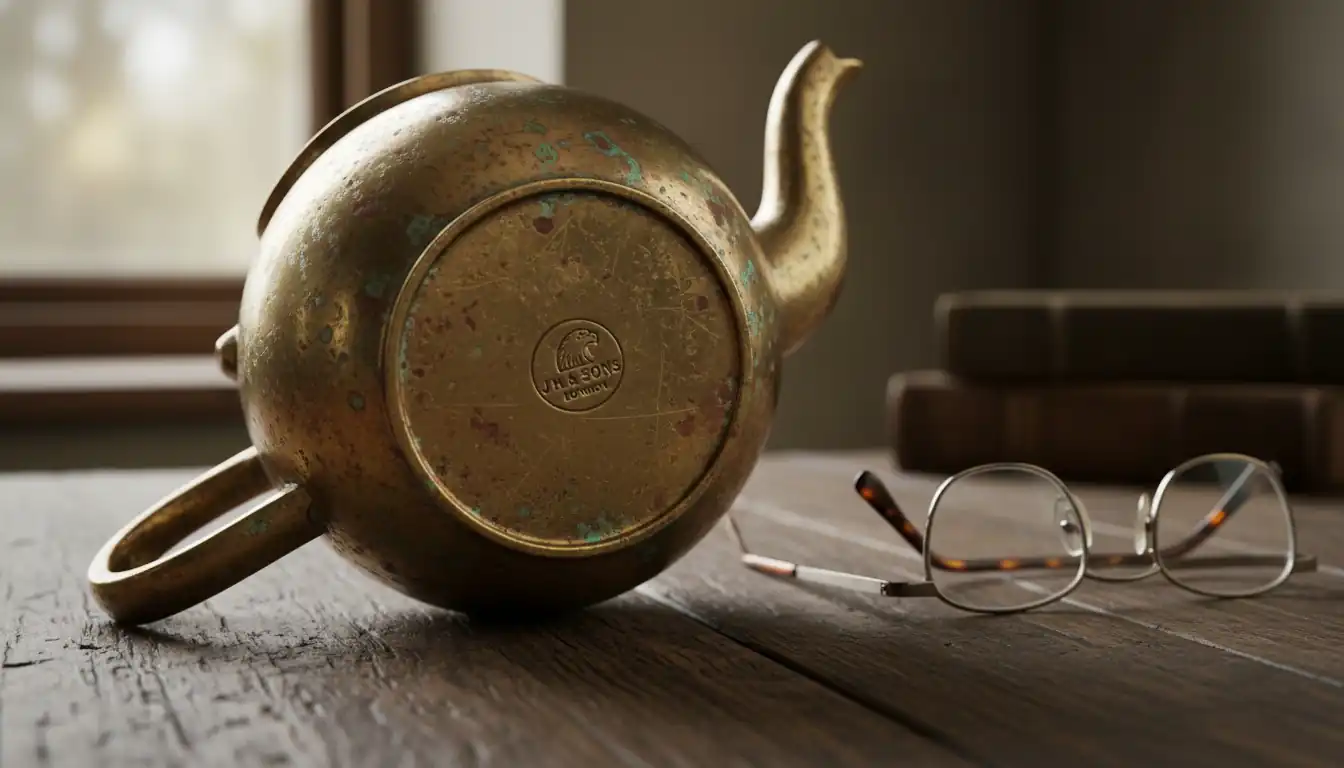
You stand in the corner of a crowded estate sale, your eyes landing on a heavy, tarnished pitcher tucked behind a stack of old magazines. It has a dull, mustard-colored glow and a weight that surprises you when you lift it. Is it a mass-produced piece of 1970s home decor, or a mid-19th-century bronze masterpiece worth thousands? Most people would put it back, intimidated by the thick layer of grime and the cryptic symbols stamped into the base.
Identifying antique metalwork is often viewed as a dark art, reserved for those with decades of experience and a library of leather-bound reference books. You might feel like you are guessing, but the metal itself is constantly speaking to you. Every scratch, every variation in color, and every tiny indentation is a data point. By learning to read these physical cues, you can transform a casual weekend hobby into a disciplined hunt for historical treasures.
This guide will walk you through the forensic process of identifying antique metals. You will learn how to use your senses to evaluate material quality, how to decode the "secret" language of maker’s marks, and how to use simple household items to perform chemical tests. By the time you finish, you will have the framework needed to spot a diamond in the rough and the tools to verify its history with professional precision.
Decoding the Physical DNA of Antique Metals
Before you ever look for a name or a date stamped into a piece of metal, you must look at the material itself. The physical "DNA" of an object—its weight, its surface texture, and the way it has aged—tells a story that a forged mark cannot easily replicate. This first-pass evaluation is your most important defense against modern reproductions.
Patina and Surface Oxidation
True patina is not just dirt; it is a chemical transformation that happens over decades or centuries. When you look at an antique brass or bronze object, the "skin" of the metal should have depth. On a high-quality antique, patina develops in layers. You might see deep browns in the recessed areas, transitioning to a lighter, honey-colored glow on the "high points" where hands have touched the object over the generations.
Chemically aged finishes, common on modern "vintage-style" items, often look flat and uniform. If the dark coating looks like it was sprayed on or if it wipes away easily with a damp cloth, you are likely looking at a modern piece. Authentic oxidation is hard-won. On copper, look for the "verdigris"—that distinct powdery green crust. While modern fakers can mimic this with acid, real verdigris is usually uneven and firmly attached to the metal, often appearing in crannies where moisture naturally collected over fifty years.
Weight and Casting Imperfections
Pick the item up. Does the weight match your visual expectation? Solid brass and bronze are significantly heavier than the zinc or white metal alloys often used in cheap reproductions. If a large, ornate candlestick feels surprisingly light, it is likely a hollow casting or made of a "pot metal" that has been brass-plated.
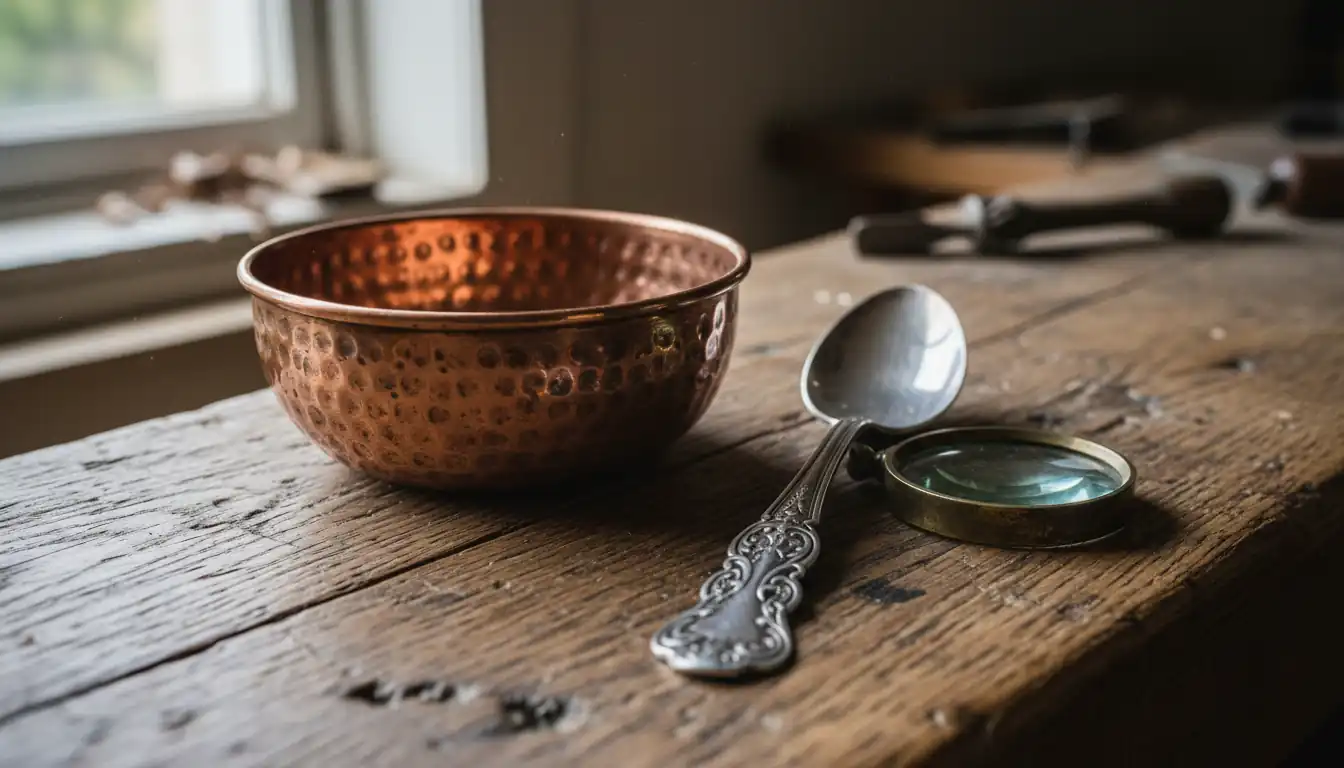
You should also run your fingers along the underside or the interior of the piece. Antique metalwork was often created using sand casting. This process involves pouring molten metal into a mold made of compressed sand. As a result, the "unseen" surfaces of an antique—like the inside of a vase or the bottom of a statuette—will often have a slightly gritty, orange-peel texture. Modern mass-produced items are typically die-cast in steel molds, resulting in surfaces that are unnaturally smooth and uniform everywhere. If you feel those tiny, sandy irregularities, you are likely holding a piece with significant age.
Reading the Hidden Language of Maker Marks
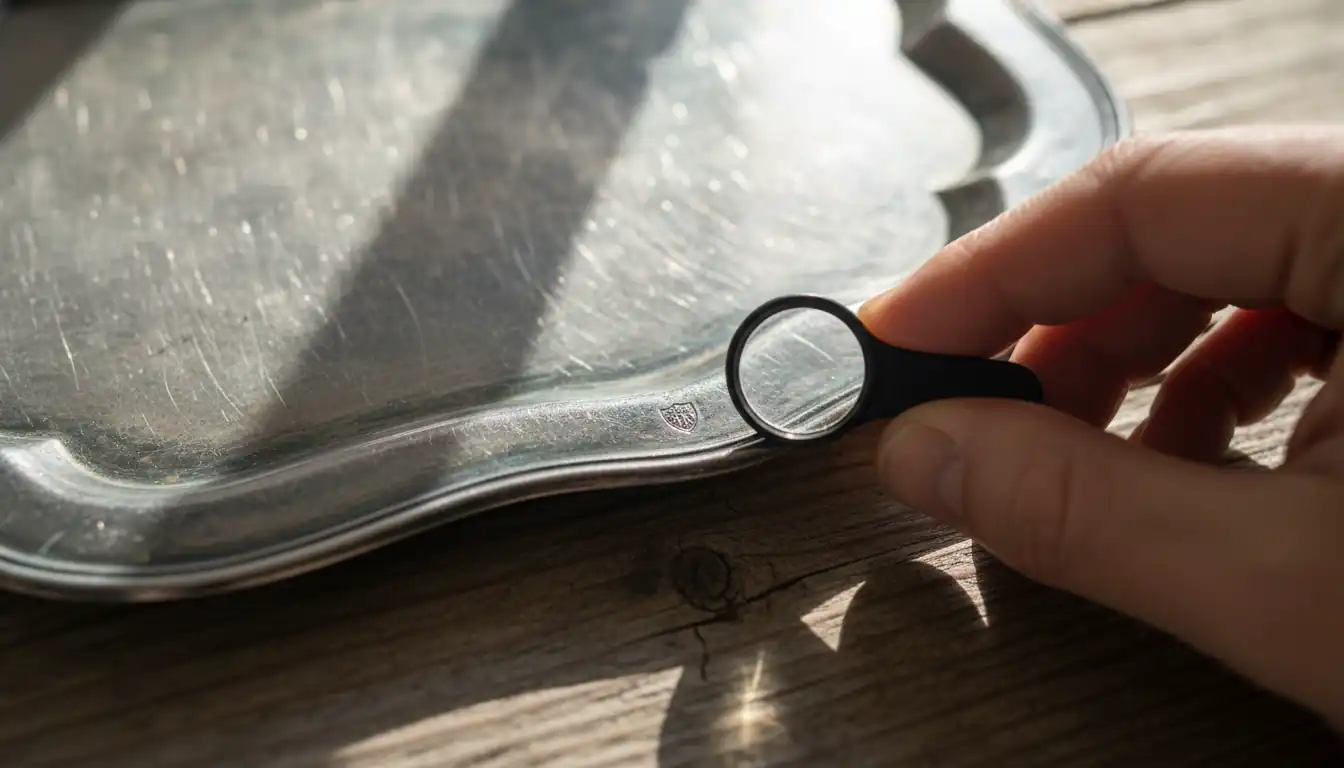
Once you have established that the material has the "heft" and "skin" of a true antique, it is time to look for the signature. In the world of metalwork, these are known as hallmarks, maker's marks, or registry marks. They are the primary way a craftsman or a company "signed" their work, and they act as a coded map of the item's origin.
Deciphering Regional Hallmarks
How to identify hallmarks on brass? The process begins by locating the stamp, which is usually found on the base, the rim, or a hidden flange. British pieces are among the most documented. From 1842 to 1883, the British used a "diamond" registry mark. This kite-shaped symbol contains letters and numbers in its corners that tell you the exact day, month, and year the design was registered. If you see a diamond mark, you can be certain the design originated in the mid-to-late Victorian era.
American marks tend to be more straightforward, often featuring the full name of the manufacturer (such as "Bradley & Hubbard" or "Virginia Metalcrafters") or a specific logo. Continental European marks, particularly those from Germany or France, can be more cryptic. You might find a small crown, an animal silhouette, or a set of initials inside a shield. These symbols often represent the city of guild origin. For example, a pinecone mark is frequently associated with Augsburg, Germany, a major center for metalwork for centuries.
Identifying Spurious and Fake Stamps
The presence of a mark does not always guarantee authenticity. As the market for antiques grew, so did the market for "spurious" marks. These are fake stamps applied to modern or lower-quality items to deceive buyers. To spot a fake, look at the "strike" of the mark.
An authentic mark was usually stamped into the metal when it was relatively new. Over time, the edges of that stamp should soften as the metal oxidizes and wears down. If you see a mark that looks incredibly sharp and crisp, but the rest of the object is heavily pitted and worn, be suspicious. This is a sign that someone may have stamped a "famous" name into a generic old piece recently. Furthermore, look for "ghosting"—a faint double-image caused by a stamp slipping. While this happened occasionally in the past, a perfectly centered, laser-straight mark on a supposedly 18th-century piece is often a red flag for modern machine-stamping.
Distinguishing Alloys Through Chemical and Magnetic Tests

Sometimes, visual inspection isn't enough to tell two similar-looking metals apart. Brass and bronze, for instance, can look nearly identical when covered in a dark patina. However, their value and historical context can be vastly different. This is where you move from observation to active testing.
The Vinegar Test for Bronze vs Brass
If you find yourself wondering how to tell bronze from brass with vinegar, you are looking for a specific chemical reaction. Bronze is an alloy of copper and tin, while brass is an alloy of copper and zinc. Because bronze generally has a higher copper content, it reacts differently to mild acids.
To perform this test, find an inconspicuous spot—perhaps the bottom of a foot or the inside of a rim. Apply a small drop of white vinegar to the surface and wait for about five minutes. After you wipe it away, look at the color of the "bright" metal underneath.
- Brass: Usually reveals a bright, yellow, or gold-like tone.
- Bronze: Typically shows a deeper, reddish-pink or salmon hue due to the higher copper concentration.
This subtle color shift is one of the most reliable ways to distinguish the two without using professional metallurgical equipment.
Magnetic Responses in Plated vs Solid Metals
One of the most common disappointments for a new collector is discovering that their "solid brass" find is actually brass-plated steel. The easiest way to avoid this is to carry a small, strong magnet—ideally a neodymium (rare-earth) magnet.
Solid brass, bronze, copper, and pewter are non-ferrous, meaning they contain no iron. A magnet will not stick to them. If you place your magnet against a "brass" lamp and it snaps firmly into place, you are holding a piece of steel or iron that has been electroplated with a thin layer of brass. While some high-quality Victorian pieces used iron weights in their bases for stability, the decorative body of the piece should always be non-magnetic if it is advertised as solid precious metal.
| Metal Type | Magnetic? | Vinegar Reaction Color |
|---|---|---|
| Solid Brass | No | Bright Yellow |
| Solid Bronze | No | Reddish-Pink |
| Plated Steel | Yes | N/A (Magnet sticks) |
| Solid Copper | No | Bright Orange/Pink |
Instant Appraisal in Your Pocket
The manual methods of identification—checking the weight, squinting at tiny hallmarks, and carrying magnets—are the foundation of a good collector’s skillset. However, there comes a point where the sheer volume of marks and manufacturers becomes overwhelming. You might find a mark that doesn't appear in any of your books, or a piece of hardware that defies your initial categorization.
This is where the Relic app becomes an essential part of your kit. Rather than spending hours scrolling through grainy forum photos or carrying a suitcase full of price guides, you can use the camera on your iPhone to get an immediate answer. Relic uses advanced AI to analyze the specific geometry of an object and the unique patterns of its maker's marks.
Leveraging AI for Visual Pattern Recognition
When you take a photo of a metal mark with Relic, the AI doesn't just look for a name; it recognizes the "visual fingerprint" of the manufacturer. It can distinguish between a genuine 19th-century Tiffany & Co. stamp and a common 20th-century imitation by analyzing the font spacing and the depth of the strike. This level of detail provides a real appraisal and historical context in seconds, which is invaluable when you are standing in a dusty barn or a fast-paced auction house.
Moving Beyond Manual Catalogs
The traditional way of identifying antiques involves a lot of "maybe." You think it might be French; you think it might be from the 1880s. Relic replaces that uncertainty with a searchable catalog of scanned items and market insights. For professionals like dealers or pickers, this one-touch scanning is a massive time-saver. Instead of doing research after you get home, you can know the market value of an item before you even negotiate the price. With a 4.9-star rating from over 20,000 reviews, it has become a trusted tool for those who need professional-grade accuracy without the professional-grade price tag.
"The true value of an antique isn't just what someone will pay for it, but the verified history you can prove it possesses."
Tracing the Evolution of Metalworking Techniques
To truly master the art of reading metal, you have to understand the "why" behind the object's construction. The way an item was made is often a more honest indicator of age than any mark. The 19th century was a period of massive technological transition, and those changes are etched into the hardware we find today.
Industrial Revolution Impact on Hardware
One of the most overlooked clues in dating metalwork is the humble screw. Before the mid-19th century, screws were made by hand. The threads were uneven, and the heads were often slightly off-center. If you find a piece of brass furniture hardware held together with perfectly uniform, pointed screws, it was likely made after 1850.
Furthermore, the type of screw head is a dead giveaway. The Phillips head screw (the one that looks like a cross) wasn't patented until the 1930s. If you see a Phillips head screw on a "17th-century" Spanish chest, and the screw hole doesn't look like a later repair, the piece is almost certainly a modern reproduction. Authentic early pieces will almost exclusively use flat-head screws, and even then, the slots will often be slightly irregular.
The Shift from Sand Casting to Die Casting
As mentioned earlier, the texture of the metal tells you about the technology available at the time of its birth. In the 1700s and early 1800s, sand casting was the standard. This required a new mold for every few pourings, leading to slight variations between "identical" pieces. If you have a pair of early 19th-century candlesticks, they should not be 100% identical. There should be tiny differences in the casting flaws or the way the base is finished.
By the late 1800s, die casting and machine spinning became more common. This allowed for much thinner walls of metal and a level of precision that hand-casting couldn't match. If a brass bowl is perfectly thin, perfectly symmetrical, and has no visible tool marks on the interior, it is likely a product of the industrial age. While these pieces can still be valuable, they lack the "soul" and the hand-worked character of earlier sand-cast items.
Conclusion
Identifying antique metal marks is a journey that begins with your fingertips and ends with historical verification. By training your eyes to see the depth of a true patina and using a magnet to weed out plated imitations, you are already ahead of 90% of casual shoppers. You have learned that a hallmark is a signature that must be read in context, and that a simple drop of vinegar can reveal the hidden copper heart of a bronze statue.
The next time you are at a garage sale or an estate auction, don't just look at the price tag. Pick the item up. Feel its weight. Look for the sandy texture of an old mold and the irregular slot of a hand-cut screw. And when you find that mysterious mark that seems to hold a secret, use the Relic app to bridge the gap between your intuition and a professional appraisal.
The world of antiques is full of hidden masterpieces waiting to be recognized. Now that you know how to read the language of metal, you are ready to find them. Download Relic today and see what stories your treasures have been waiting to tell.
Identify antiques instantly
Point your camera at any antique, collectible, or vintage item. Get valuations, history, and market insights in seconds.
Download for iPhone