Your Kitchen Cabinets Might Hold a Fortune: The Secret Language of Pottery Marks

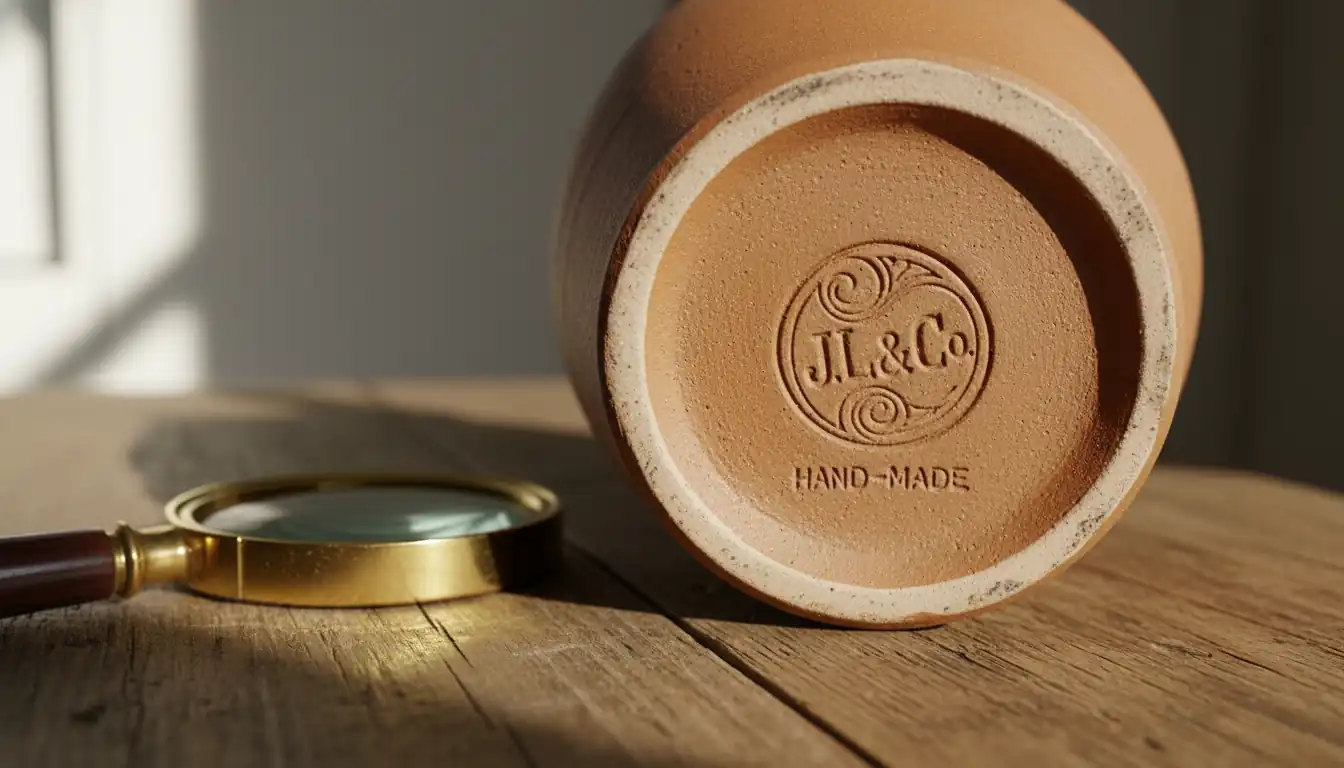
That dusty bowl sitting on your top shelf might be more than a vessel for old keys or potpourri. For the untrained eye, it is just ceramic; for the collector, it is a historical document written in the language of clay, glaze, and fire. Every year, priceless pieces of porcelain and stoneware are sold for pennies at garage sales because the owners couldn't read the tiny symbols stamped on the bottom.
These marks, known as backstamps or maker’s marks, are the fingerprints of the ceramic world. They tell you who made the piece, where it was born, and often, exactly when it left the kiln. Learning to decode these symbols transforms a casual hobby into a high-stakes treasure hunt, turning every thrift store visit into a potential windfall.
You are about to learn how to see what others miss. From the prestigious kilns of 18th-century Europe to the gritty studio potteries of the American Midwest, this guide will teach you the visual shorthand of the masters. By the time you finish reading, you will know how to distinguish a masterpiece from a mass-produced replica using nothing but your eyes, your hands, and a few modern tools.
Decoding the Visual Language of Famous Makers
The journey into pottery identification begins with the "Big Three" of European ceramics. These manufacturers didn't just make dishes; they defined the aesthetic of empires. Their marks have evolved over centuries, and understanding these shifts is the first step in determining if you are holding a fortune.
European Giants and Their Signature Stamps
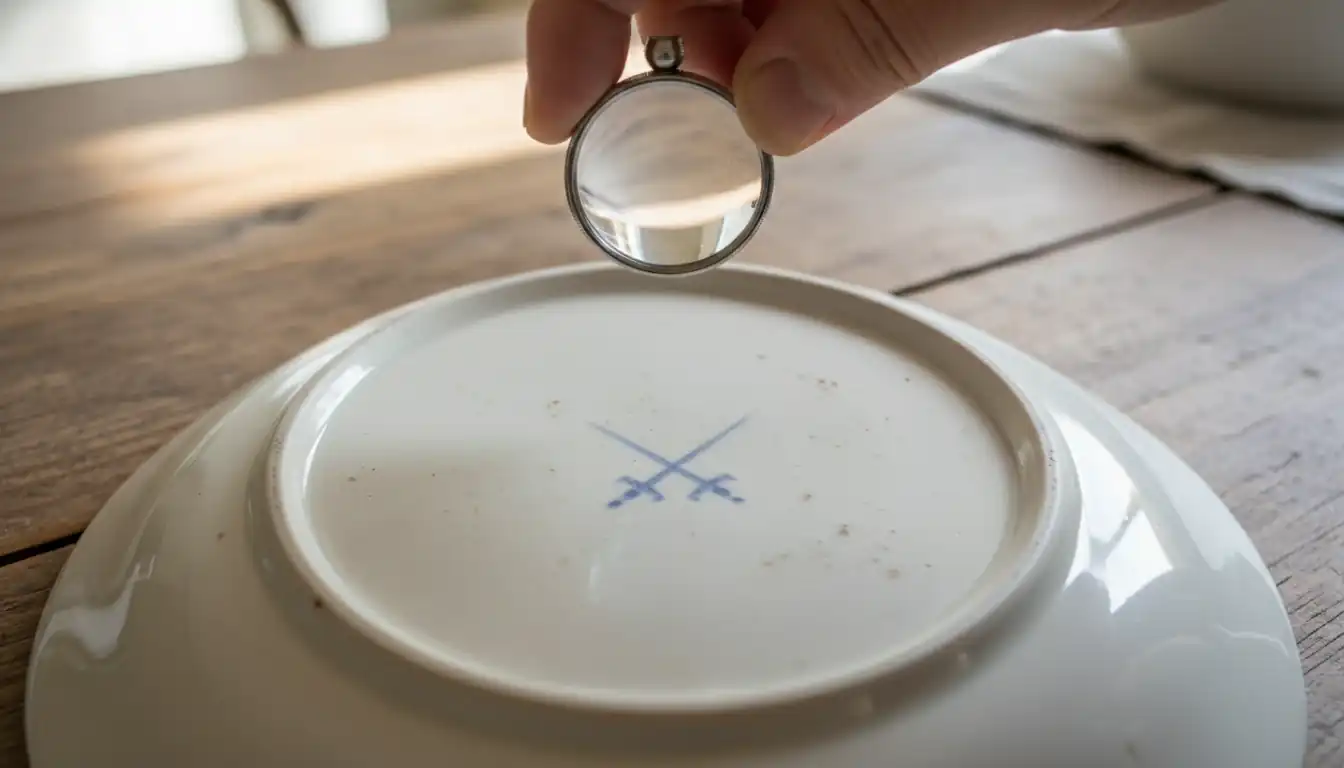
Meissen is often considered the gold standard of European porcelain. Established in 1710, it was the first factory in Europe to produce "true" hard-paste porcelain. Their signature mark—the crossed swords—is perhaps the most famous symbol in the ceramic world.
Think of the Meissen swords as a living timeline. In the early 1720s, the swords were often spindly and somewhat erratic. By the mid-18th century, they became more fluid and elegant. If you find a mark where the hilts of the swords are joined or if there is a small dot between the blades (the "Academic" period), you are looking at a piece from the late 1700s. The presence of curved blades usually indicates a 19th-century origin.
Wedgwood, the pride of British pottery, took a different approach. Unlike the pictorial swords of Meissen, Wedgwood relied heavily on typography. The earliest pieces were simply impressed with the name "Wedgwood" in all capital letters.
| Period | Mark Characteristics |
|---|---|
| 1759–1769 | "Wedgwood" in irregular, hand-stamped block letters. |
| 1769–1780 | "Wedgwood & Bentley" (partnership era, highly valuable). |
| 1780–1860 | "Wedgwood" in clean, sans-serif impressed type. |
| 1891–Present | "Wedgwood, England" (Post-McKinley Tariff Act). |
A common trap for new collectors is the "Wedgewood" spelling. If you see a "e" in the middle of the name, it is almost certainly a lower-quality imitation. Josiah Wedgwood was meticulous about his branding, and a spelling error was never permitted to leave his factory.
Delft Blue, or Delfts Blauw, offers a different challenge. While many associate it with windmills, the most authentic pieces from De Porceleyne Fles (the only remaining original factory from the 17th century) use a very specific mark. Look for a stylized jar, followed by the initials 'JT' and the word 'Delft.' If the mark looks like a simple, modern stamp of a windmill without these accompanying details, it is likely a souvenir piece rather than a collector's item.
American Art Pottery Icons
Across the Atlantic, American potteries developed a distinct visual language that mirrored the Arts and Crafts movement. Roseville Pottery is the most prominent name here, and its marking system is a masterclass in evolution.
Early Roseville pieces often lacked a permanent mark, instead relying on paper labels that have long since peeled away. As the company grew, they transitioned to "RV" marks and eventually to the familiar raised "Roseville" script seen on the bottom of floral vases from the 1930s and 40s. If you find a piece with a large, impressed "U.S.A." alongside the name, you’ve found a mid-century production piece.
The Paul Revere Pottery, famous for its "Saturday Evening Girls" (SEG) line, used stamps that feel much more personal. These marks often include a small circular stamp featuring a rider on a horse, or simply the hand-painted initials of the artist. Because these were produced in a communal, craft-focused environment, the marks are often slightly uneven, reflecting the human hand behind the work.
The Mystery of the Unmarked Masterpiece
What happens when you flip a beautiful vase over and find... nothing? This is a common point of frustration for many collectors. You might find yourself asking: how to identify unmarked pottery? The answer lies in the physical DNA of the piece itself. When the "signature" is missing, the body of the clay must speak for itself.
Physical Indicators Beyond the Stamp
The first thing you should examine is the "foot ring"—the unglazed circle on the bottom where the piece rested in the kiln. This area is a window into the soul of the pottery. A perfectly smooth, mechanically rounded foot ring usually suggests modern, mass production. Conversely, a foot ring that shows slight irregularities, or "kiln scars" (small bits of grit or tripod marks), points toward an older, hand-finished process.
Next, consider the weight and density. Porcelain is translucent and surprisingly light for its strength. If you hold a piece up to a bright light and can see the shadow of your fingers through the ceramic, it is likely fine porcelain or bone china. Stoneware, on the other hand, is heavy, opaque, and rugged.
You can also perform the "ping" test. Gently tap the rim of the piece with your fingernail or a wooden pencil.
- High-fired porcelain will produce a clear, sustained ring, almost like a crystal bell.
- Earthenware or low-fired pottery will produce a dull "thud."
- A cracked piece, even if the crack is invisible to the eye, will sound flat and discordant.
A piece of pottery is like a bell; its resonance tells you the quality of its internal structure.
Regional Styles and Clay Composition
The color of the raw clay on the foot ring acts as a geographic fingerprint. Potteries historically used whatever earth was available nearby.
- Ohio Potteries: Famous names like Rookwood and Weller often used local Ohio River Valley clay, which fires to a distinct buff or light yellow color.
- Redware: Common in early American colonial pottery, this uses iron-rich clay that remains a deep brick-red after firing.
- English Creamware: Developed by Wedgwood, this has a distinct off-white, yellowish tint that distinguishes it from the stark white of continental porcelain.
By looking at the texture of the clay—is it grainy like sand or smooth like butter?—you can narrow down the origin even without a stamp. For example, many early Japanese pieces use a very fine, white "kaolin" clay that feels almost soft to the touch, whereas German salt-glazed stoneware has a "pockmarked" texture similar to an orange peel.
Spotting Forgeries and Replicas
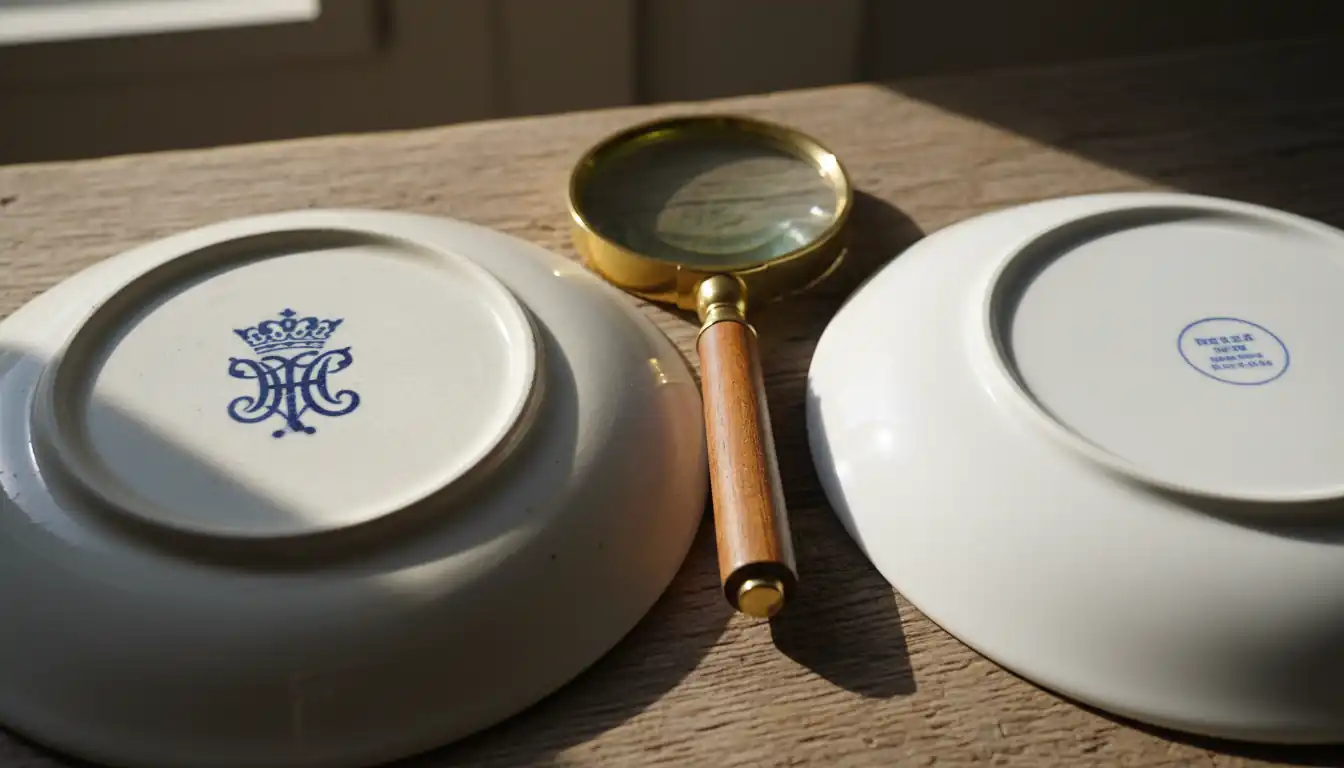
As long as there has been valuable pottery, there have been people trying to fake it. The market is currently flooded with "reproduction" Meissen and "tribute" Chinese porcelain. To protect your investment, you must learn to look past the mark and evaluate how that mark was applied.
Red Flags in Porcelain Marks
One of the most common techniques forgers use is the "cold stamp." This is a mark applied to a piece after it has already been fired and glazed. Because the mark isn't fused into the ceramic under high heat, it often looks "sitting on top" of the surface. If you run your finger over a mark and it feels raised or scratchy, or if you can see the edges of a decal, be wary. Authentic marks from major houses were almost always applied "underglaze" or "inglaze," meaning they are part of the glassy surface itself.
In Chinese porcelain, pay close attention to the calligraphy. Genuine reign marks were written by master scribes who spent years perfecting their brushwork. Fakes often feature "clunky" characters with inconsistent line weights. If the characters look shaky or if the spacing feels cramped, it’s a red flag.
The Evolution of Backstamps Over Time
History provides us with a built-in "cheat code" for dating pottery: international trade laws. The McKinley Tariff Act of 1890 required all goods imported into the United States to be marked with their country of origin.
- Pre-1891: Usually no country name, just the maker's mark.
- 1891–1914: Marks will include the country name (e.g., "France," "Germany," "Japan").
- Post-1914: The phrase "Made in" was added (e.g., "Made in Japan").
If you find a piece of "Nippon" pottery, you know it was made between 1891 and 1921. After 1921, the U.S. required the name "Japan" to be used instead of the traditional "Nippon." These small linguistic shifts are the most reliable way to debunk a seller's claim that a piece is "18th century" when the stamp clearly says "Made in England."
Modern Tools for Instant Appraisal
Even the most seasoned collectors can't memorize the tens of thousands of marks that exist. In the past, you had to carry heavy reference books or spend hours scrolling through grainy forum photos. You might wonder: is there a pottery marks database online? While several websites catalog these marks, they are often difficult to search if you don't already know what you're looking for.
Leveraging AI with the Relic App
This is where technology has finally caught up with the art world. Instead of guessing, you can now use the Relic app to get an instant appraisal and history of your find. Relic uses advanced AI to analyze more than just the mark; it looks at the glaze, the form, and the artistic style to provide a real-world valuation.
Imagine you are at an estate sale and see a strange, green-glazed vase with a faint, blurry stamp. While others are fumbling with Google, you can simply take a photo with Relic. The app's AI-driven analysis identifies the nuances that the human eye might miss—like the specific "crazing" pattern in the glaze or the exact shade of "Oxblood" red that indicates a specific maker.
With over 20,000 reviews and a 4.9-star rating, Relic acts as a digital expert in your pocket. It doesn't just tell you what the mark is; it gives you the historical context and current market insights you need to decide if you should buy it or leave it on the shelf. This is particularly helpful for those "unmarked" pieces we discussed earlier, where the AI can compare the physical silhouette of your item against a massive database of known shapes.
Navigating Digital Archives and Databases
While apps like Relic provide immediate answers, some collectors still enjoy the "detective work" of manual databases. Sites like the Marks Project (for American studio pottery) or the Gotheborg site (for Chinese and Japanese ceramics) are excellent secondary resources.
However, the limitation of these databases is that they require you to describe what you see. If you misinterpret a symbol—mistaking a stylized leaf for a crown—you will end up in the wrong section of the archive. Digital tools that use visual recognition remove this human error, ensuring your appraisal is based on visual facts rather than subjective interpretation.
Global Markets and High Value Rarities
If you want to find the "holy grail" of pottery, you have to look toward the global market. Currently, two areas are seeing explosive growth at auction: Imperial Chinese porcelain and Mid-Century Modern (MCM) studio pottery.
Deciphering Chinese Reign Marks
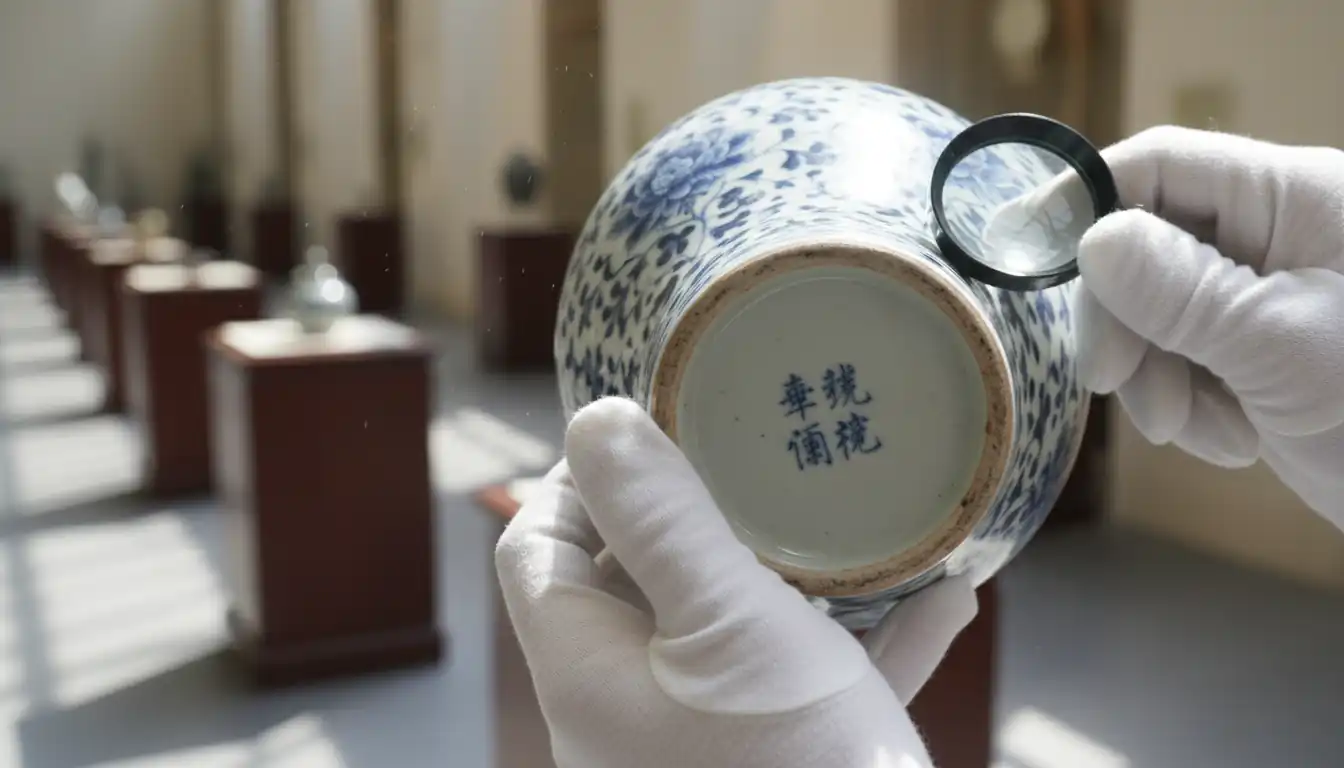
Chinese porcelain is a field where a single bowl can sell for $30 million. The key is the nien hao, or reign mark. These are typically six-character marks written in vertical columns, read from top to bottom and right to left.
How to read a 6-character Kaishu mark:
- Top two characters: Identify the dynasty (e.g., "Ta Ming" for Great Ming).
- Middle two characters: Identify the specific Emperor (e.g., "Chenghua").
- Bottom two characters: Usually mean "made for" or "made in the reign of."
The "Big Four" dynasties to watch for are the Ming, the Kangxi, the Yongzheng, and the Qianlong. However, be aware that later Chinese potters often added "apocryphal" marks—putting a Ming mark on a 19th-century vase out of respect for the past. This isn't always a "fake" in the modern sense, but it significantly changes the value. A genuine Chenghua mark is a museum piece; a 19th-century "tribute" mark is a decorative item worth a few hundred dollars.
The Rise of Mid Century Modern Studio Pottery
On the opposite end of the spectrum is the minimalist world of studio pottery. From the 1950s through the 1970s, artists like Lucie Rie, Hans Coper, and Peter Voulkos moved away from factory stamps. Their marks are often "incised" (scratched) into the wet clay.
- Lucie Rie: Look for a tiny, impressed "LR" monogram, often hidden near the base.
- Shoji Hamada: Often left his work entirely unmarked, relying on his "finger-painted" glaze style as his signature.
- California Faience: Often used a simple block-letter stamp that looks almost industrial.
The value in MCM pottery isn't in the prestige of a factory, but in the "soul" of the artist. These pieces are currently commanding high prices because they fit perfectly into modern interior design. A small, hand-thrown bowl with the right set of initials can easily outperform a massive, ornate Victorian urn at a modern auction.
Conclusion
The world of pottery is a vast, silent library. Every mark, every clay body, and every glaze drip is a word in a story that spans centuries. By learning to decode the visual language of makers like Meissen and Wedgwood, and by understanding the physical indicators of unmarked pieces, you have moved from a spectator to a participant in this history.
Remember that identification is a multi-step process:
- Inspect the mark for authenticity and age.
- Feel the body for weight, texture, and resonance.
- Check the history using trade laws like the McKinley Tariff Act.
- Verify your findings with modern AI tools like the Relic app to ensure your appraisal is accurate.
The next time you walk through an antique mall or clear out a relative’s attic, don't just look at the colors and shapes. Flip the piece over. Look for the swords, the initials, or the subtle texture of the foot ring. Your kitchen cabinets—or that dusty box in the garage—might just be holding the fortune you’ve been looking for. Happy hunting.
Identify antiques instantly
Point your camera at any antique, collectible, or vintage item. Get valuations, history, and market insights in seconds.
Download for iPhone