Stop Overlooking Hidden Gems: The Secret Language of Antique Glass Marks

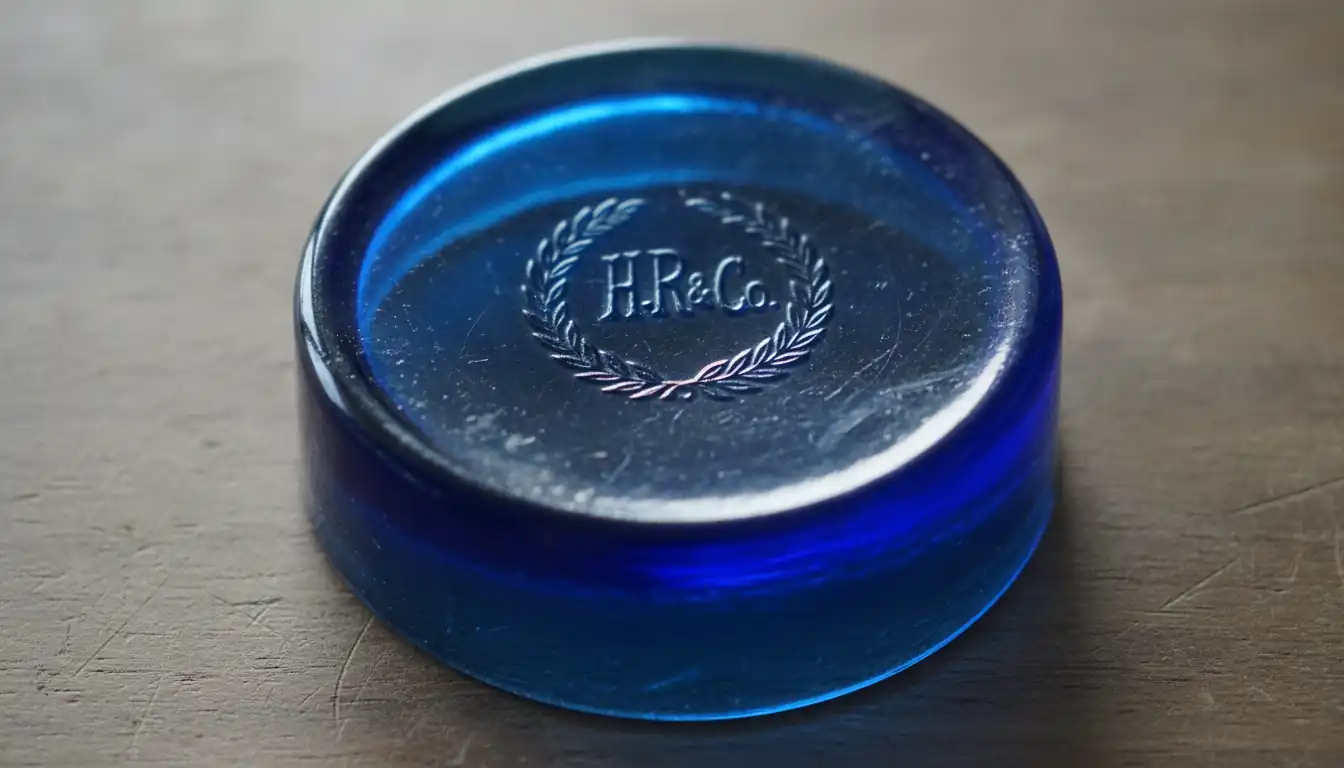
You are standing in the corner of a crowded estate sale, the air thick with the scent of old paper and floor wax. Your eyes land on a heavy, amber-colored glass bowl tucked away on a bottom shelf. It feels substantial in your hand, the light catching a series of intricate geometric cuts that seem too precise for a modern reproduction. You flip it over, squinting at the base, but all you see is a faint, cloudy smudge. Is it a scratch, a bit of residue, or the signature of a master craftsman?
This moment is the threshold between a casual hobbyist and a serious collector. The ability to find and interpret the "secret language" of antique glass marks is what separates those who find bargains from those who find treasures. Most people walk past five-figure masterpieces every day because they don't know where to look or what tools to use to reveal the history hidden in the silica.
In this guide, you will learn the exact techniques used by professional appraisers to locate elusive signatures. We will explore the evolution of glassmaking through the lens of its branding, from the hand-blown era to the industrial boom. You will also discover how to distinguish between prestigious European imports and domestic American classics, and how modern technology is changing the way we authenticate these fragile pieces of history.
The Physical Hunt for Hidden Signatures
Finding a mark on antique glass is rarely as simple as reading a label on a jar of jam. Makers often hid their signatures to avoid distracting from the aesthetic beauty of the piece. For a beginner, the frustration of "missing" a mark is common, but once you train your eyes and your tools, the glass begins to speak.
Mastering Lighting and Magnification Techniques
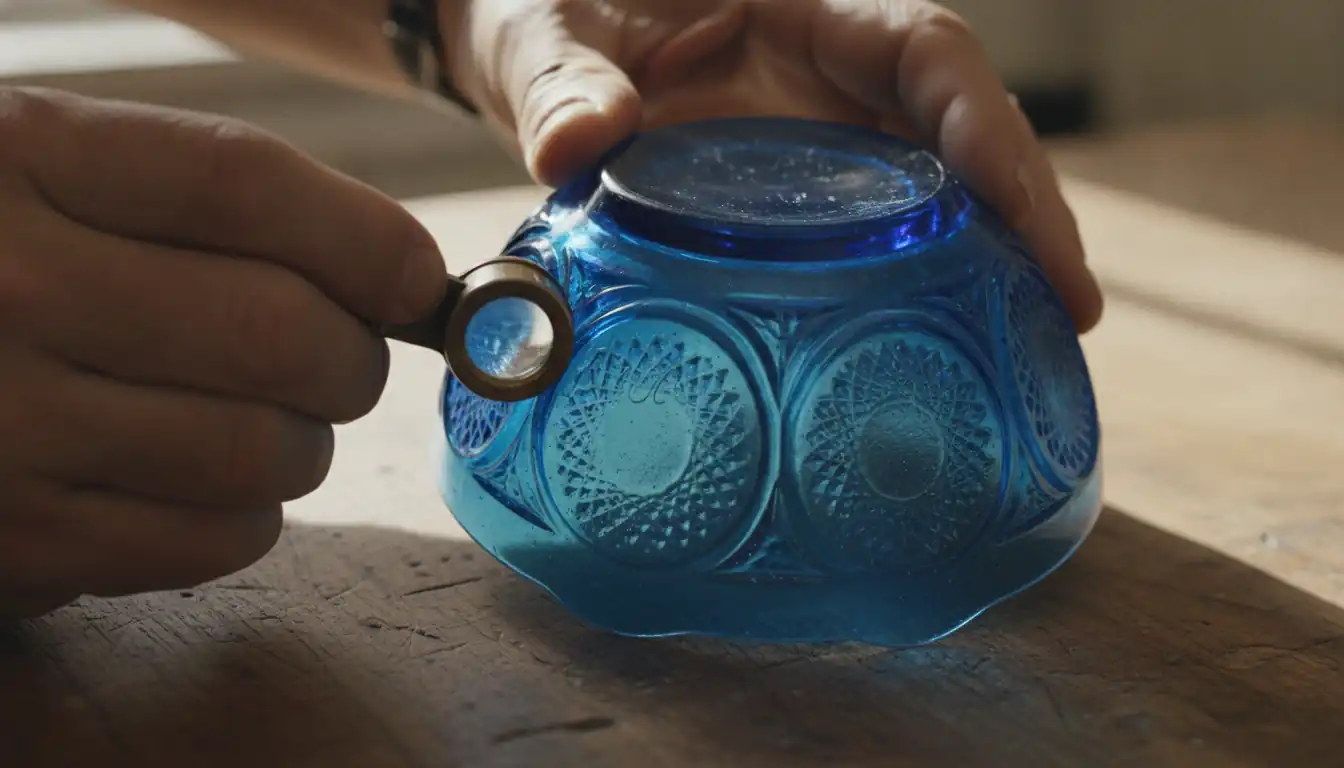
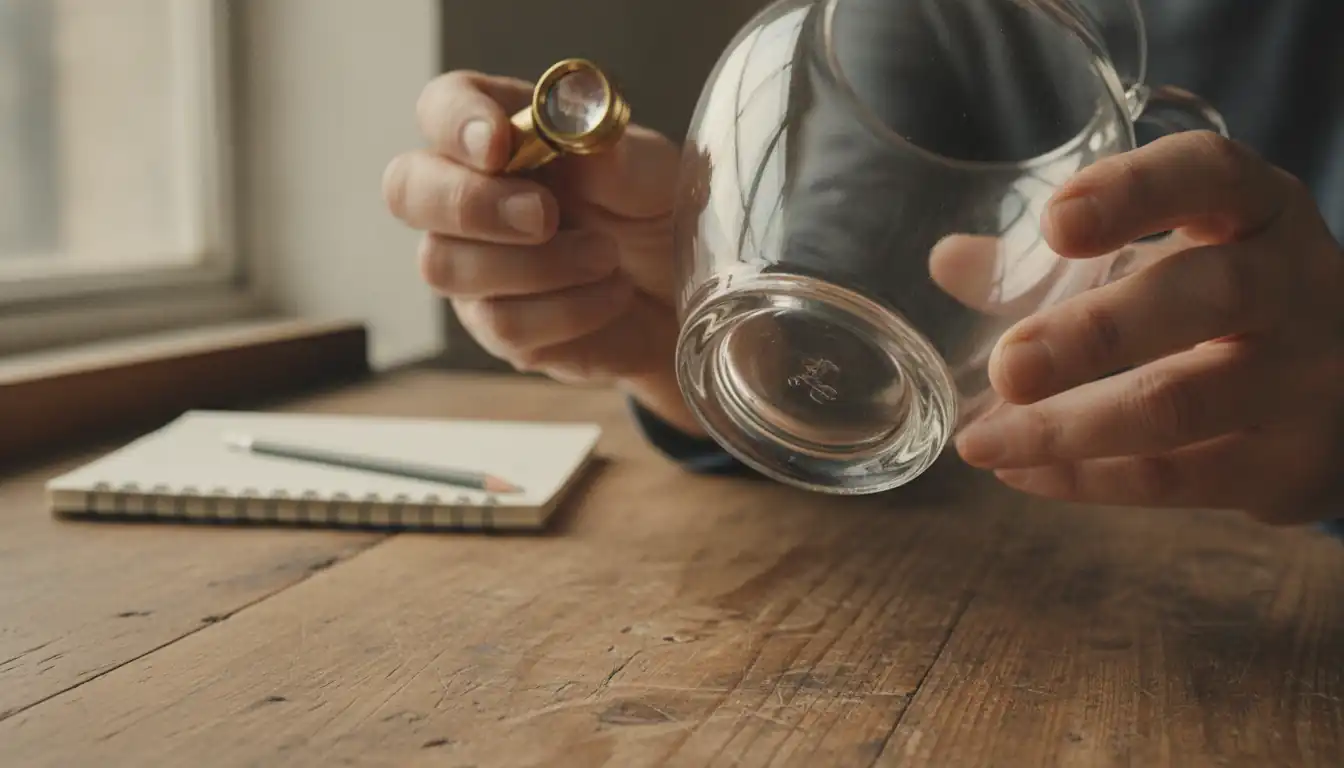
The most common mistake collectors make is relying on overhead room lighting. Standard light bulbs create too much glare on reflective surfaces, effectively "blinding" you to faint etchings. To see what others miss, you must master the use of raking light. This involves holding a single, concentrated light source—like a high-lumen LED flashlight—at an acute angle to the surface of the glass. The light "rakes" across the surface, casting tiny shadows into the indentations of an acid-etched mark or a sandblasted signature.
Beyond lighting, your toolkit should include two essential items:
- A Jeweler’s Loupe: A 10x magnification loupe is the industry standard. It allows you to see the "stipple" pattern in a mark, which can help determine if it was etched with acid or modern laser technology.
- A Long-Wave UV Light (Blacklight): While not a magnifying tool, a blacklight reveals the chemical composition of the glass. For example, many early 20th-century pieces contain manganese or uranium, which glow under UV light. Finding a specific "glow" can confirm that a mark is era-appropriate for the glass's recipe.
Common Locations for Elusive Maker Marks
Where should you start your search? Glassmakers followed certain conventions, but they were also creative. You have to check the "usual suspects" first before moving to more obscure locations.
- The Center of the Pontil Scar: On hand-blown glass, the base often has a "pontil scar" where the glass was broken off the blowpipe. Makers like Steuben or Tiffany often signed their names or initials right across this scar or immediately circling it.
- The Outer Rim of the Base: Many companies, such as Heisey or Fenton, placed their logos on the very edge of the bottom rim. These marks are often worn down by decades of being slid across dining tables, making them feel more like a texture than a visible logo.
- Hidden Within the Pattern: This is the most difficult to find. In pressed glass or "Depression Glass," the maker might integrate their logo into the molded design. You might find a tiny "H" or "N" tucked inside the petal of a flower or the scrollwork of a handle.
Pro Tip: If you suspect a mark is present but can't see it, lightly run your fingernail over the area. Your sense of touch is often more sensitive to the slight "catch" of an etched signature than your eyes are to the visual mark itself.
Decoding the Era Through Glassmaking Evolution
A mark is more than just a name; it is a timestamp. As glassmaking moved from a cottage industry to a mass-production powerhouse, the way marks were applied changed. Understanding this evolution allows you to date a piece even if the mark is partially obscured.
The American Brilliant Period and Intricate Etchings
From roughly 1876 to 1917, the "American Brilliant Period" (ABP) represented the pinnacle of cut glass artistry. During this time, marks were almost always acid-etched. These marks are incredibly faint—often referred to as "ghost marks." Because the glass was so deeply cut and polished, a heavy stamped logo would have been considered unsightly.
| Era | Common Marking Method | Typical Appearance |
|---|---|---|
| Pre-1850 | No Mark / Rough Pontil | Focus on manufacturing "scars" rather than logos. |
| 1880-1915 | Acid Etching | Faint, frosted appearance; often requires a loupe. |
| 1920-1950 | Molded Logos | Raised or recessed letters integrated into the glass mold. |
| 1950-Present | Paper Labels / Laser | Often lost over time; modern marks are very precise. |
During the ABP, companies like Libbey or Hawkes used very specific symbols. Libbey, for instance, used a sword under the name "Libbey" in their early marks. If you find a piece of heavy, leaded crystal with a faint sword etched in the center of the bowl, you are looking at a piece of industrial history from the turn of the century.
Depression Glass Logos and Mass Production Shifts
As the world moved into the 1920s and 30s, the labor-intensive process of hand-cutting glass gave way to "pressed" glass. This was the era of Depression Glass, where companies like Fenton, Heisey, and Northwood produced colorful, affordable glassware for the masses.
Because these pieces were made using metal molds, the marks were often "molded in." This means the logo is a raised part of the glass itself.
- Heisey: Look for the famous "H" inside a diamond. This mark was used from the late 1890s until the factory closed in 1957. If the "H" is crisp and the diamond is sharp, it’s a strong indicator of an authentic piece.
- Fenton: Fenton is famous for their "oval" logo. However, it is important to remember that Fenton didn't start putting a molded mark on their glass until 1970. If you find a piece of Fenton "Crest" glass without a mark, it’s likely an earlier, more desirable piece from the 1940s or 50s.
- Northwood: Their signature "N" inside a circle (or sometimes underlined) is a hallmark of Carnival Glass. The presence of this mark can triple the value of a piece compared to an unmarked contemporary.
Regional Signatures and International Prestige
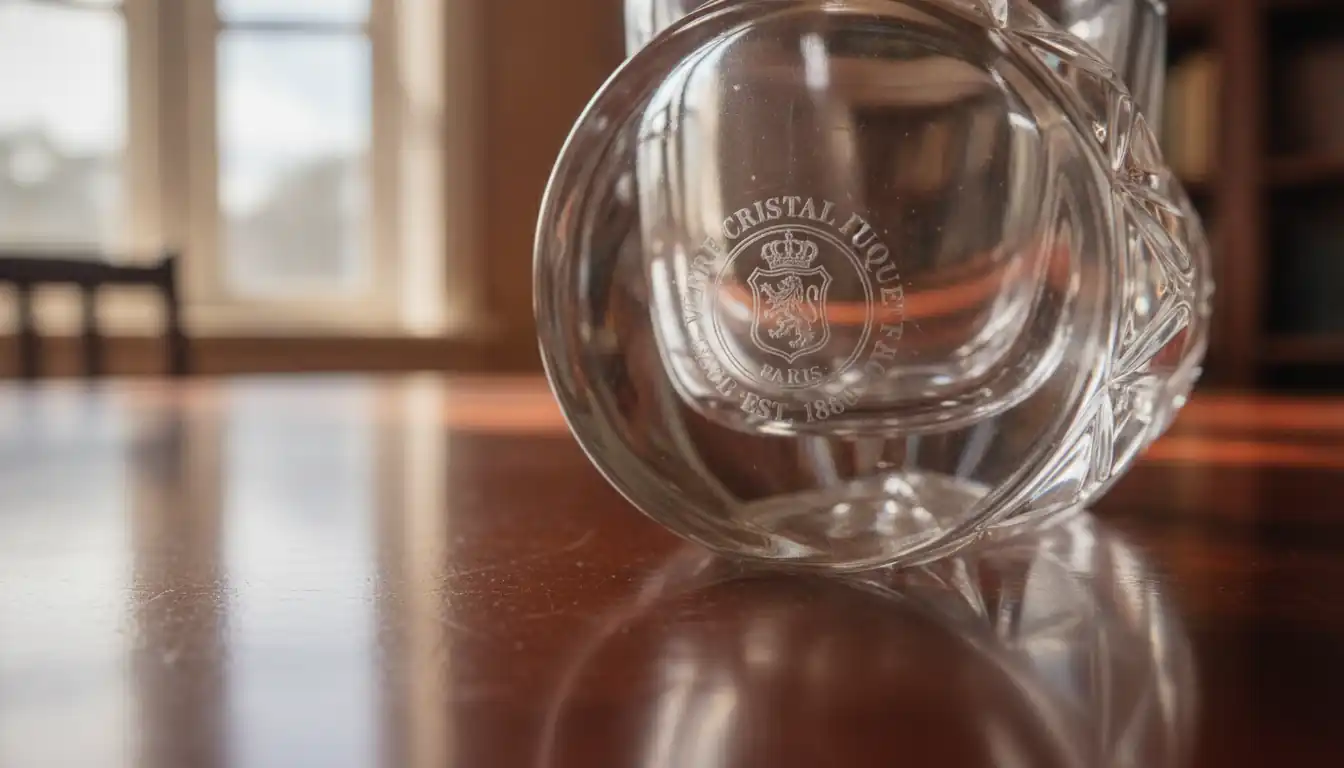
When you find a mark, your next task is to determine its "nationality." The world of antique glass is divided into distinct regions, each with its own prestige and marking conventions. Identifying the region of origin is often the fastest way to estimate the base value of a find.
The Artistry of Murano and European Glass Houses
European glass, particularly from Italy and France, often carries a higher market premium due to the centuries-old traditions of the glass houses.
Murano Glass (Italy): Murano is perhaps the most famous, yet the most difficult to identify by marks alone. Historically, Murano artists used paper or foil labels rather than permanent etchings. Because these labels often washed off or were peeled away, "unmarked" Murano is common. However, higher-end pieces from the mid-20th century might have a "Vetri Murano" signature etched with a diamond point pen.
Baccarat (France): Baccarat is the gold standard of French crystal. Since 1860, they have used a circular acid-etched mark containing a carafe, a wine glass, and a goblet. If you see this mark, you are holding a piece of museum-quality crystal. The precision of the etching is so high that it should look like it was printed on the glass, not scratched.
Waterford (Ireland): Waterford marks are notoriously difficult to find. They typically use a Gothic-style script of the word "Waterford." On older pieces, this is often found on the "foot" of the stemware, tucked right into the edge of the base.
Identifying Early American Glass Factories
Domestic American glass from the 19th century has a more utilitarian history. Companies like the Boston & Sandwich Glass Company (often just called "Sandwich Glass") rarely marked their pieces. Instead, collectors look for the "lacy" patterns and the specific weight of the lead glass.
However, the McKinley Tariff Act of 1890 changed the game for collectors. This law required all imported goods to be marked with their country of origin.
- If a piece is marked "Germany" or "France," it was likely made between 1891 and 1914.
- If it says "Made in Germany" or "Made in France," it likely dates after 1914.
This simple "Made in" stamp is a geographic and chronological anchor that helps you narrow down exactly which factory produced the item. American companies didn't need these stamps for domestic sale, so the absence of a "Made in" mark on a piece that looks mass-produced often suggests it was a domestic product from a company like Hazel-Atlas or Anchor Hocking.
The Digital Revolution in Glass Identification
For decades, the only way to identify a mysterious mark was to lug a stack of heavy reference books to every estate sale and antique mall. You would spend hours flipping through grainy black-and-white photos, hoping to find a match for the "H" or the "Crown" you just found on a vase. By the time you found the answer, the item was often sold to someone else.
The "old way" of collecting was a game of memory and luck. But today, the speed of the market requires a more efficient approach. When you're in the field, you have seconds to decide if a $50 investment is a $500 windfall or a $5 mistake.
Why Traditional Catalogs Fall Short for Modern Collectors
Traditional catalogs are static. They can't account for the subtle variations in a hand-stamped mark or the way a signature might look on a curved surface versus a flat one. Furthermore, they don't provide real-time market values. Knowing a mark belongs to "Tiffin Glass" is helpful, but knowing that Tiffin's "Twilight" color is currently trending upward in price is what makes you a successful collector.
Instant Appraisal with Relic's AI Recognition
This is where modern technology bridges the gap. The Relic app is designed specifically for these high-pressure moments in the field. Instead of searching through indexes, you simply take a photo of the glass piece or the mark itself.
Relic uses advanced AI to analyze the shape, color, pattern, and signature of the item. Within seconds, the app provides:
- Origin and History: It identifies the maker and the era, even if the mark is partially worn.
- Real Appraisal: It pulls from current market data to give you an accurate valuation.
- Historical Context: You get the story behind the piece, which is essential if you plan to resell it.
Imagine finding a piece of "signed" glass that looks like Tiffany but has a slightly different script. Instead of guessing, you can use Relic to compare the signature against thousands of authenticated examples. With a 4.9-star rating from over 20,000 reviews, the app has become a staple for professional pickers and online sellers who need to make fast, accurate decisions. It turns your phone into a professional appraiser that fits in your pocket.
Verifying Authenticity and Market Value
Even after you’ve found a mark and identified the maker, your work isn't done. The world of antique glass is rife with "fantasy marks" and clever reproductions. A mark is a piece of evidence, but it isn't the whole trial. You must look at the piece as a whole to ensure the mark actually belongs there.
Spotting Fantasy Marks and Modern Reproductions
A "fantasy mark" is a signature put on a piece of glass that the original company never actually produced. For example, you might find a piece of iridescent glass with a "Northwood" N mark, but the color and shape are something Northwood never made.
- The "N" Mark: Authentic Northwood marks are usually small and somewhat faint. Many fakes have a very large, bold "N" in a circle that looks too "perfect."
- L.C.T. (Tiffany) Signatures: Louis Comfort Tiffany pieces are among the most faked in the world. Authentic signatures were usually engraved by hand and look like elegant cursive. Many fakes use acid-etching to create a "stenciled" L.C.T. look, which is a dead giveaway of a modern reproduction.
- The "Feel" of the Etching: Run your finger over an acid-etched mark. An authentic vintage mark will feel smooth, almost like it’s part of the glass. Modern laser-etched fakes often feel "scratchy" or sharp to the touch because the laser disrupts the glass surface differently than acid does.
How Condition and Rarity Influence Final Worth
A prestigious mark can be rendered worthless by poor condition. Conversely, a common mark can be worth a fortune if the color or pattern is rare.
"Sick Glass" (Cloudiness): This is a chemical reaction where the alkalis in the glass leach out, creating a permanent cloudy white film. No amount of scrubbing will fix "sick glass." Even a signed Steuben vase loses 80-90% of its value if it is "sick."
Color Rarity: In companies like Fenton or Viking, the color is often more important than the mark. For example, a common Fenton "Hobnail" vase in white milk glass might be worth $20. The exact same vase in "Plum Opal" could be worth $500.
Key Insight: Always prioritize the "Three Cs": Color, Condition, and Clarity. A marked piece with a large chip is almost always less valuable than an unmarked piece in mint condition.
| Factor | Impact on Value | What to Look For |
|---|---|---|
| Chips/Flakes | High Decrease | Check the "rim" and the "base" where the glass touches the table. |
| Rarity of Color | High Increase | Research which colors were only produced for a single year. |
| Clarity | Moderate Decrease | Avoid "cloudy" glass that doesn't clear up with a simple wash. |
| Mark Clarity | Moderate Increase | A crisp, legible mark is always more desirable than a "ghost" mark. |
Conclusion
The world of antique glass is a vast, shimmering puzzle. By learning the secret language of marks, you’ve gained the ability to see through the dust and grime of the thrift store shelf to the artistry beneath. You now know how to use raking light to reveal hidden signatures, how to date a piece by its manufacturing style, and how to distinguish a Murano masterpiece from a mass-produced American bowl.
Remember that identification is a skill that improves with every piece you handle. Don't be afraid to flip things over, use your loupe, and question the authenticity of what you see. The hunt is half the fun, and the more you practice, the more "lucky" you will become.
If you want to speed up your learning curve and ensure you never leave a treasure behind, consider using a tool like the Relic app. Having an AI-powered appraiser in your pocket allows you to verify your instincts in real-time, giving you the confidence to make those split-second buys that define a great collection.
Your next great find is out there, hidden in plain sight. Now that you know how to read the glass, it’s time to go find it. Happy hunting!
Identify antiques instantly
Point your camera at any antique, collectible, or vintage item. Get valuations, history, and market insights in seconds.
Download for iPhone