How do you read pottery marks on the bottom of a piece?

By Ellen Whitlock ·
Read the base in order: the maker's name or symbol, then any country word, then any date code. Words narrow the age: 'Ltd' means after 1861, 'England' after 1891, and 'Nippon' before 1921. The mark tells you who made it; value depends on which maker, the decoration and the condition.
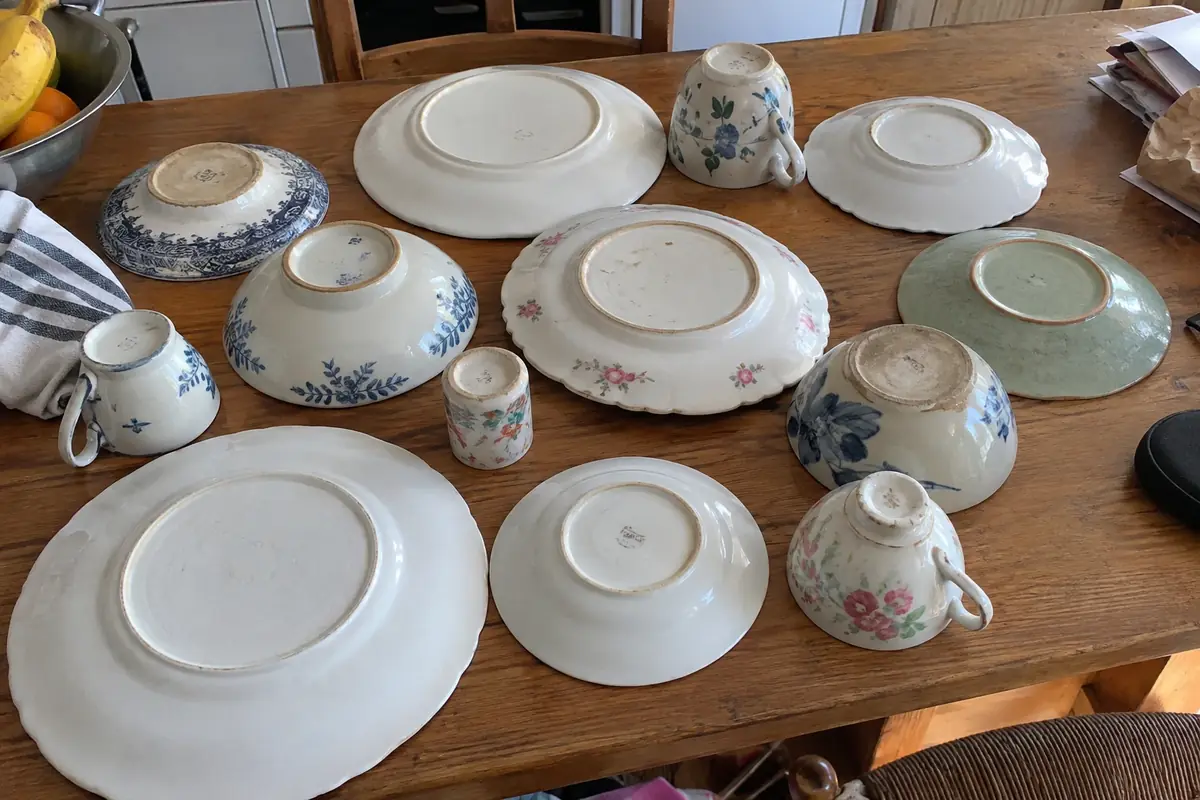
How to read the mark on the bottom of your piece
Each clue on the base narrows the one before it, so read it top to bottom. Find the closest match in the table, then confirm it with the steps.
| Mark | Years |
|---|---|
| Meissen · plain crossed swordsBlue swords with steeply curved blades, no extra marks | 1815–1924 |
| Meissen · dot between the hiltsOne dot between the hilts; points to an early piece | 1763–1774 |
| Meissen · Marcolini starA little star directly beneath the swords | 1774–1815 |
| Meissen · Pfeiffer dotInward-curving swords, no pommels, a dot between the tips | 1924–1934 |
| British · Royal ArmsRoyal Coat of Arms with a small central shield | 1806–1837 |
| British · registration diamondA diamond-shaped registry mark that dates the design, not your piece | 1843–1883 |
| Wedgwood · three-letter codeMonth, potter and year letters; the cycles repeat, so TOT is June 1865 or 1891 | 1860–1928 |
| Wedgwood · two-digit yearThe last two digits of the year, so 30 means 1930 | 1929 on |
| Wedgwood & Co. · TunstallA different firm from Josiah Wedgwood | 1860–1965 |
| 'Ltd' or 'Limited'Common only from the 1890s, so an early one is unusual | 1861 on |
| 'Rd No.' numberA registered-design number | 1884 on |
| Rookwood · RP with flamesReversed R and P, with one flame added each year | 1886–1900 |
| Rookwood · RP, 14 flames, numeralA Roman numeral beneath gives the year, so XXVI is 1926 | 1901 on |
| 'Nippon' · Japanese exportExport backstamp, used before the change to 'Japan' | 1891–1921 |
| 'England' in the markRare before this date, and some makers never added it | 1891 on |
| 'Made in England'Generally this late, though Minton used it about 1902 | 1914 on |
| Lenox · green wreathGreen wreath with no 'Made in U.S.A.' beneath it | 1906–1931 |
| Lenox · wreath, 'Made in U.S.A.''Made in U.S.A.' added beneath the wreath | 1931–1953 |
| Lenox · 'Lenox - Made in U.S.A.''by Lenox' dropped; made entirely in Trenton, New Jersey | 1953 on |
| Noritake · M in wreathGreen M in a wreath, for Morimura, with 'Made in Japan' | 1921–1941 |
| Homer Laughlin · year digit, month letterOne year digit plus a month letter; L is East Liverpool, N is Newell | 1922–1929 |
| Homer Laughlin · two-digit yearTwo year digits plus a month letter | 1932–1968 |
| Homer Laughlin · four-digit yearThe plain year, with no month or plant letter | 1969–1980 |
| McCoy · 'NM' initialsIncised Nelson McCoy initials; the first McCoy marks came around 1927 | 1930–1940 |
| McCoy · name'McCoy' in incised, then embossed, lettering | 1940–1967 |
| 'Occupied Japan' · Japanese exportsFixes the date closely, which few marks do | 1947–1952 |
Words like 'Ltd' and 'England' give an earliest date, not the year your piece was made.
Read the base of your pottery in order
- Note how it was made. Impressed, incised, painted or printed. That tells you whether it is a factory backstamp or a potter's own hand.
- Read the name or symbol. Look it up in a marks database such as Kovels.
- Look for a country word or company suffix. On Noritake export porcelain, 'Nippon' comes before 'Japan'. 'Ltd' and 'Limited' narrow the age, and 'Royal' points to the mid-19th century or later. A stamp that says Occupied Japan has its own guide: Occupied Japan mark guide.
- Decode any date code. Wedgwood, Rookwood and Homer Laughlin each encode the year, and the table shows how. According to thepotteries.org, a registration mark gives the date the design was registered, not the day your piece was made.
- Check metal parts separately. Stamps on a silver rim, lid or mount follow a different system; see silver marks and hallmarks.
What makes a marked piece worth more
The mark says who made it, not the price; for two common makers, see McCoy pottery prices and the value of a Hummel.
- The maker
- The maker's name is the biggest lever. Revere Auctions says most standard Rookwood brings $150 to $600 at auction, yet a plain 1940s vase and an early vase by a leading decorator can differ by a hundred times in price.
- Age of the mark
- Earlier versions of a maker's mark usually attract more collector interest than later ones, so reading the year matters.
- Hand painting
- Two pieces with the same mark can differ widely if one was painted by hand and the other molded with a plain glaze. Hand-painted Rookwood outranks glaze-only production ware, which typically starts around $200 to $500.
- Condition
- Chips, cracks and repairs lower what a buyer will pay. So does drilling a vase for lamp wiring, which costs a Rookwood much of its worth.
- The exact name
- A name that sounds like a famous one can belong to a less valuable firm, so check the exact wording before you look up a price. Wedgwood & Co. of Tunstall ran from 1860 to 1965 and was separate from Josiah Wedgwood.
Real maker's mark or a look-alike?
A famous name or symbol on the base does not always mean the famous maker. Crossed swords are the classic case: other factories used the Meissen mark misleadingly, so the paint and the piece itself have to hold up too. Signs of a look-alike:
- Crossed swords with a dot between the tips. Genuine ones curve inward without pommels, which the Meissen Porcelain Museum gives as the Pfeiffer form.
- A Wedgwood mark with '& CO.', an initial 'J' or the spelling WEDGEWOOD. True Wedgwood never used them.
- A British-style mark on American ware. American makers sometimes copied British marks to suggest quality.
- A pattern name standing in for a maker. The willow pattern was probably created for Spode around 1790 and many factories have made it since, so the base decides; see Blue Willow china.
What if the base has no mark you recognize?
Not every piece was marked, so an older piece can be genuine with a blank base. Studio potters often used their own hand marks, and The Marks Project catalogs American ceramic artists from 1945 to the present. If the base is blank or worn, photograph the whole piece as well, since shape, glaze and decoration are clues when the mark is not.
Common pottery mark questions
How can I tell how old my pottery is from the mark?
Start with the wording on the base, then look for a date code from the maker. Wedgwood, Rookwood and Homer Laughlin all encode the year.
Does 'Made in England' mean my piece is old?
Only somewhat. Wedgwood standardized it in 1908, and Minton used it about 1902.
Does a famous maker's mark mean my piece is valuable?
Not by itself. Who decorated it, how it was decorated and its condition move the price far more than the mark does.
My piece has crossed swords. Is it Meissen?
Maybe, but check. The swords alone don't prove it, since other factories used the mark misleadingly. The blade shape and any dot or star help place genuine Meissen in time.