That Dusty Brass Candlestick Could Be a Masterpiece—Here’s How to Decode Its Hidden Marks

You are standing in a crowded thrift store or a dusty estate sale when a dull, heavy object catches your eye. It is covered in decades of grime, looking more like a discarded piece of industrial scrap than a family heirloom. You pick it up, feeling the surprising weight in your palm, and wonder if you are holding a mass-produced souvenir from the 1970s or a genuine 18th-century masterpiece. This moment of uncertainty is the threshold where every great collection begins.
Identifying antique metalware is a skill that combines the precision of a chemist with the eye of an art historian. Brass, in particular, has been the "gold of the common man" for centuries, used in everything from navigational instruments to fireplace fenders. However, because it has been consistently popular, the market is flooded with reproductions, plated fakes, and later "revival" pieces that can easily fool the untrained eye.
To find the true value hidden beneath the tarnish, you need to look past the surface. You must learn to read the metal itself—its weight, its color, the way it was joined together, and the tiny, often microscopic marks left behind by the person who forged it. By the time you finish this guide, you will have the framework to decode these objects and determine if your find is a piece of history or just a piece of scrap.
Distinguishing Genuine Brass from Copper and Plated Fakes
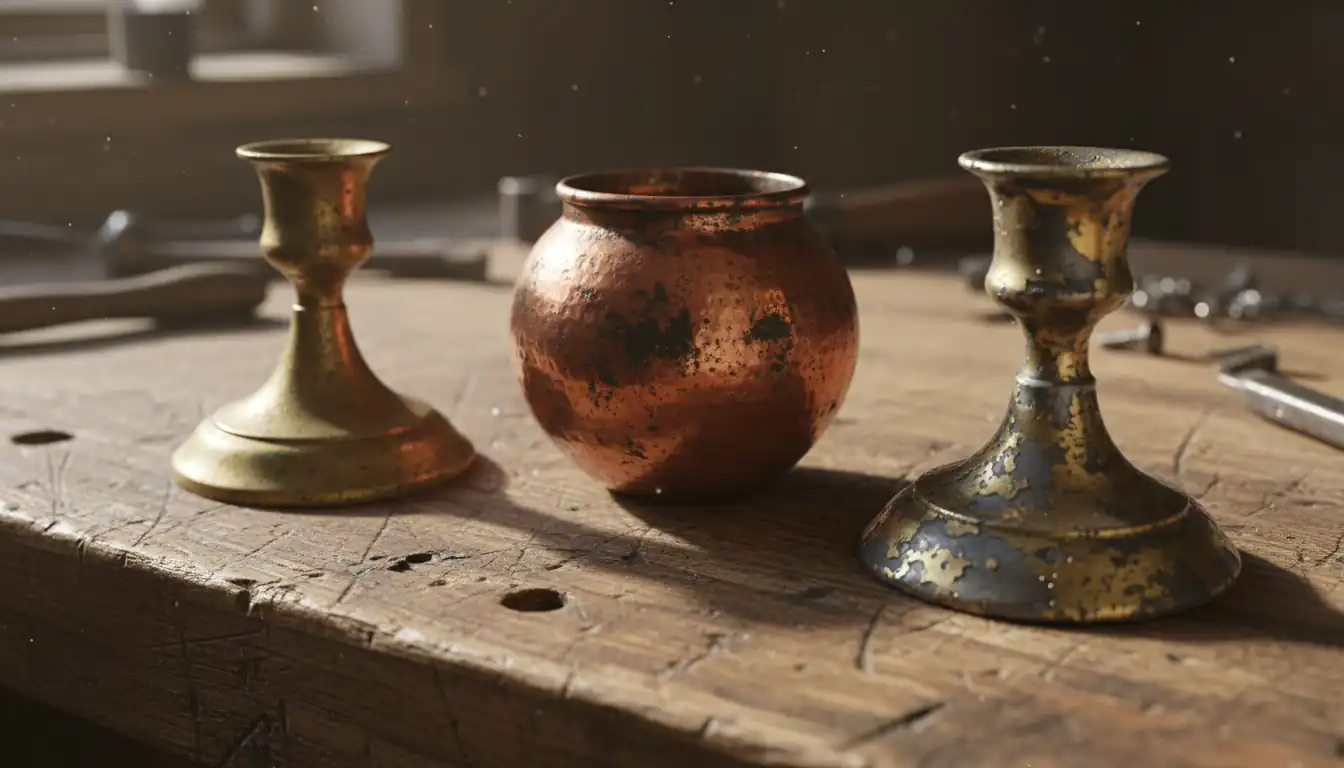
Before you can determine how old an object is, you have to be certain about what it is made of. This is the most common hurdle for new collectors. Many people ask how to tell old brass from copper, and while they are related, they are distinct materials with very different market values and historical uses. Copper is a pure elemental metal, while brass is an alloy—a mixture of copper and zinc.
The first clue is the color. If you can find a spot on the item that hasn't been completely overtaken by oxidation, look at the hue. Copper has a distinct reddish-pink tone, much like a modern penny. Brass, because of the zinc content, leans toward a golden-yellow. Over decades, these colors change as they react with oxygen. Copper tends to develop a deep, chocolate brown patina or, if exposed to moisture, a crusty green "verdigris." Brass, on the other hand, usually turns a dark, mustard yellow or a dull brownish-black that lacks the reddish undertones of copper.
The Scratch and Magnet Tests
If the patina is too thick to see the color, you may need to perform a "scratch test." This should always be done in an inconspicuous area, such as the inside of a hollow base or the underside of a rim. Use a sharp needle or a small file to make a tiny, shallow mark.
- Solid Brass: The scratch will reveal a bright, buttery yellow metal.
- Solid Copper: The scratch will reveal a soft, pinkish-orange metal.
- Plated Metal: If the scratch reveals a silvery or greyish metal underneath a thin yellow surface, you are looking at a plated item, likely brass over white metal or zinc.
The "magnet test" is your most powerful ally when weeding out modern fakes. Solid brass and copper are non-ferrous, meaning they are not magnetic. If you hold a strong magnet to the item and it sticks, the piece is made of steel or iron that has been plated with a thin layer of brass. While some high-quality Victorian pieces used iron weights in their bases for stability, the decorative body of the item should never be magnetic if it is genuine brass.
Color Variations and Patina Depth
The depth of the patina can also tell you a story about the metal's authenticity. On a genuine antique, the oxidation is not uniform. It will be deeper in the crevices and thinner on the "high points" where hands have touched the object over the years. Modern "antiqued" finishes often look too perfect; the darkening agent is applied evenly across the entire surface, which is a red flag.
| Feature | Solid Brass | Solid Copper | Brass-Plated Steel |
|---|---|---|---|
| Base Color | Golden-yellow | Reddish-pink | Grey/Silver (underneath) |
| Magnetism | Non-magnetic | Non-magnetic | Strongly magnetic |
| Patina | Dull mustard to dark brown | Deep brown to green | Often shows rust or pitting |
Pro Tip: If you see "pitting" or small orange rust spots bubbling up through the yellow surface, it is a guaranteed sign of brass-plated steel. Solid brass does not rust; it only tarnishes.
Reading the Scars of History in Metal Construction
Once you have confirmed the material is solid brass, the next step is determining its age. You do this by looking at how the object was physically constructed. Before the Industrial Revolution, metalwork was a labor-intensive process involving hand-tools, sand-casting, and manual assembly. These processes left "scars" or marks that modern machinery simply doesn't produce.
One of the most reliable ways to tell the age of antique brass is to look for seams. If you are looking at a brass pot, a chocolate pot, or a large candlestick, look closely at the body. Pieces made before the mid-19th century often feature "brazed" seams. These are visible lines where two sheets of metal were joined together using a different alloy.
In very old pieces (pre-1850), you might see "dovetail" seams. This looks like a series of interlocking jagged teeth or zig-zags along the side or bottom of the piece. This was a highly skilled way of joining metal before modern welding existed. If your item is perfectly smooth and seamless all the way around, it was likely "spun" on a lathe or stamped by a machine, techniques that became dominant in the late 1800s and 20th century.
Seams and Casting Imperfections
Early brass was often "sand-cast." A mold was made in special sand, and molten brass was poured in. When the metal cooled and was removed from the mold, it often had tiny pits, air bubbles, or "sand marks" on the surface. Even after polishing, these small irregularities remain.
If you look at the underside of an old brass candlestick, you might see a rough, unfinished surface with circular marks. These are "pitting" marks from the sand mold. In contrast, modern reproductions are die-cast in steel molds, resulting in a surface that is perfectly smooth and uniform, even in the places the eye rarely sees.
Hardware and Screw Thread Evolution
Hardware is the "smoking gun" of antique identification. If your brass item has moving parts or is held together by screws, the threads of those screws can tell you the decade of manufacture.
- Hand-Cut Screws (Pre-1830): These were made by hand with a file. The threads are irregular, the spacing between them is uneven, and the tips are usually blunt rather than pointed. The slot on the head of the screw is often off-center.
- Early Machine Screws (1830–1880): These show more uniformity but still often have blunt tips. You may see slight variations in the depth of the threads.
- Modern Screws (Post-1880): These are perfectly uniform, with sharp, pointed tips and centered slots. They look like the screws you would buy at a hardware store today.
If you find a heavy brass door knocker or a set of bookends held together by perfectly uniform, pointed screws, the piece is either modern or has been repaired with modern parts. Genuine 18th-century brass was almost always held together by peening (hammering the end of a metal rod) or by these primitive, blunt-tipped screws.
Decoding the Cryptic Symbols of Master Metalworkers
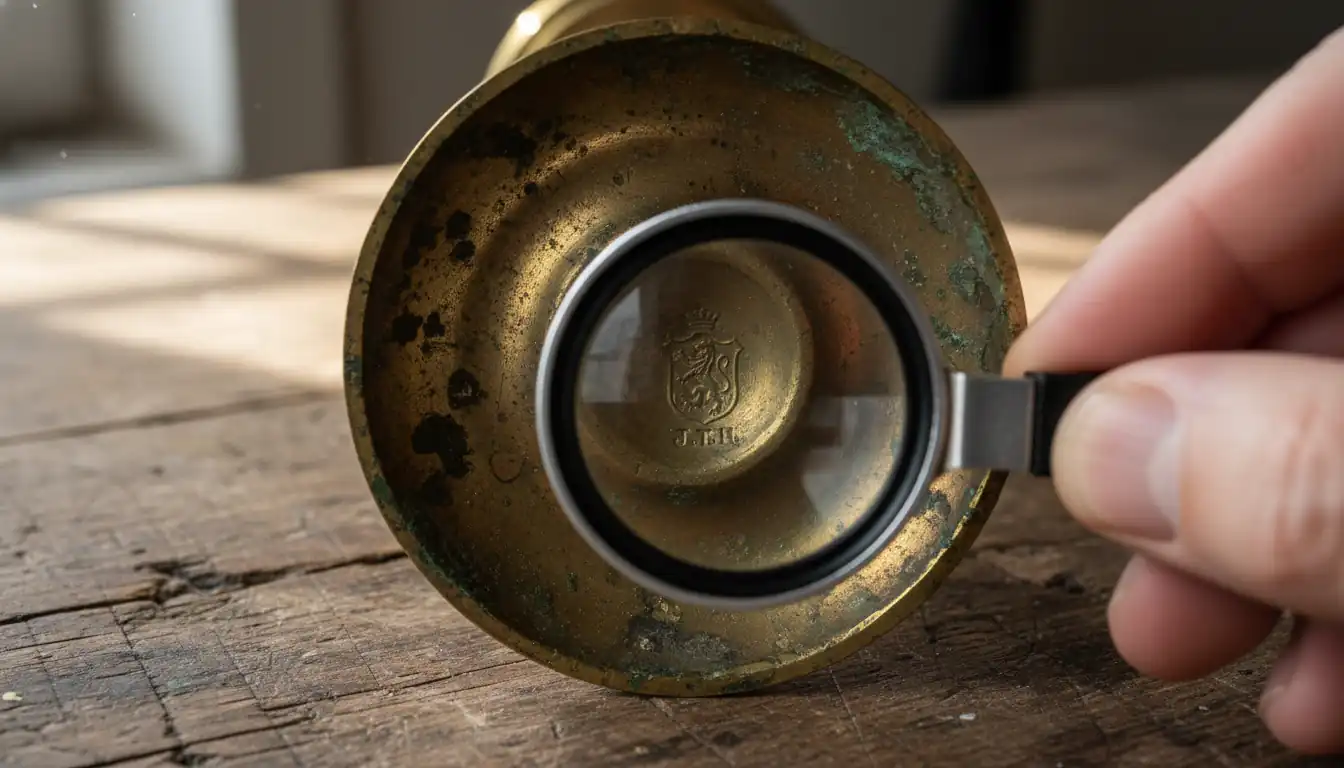
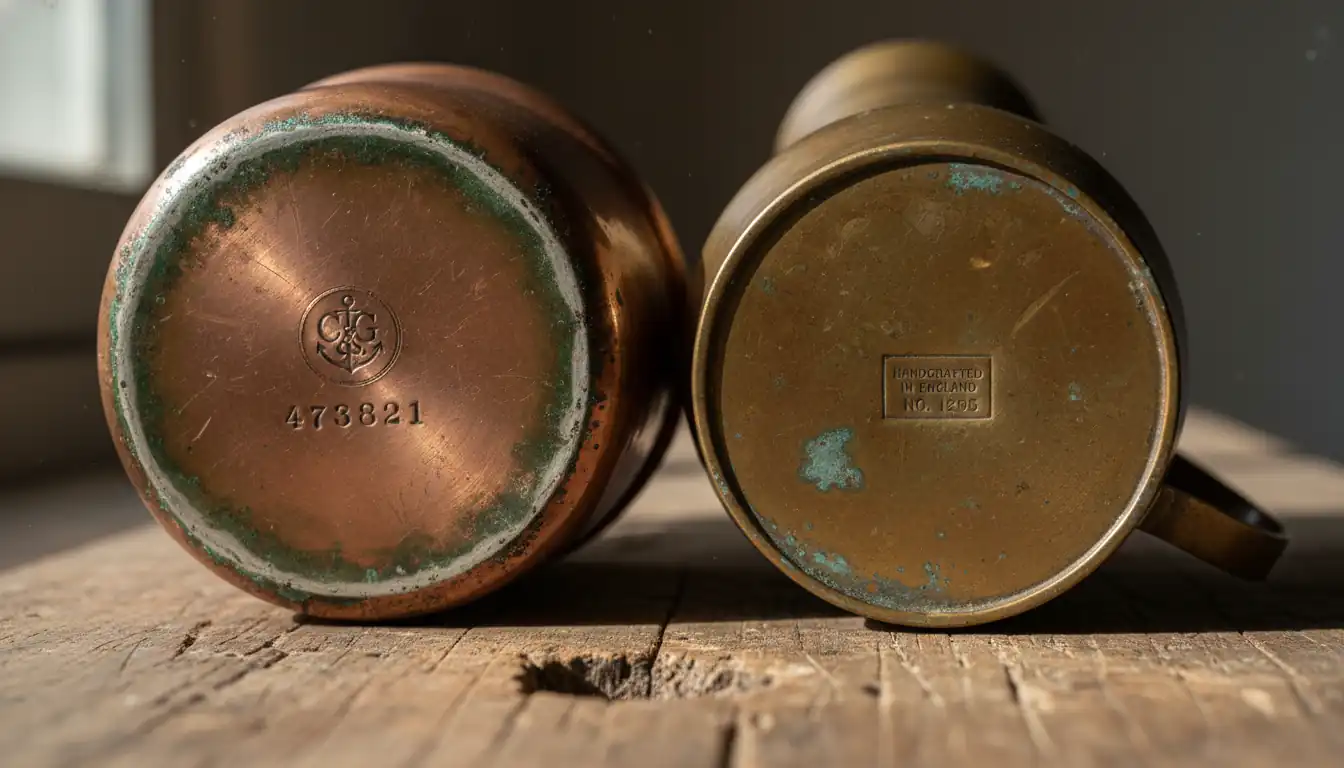
For many collectors, the "holy grail" of identification is the maker's mark. These are stamps, symbols, or names impressed into the metal that act as a signature. However, finding them requires patience. Unlike modern items where the brand is front and center, antique marks are often hidden in places that wouldn't disrupt the aesthetic of the piece.
Common places to search include:
- The very bottom of the base or feet.
- Inside the rim of a lid.
- Underneath a handle or a decorative flourish.
- On the "bobeche" (the small cup that catches wax) of a candlestick.
In the world of American brass, names like Benedict, Stickley, or Bradley & Hubbard are highly sought after. British brass often carries a "Registry Mark" (a diamond-shaped stamp) or a "Broad Arrow" mark if it was produced for military use.
Common British and American Foundry Stamps
British marks from the Victorian era often include a "Year Letter" which can tell you the exact date the design was registered. American makers from the Arts and Crafts movement, like the Roycrofters, used a distinct orb-and-cross symbol. Identifying these marks can instantly turn a $20 "old pot" into a $500 collector's item.
However, time is not always kind to metal. Over a century of polishing with abrasive cleaners can wear these marks down until they are nothing more than a faint, ghostly smudge. This is where traditional research often fails. You might spend hours scrolling through grainy forum photos or heavy reference books trying to match a half-visible symbol.
Identifying Marks with Modern Tools
When a mark is too worn to read with the naked eye, technology can step in. The Relic app is a specialized tool designed for exactly this scenario. Instead of guessing at a faded stamp, you can take a clear photo of the mark—or even the entire item—and upload it to the app.
Relic uses advanced AI trained on thousands of historical foundry marks and design patterns. It analyzes the geometry of the mark and the form of the object to provide a real appraisal, history, and origin. If you’re staring at a cryptic symbol on the bottom of a brass tray, Relic can often identify the specific workshop it came from and tell you when that mark was in use. It bridges the gap between a "mystery object" and a documented piece of history in seconds.
Regional Styles That Reveal Origin and Era
If an item lacks a maker's mark, you must rely on its "design language." Every era and region had a specific way of working with brass that reflected the tastes of the time. By learning these styles, you can often narrow down an item's origin even without a signature.
Arts and Crafts vs. Victorian Metalwork
The contrast between these two eras is the best place to start. Victorian brass (roughly 1837–1901) was all about opulence and "more is more." You will see heavy ornamentation, floral motifs, scrolls, and intricate castings. Victorian pieces were often highly polished to a mirror-like shine, as they were intended to show off the owner's wealth and the brightness of their home under new gas lighting.
The Arts and Crafts movement (late 19th to early 20th century) was a direct rebellion against Victorian clutter. These pieces emphasize "honest" construction. You will see:
- Hammer Marks: Instead of a smooth finish, the surface is covered in small, rhythmic indentations from a craftsman's hammer.
- Visible Joinery: Rivets and seams are often left visible as a design choice rather than hidden.
- Simplified Forms: The shapes are geometric and sturdy, focusing on the natural beauty of the metal rather than applied decoration.
Continental European Influence on Brass Design
French brass is often in a category of its own. If you find a piece that looks like brass but has an incredibly fine, gold-like detail and a soft, matte glow, it might be ormolu. This was a process of fire-gilding where a gold-mercury amalgam was applied to brass. French ormolu from the 18th and 19th centuries is world-renowned for its quality and is significantly more valuable than standard domestic brass.
English domestic brass, by comparison, tends to be sturdier and more utilitarian. Think of heavy "puddled" brass candlesticks with thick walls and simple, turned designs. Dutch brass is famous for its "repoussé" work—where patterns are hammered into the metal from the reverse side to create a raised design on the front, often seen in large decorative wall plaques or log boxes.
| Style | Key Characteristics | Common Era |
|---|---|---|
| Victorian | Ornate, floral, highly polished, complex castings | 1840–1900 |
| Arts & Crafts | Hammered texture, visible rivets, simple lines | 1890–1920 |
| French Ormolu | Gold-gilded, extremely fine detail, neoclassical themes | 1750–1850 |
| Dutch Repoussé | Raised patterns hammered from the back, folk art themes | 1700–1900 |
Modern Shortcuts for Identifying Obscure Metal Antiques
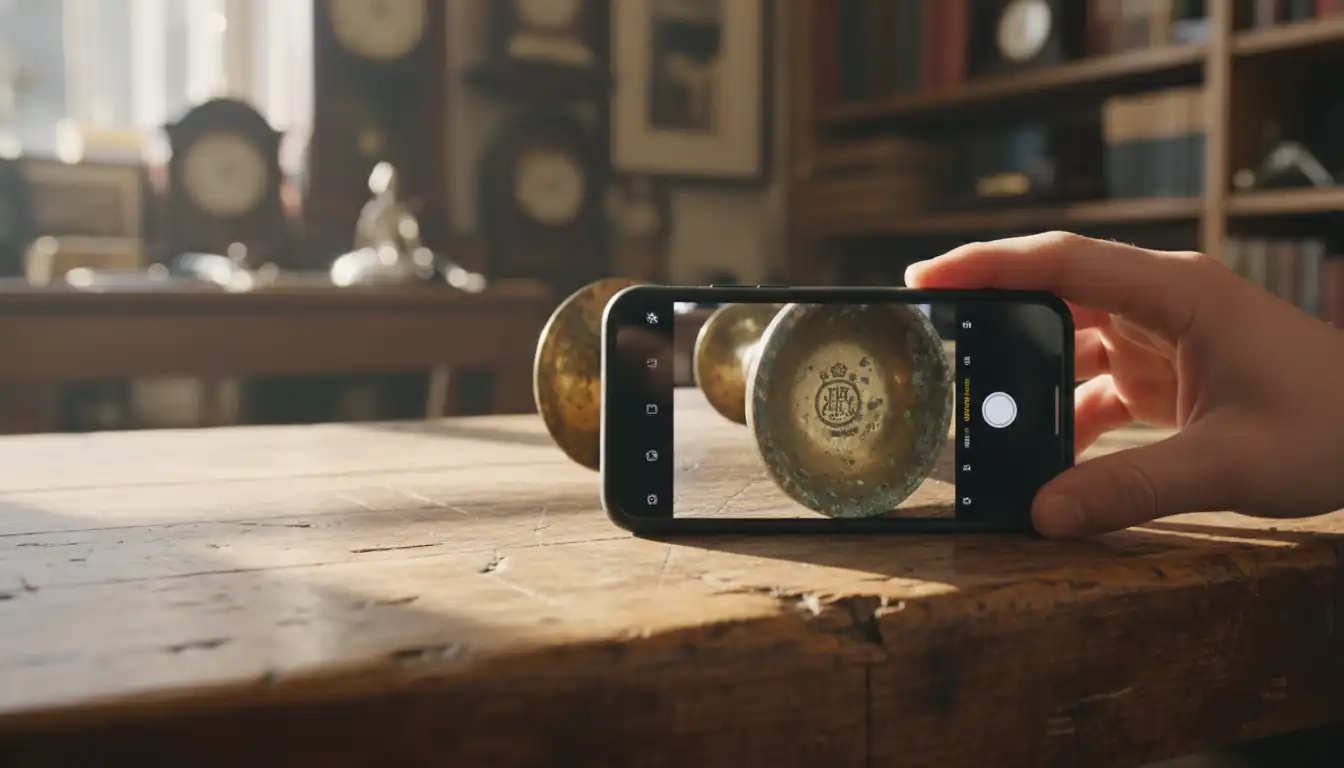
In the past, becoming an expert in antique metalware required years of handling objects, visiting museums, and building a massive library of reference books. While that experience is still valuable, the learning curve has been dramatically shortened by digital tools. The "old way" of identifying an item involved hours of manual searching, often leading to dead ends because you didn't know the right terminology to search for.
Today, the process is much more streamlined. You no longer need to know that a specific curve on a handle is called a "cyma recta" to find out where it came from. By using AI-driven platforms, you can leverage the collective knowledge of the world's antique archives through your smartphone camera.
Using AI Image Recognition for Instant Appraisals
The Relic app has become a staple for collectors who want to move quickly. When you're at an auction or a garage sale, you don't have time to go home and check a book. You need to know now if that $50 asking price is a bargain or a rip-off.
When you scan an item with Relic, the AI doesn't just look at the surface; it evaluates the form, the likely weight based on the material's appearance, and the specific "wear patterns" that suggest genuine age. It then cross-references this data with a vast catalog of known antiques. The result is a comprehensive report that includes:
- Origin and History: Where and when the item was likely made.
- Market Value: What similar items have recently sold for at auction.
- Authenticity Markers: What specific details you should look for to confirm it's not a reproduction.
Digital Archives and Database Cross-Referencing
Beyond instant identification, these tools allow you to keep a digital inventory of your collection. This is vital for insurance purposes and for tracking the appreciation of your items over time. Instead of a shoebox full of paper receipts, you have a searchable database of your finds, complete with professional-grade appraisals.
The hobby of collecting brass and copper is changing. It is becoming more accessible, but the fundamental thrill remains the same: the moment you realize that the "dusty old thing" in your hands is actually a piece of history. Whether you are using a magnet and a magnifying glass or the latest AI technology, the goal is to uncover the story the metal is trying to tell.
Conclusion
Identifying antique brass is a journey that starts with a simple touch and ends with a deep understanding of human craftsmanship. By mastering the basics—distinguishing brass from copper, recognizing the marks of hand-construction, and learning the design languages of different eras—you transform yourself from a casual shopper into a savvy collector.
Remember these key steps:
- Test the material: Use the magnet and scratch tests to ensure you're dealing with solid metal.
- Inspect the construction: Look for the seams and screw threads that act as a chronological map.
- Search for the signature: Check the hidden spots for foundry marks or registry stamps.
- Analyze the style: Let the shape and texture of the piece tell you its regional story.
If you find yourself stuck on a particularly stubborn piece of metal, don't guess. Download the Relic app and let its advanced AI do the heavy lifting. With a single photo, you can unlock the history and value of your find, ensuring that no masterpiece ever goes unrecognized in your collection again. The next time you see a glimmer of gold beneath a layer of dust, you'll know exactly what to do.
Identify antiques instantly
Point your camera at any antique, collectible, or vintage item. Get valuations, history, and market insights in seconds.
Download for iPhone