Your Vanity Might Be Hiding a Fortune: Spotting the Rare Perfume Bottles Worth Thousands

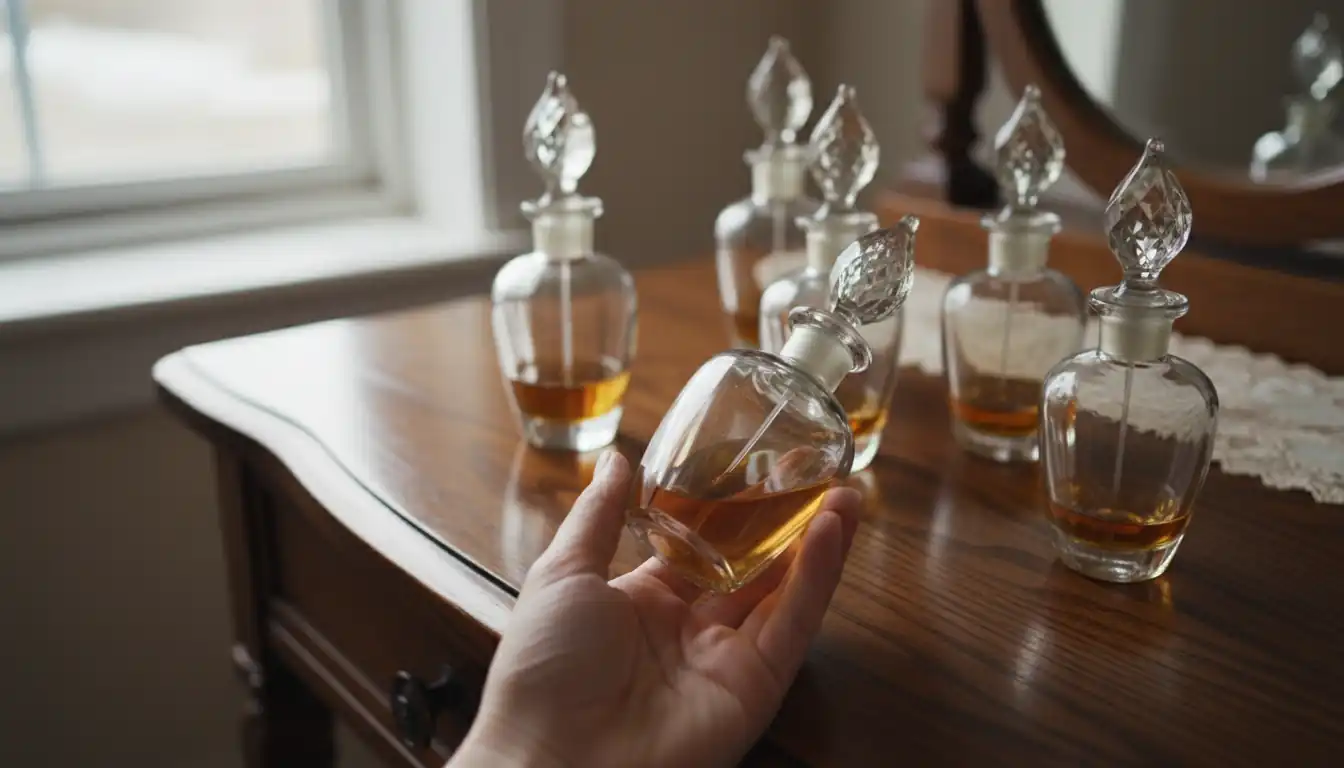
That dusty, forgotten bottle sitting on the back of your grandmother’s vanity might be more than a sentimental keepsake. While many old perfume containers are simply beautiful glass, a select few are high-stakes treasures that collectors chase with fervor. In the world of high-end glass, a single ounce of empty space can be worth five figures if the bottle was crafted by the right hands at the right time.
You don't need to be a professional appraiser to start spotting these hidden gems. Identifying a valuable bottle is a sensory experience—it involves the weight in your palm, the way the glass catches the light, and the tiny, almost invisible marks left by a master craftsman’s tools. By learning to read the language of glass and design, you can transform a casual trip to a thrift store or an estate sale into a high-value treasure hunt.
This guide will walk you through the physical hallmarks of quality, the artistic movements that define the market, and the modern tools that can confirm a find in seconds. Whether you are looking to start a collection or simply want to know if that heirloom is worth a fortune, understanding these nuances is your first step toward becoming an expert.
Physical Hallmarks of High Value
Before you look at a label or a brand name, you should look at the glass itself. Mass-produced bottles from the mid-20th century onward are typically made of soda-lime glass, the same material used for jelly jars and soda bottles. High-value collectibles, however, are often made of lead crystal or superior-grade glass that possesses entirely different physical properties.
Glass Quality and Weight
The first thing you will notice when picking up a high-value bottle is its surprising heft. Lead crystal contains a high percentage of lead oxide, which increases the density of the material. If you hold a standard glass bottle in one hand and a crystal bottle of the same size in the other, the crystal will feel significantly more substantial. This weight isn't just for show; it changes how the object interacts with the world around it.
Crystal has a much higher refractive index than standard glass. This means that when light enters the bottle, it bends more sharply, creating those brilliant "rainbow" flashes known as fire. If you hold a bottle up to a window and it looks dull or grayish, it’s likely common glass. If it splits the sunlight into a spectrum of colors, you are likely holding something of much higher quality.
Another quick test is the "ring" of the glass. Gently tap the edge of the bottle with your fingernail. Standard glass produces a short, dull "thud." Lead crystal, because of its density and molecular structure, will produce a clear, bell-like ring that resonates for a second or two. It is a literal harmony of materials that signals you are holding a piece of art rather than a piece of trash.
Hand Finished Details
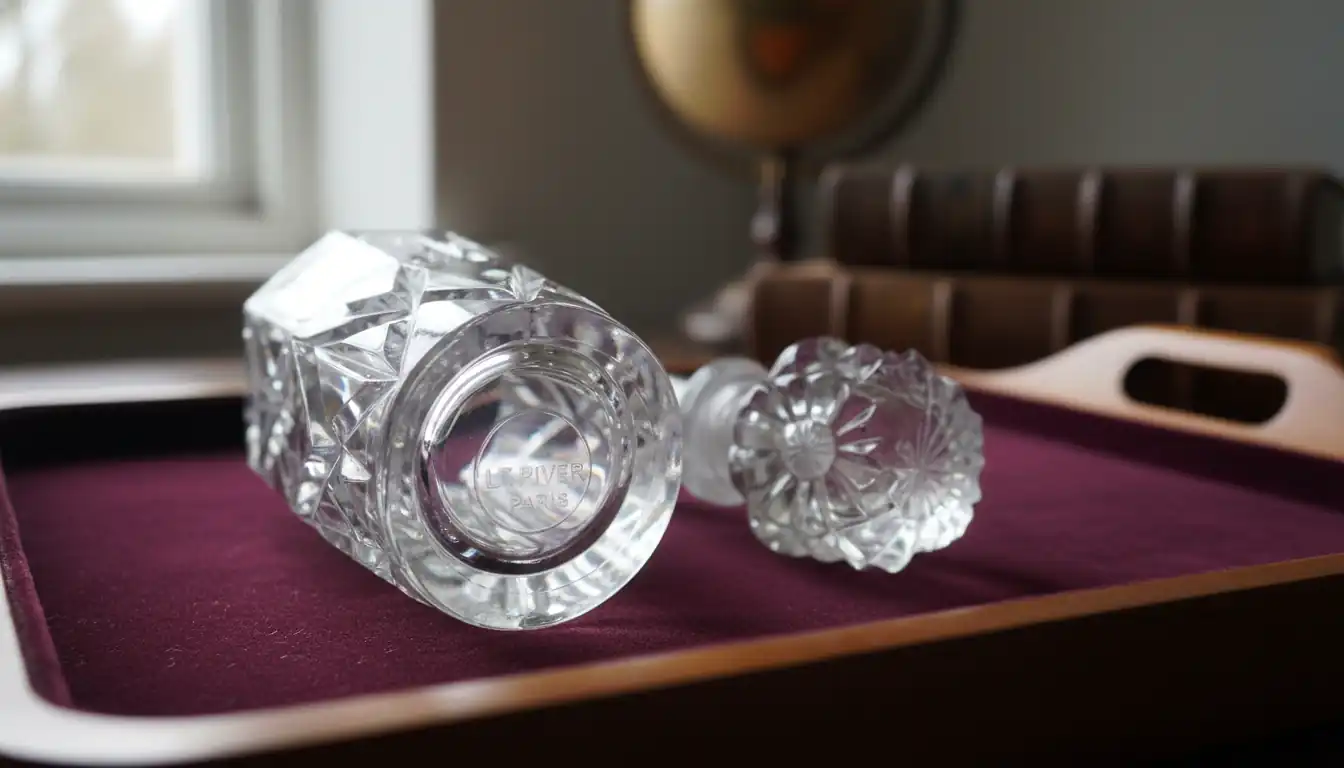
In the world of fine glass, perfection is often found in the imperfections of the process. One of the most important things to look for is the "pontil mark." When a glassblower creates a bottle by hand, they use a metal rod called a pontil to hold the piece. When the bottle is finished and snapped off the rod, it leaves a scar on the bottom.
- Rough Pontil: This is a jagged, circular scar. While it shows the piece was handmade, it is often found on more utilitarian or older, less refined bottles.
- Polished Pontil: High-end makers didn't like the look of a jagged scar. They would grind the mark down until it was a smooth, concave dimple. If you run your thumb over the bottom of a bottle and feel a perfectly smooth, circular indentation, it’s a sign of a "ground and polished" finish, a hallmark of expensive craftsmanship.
- Mold Seams: Look closely at the sides of the bottle. Cheap bottles are made in two-part molds, leaving a visible line or "seam" running from the base to the rim. Truly high-end bottles are either hand-blown or the seams have been meticulously polished away so the surface is unbroken.
| Feature | Standard Glass | High-End Crystal |
|---|---|---|
| Weight | Light, feels "hollow" | Heavy, feels "dense" |
| Light | Dull, flat refraction | Brilliant, rainbow "fire" |
| Sound | Short, dull thud | Long, musical ring |
| Bottom | Flat or molded ring | Polished pontil dimple |
| Seams | Visible vertical lines | Seamless or hand-polished |
Pro Tip: Always carry a small LED flashlight. Shining a light through the base of the bottle can reveal internal "seeds" (tiny bubbles) or "straw marks" (faint lines from the cooling process) that help identify the age and method of manufacture.
Design Eras and Iconic Makers
Once you have determined that the physical material is of high quality, the next step is to identify the "soul" of the bottle—its design. The most valuable perfume bottles aren't just containers; they are miniature sculptures that reflect the artistic zeitgeist of their time. Being able to recognize the silhouette of a specific era can help you date a bottle within seconds.
Art Nouveau and Art Deco Masterpieces
The two most dominant eras for collectible perfume bottles are Art Nouveau and Art Deco. These styles are polar opposites, making them relatively easy to distinguish once you know what to look for.
Art Nouveau (roughly 1890–1910) is defined by "whiplash" curves and organic forms. If the bottle looks like it was grown in a garden rather than made in a factory, it’s likely Nouveau. You will see flowing lines, depictions of flowers, dragonflies, and ethereal women with long, winding hair. These bottles are often romantic, soft, and highly detailed.
Art Deco (roughly 1920–1939) moved away from nature and toward the machine age. These bottles are all about power, speed, and geometry. Look for bold symmetry, stepped "skyscraper" designs, and sharp, clean angles. If the bottle looks like it belongs in a 1920s jazz club or on the dashboard of a vintage Bugatti, it’s Art Deco. This era is currently one of the most "hot" segments of the market, with collectors paying a premium for bold, architectural shapes.
The Big Three: Lalique, Baccarat, and Schiaparelli
While thousands of companies have produced perfume, three names stand above the rest in terms of investment value. Finding a signed piece from any of these three is the equivalent of hitting a mini-jackpot.
René Lalique is perhaps the most famous name in perfume bottle history. He revolutionized the industry by moving away from precious metals and focusing on the artistic potential of glass. Lalique bottles are famous for their "frosted" or opalescent finish. He often used a technique called cire perdue (lost wax) for his most intricate designs. Look for the "R. Lalique" signature etched into the base. Even a small, simple Lalique bottle can fetch hundreds, while rare designs go for tens of thousands.
Baccarat is the gold standard of crystal. They didn't just make bottles for one brand; they were the "contractor of choice" for high-end houses like Guerlain and Dior. Baccarat glass is legendary for its purity and clarity. If you find a bottle that feels like a solid block of ice and has a tiny "Baccarat France" circular logo etched on the bottom, you are looking at a piece of royal-grade history.
Schiaparelli bottles are the wildcards. Elsa Schiaparelli was a surrealist fashion designer who collaborated with artists like Salvador Dalí. Her bottles are famous for being "weird." The most iconic is the "Shocking" bottle, shaped like a woman’s torso (modeled after Mae West). These bottles are highly sought after because they bridge the gap between perfume collecting and fine art.
- Lalique: Look for frosted glass, relief carvings of birds or nymphs, and an "R. Lalique" signature.
- Baccarat: Look for extreme clarity, heavy weight, and the circular acid-etched hallmark.
- Schiaparelli: Look for surrealist shapes, bright "shocking pink" accents, and unconventional silhouettes.
Instant Identification with Modern Technology
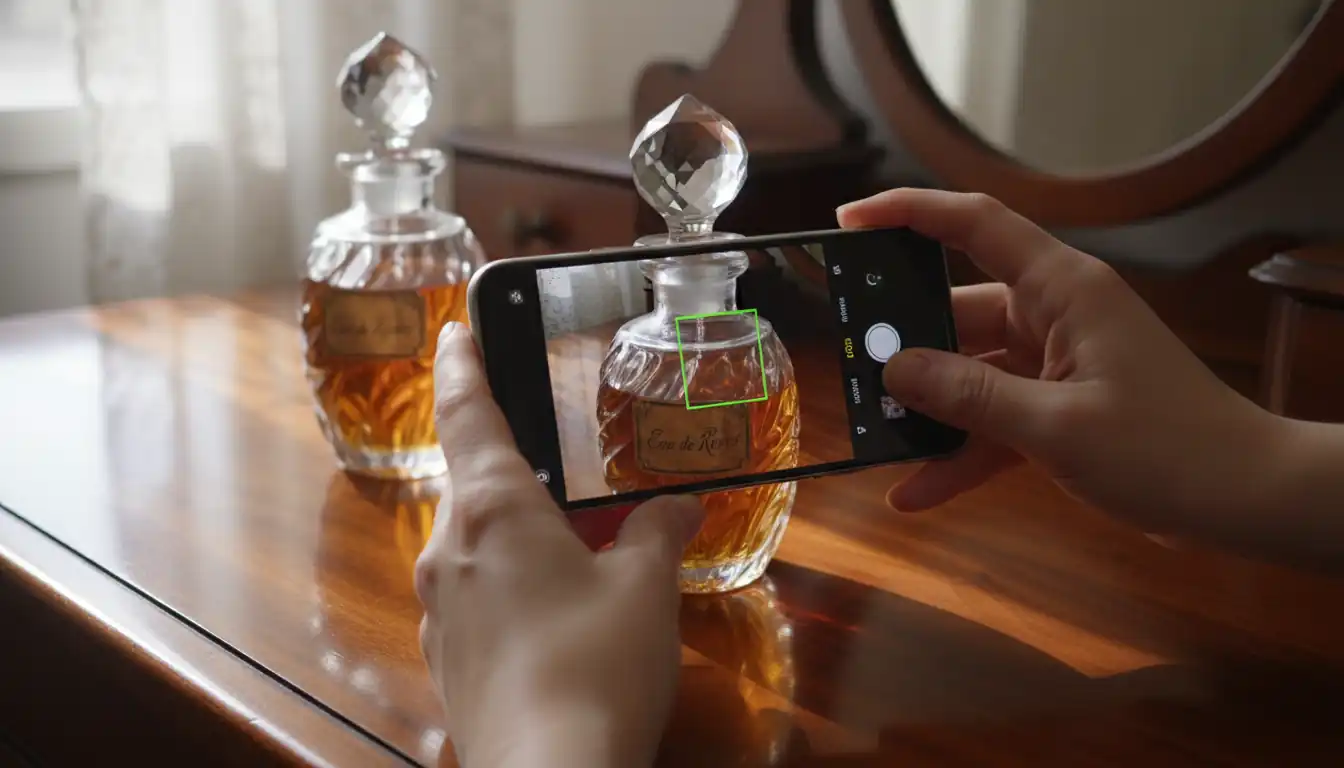
In the past, identifying a rare bottle required a library of reference books and years of experience. You would have to spend hours squinting at maker's marks and cross-referencing auction catalogs. Today, the barrier to entry has vanished thanks to artificial intelligence. If you are standing in a dusty corner of an antique mall and see a bottle that "feels" right, you don't have to guess.
Using AI for Rapid Appraisal
This is where technology like the Relic app becomes an essential tool for the modern hunter. Relic works by using advanced image recognition and AI to analyze the physical characteristics of an object. You simply take a photo of the bottle—focusing on its shape, color, and any visible marks—and the app scans a massive database of historical records and auction results.
Instead of wondering if a bottle is a genuine 1920s Baccarat or a 1980s reproduction, Relic can provide a real appraisal and history of the item instantly. It looks at the silhouette, the texture of the glass, and the specific design language to tell you exactly what you are holding. This speed is a massive advantage. In the competitive world of "picking," the person who can identify value the fastest is the one who walks away with the prize.
Verifying Maker Marks with Photo Analysis
One of the hardest parts of bottle identification is reading the signatures. Over decades, acid-etched marks can fade, and embossed glass can wear down. Your eyes might see a faint smudge, but the AI in an app like Relic can often "see" the patterns within that smudge that correspond to known maker marks.
By uploading a clear, well-lit photo of the base, you can get a confirmation of the origin that might otherwise require a magnifying glass and a lot of luck. This level of professional-grade insight allows you to buy with confidence, knowing the difference between a $20 decorative piece and a $2,000 collector's item before you ever reach the cash register.
Condition Factors That Make or Break Value
You’ve found a heavy, crystal bottle with a polished pontil and a Lalique signature. You’re ready to celebrate, right? Not so fast. In the world of high-end collectibles, condition is everything. A single chip or a missing part can turn a four-figure treasure into a fifty-dollar paperweight.
The Importance of Original Stoppers
The stopper is the "crown" of the perfume bottle, and it is the most common point of failure. Because stoppers are separate pieces of glass, they are easily broken or lost. Over the years, many owners would find a stopper from a different bottle that "mostly" fit and call it a day. Collectors call these "married" bottles, and they are generally avoided.
A genuine stopper was often ground specifically to fit its individual bottle. In high-end pieces, you might even see a tiny number etched onto the bottom of the stopper that matches a number etched inside the neck of the bottle. If those numbers don't match, the bottle is a "marriage."
- Check the Fit: A proper stopper should sit snugly and not wobble.
- Check the Material: The glass of the stopper should match the color and clarity of the bottle perfectly.
- Check for "Nicks": Run your finger along the "plug" (the part that goes inside the bottle). Even tiny "flea bite" chips here can reduce the value by 20-30%.
Evaluating Patina and Residue
When you find an old bottle, your first instinct might be to scrub it clean. Stop. You could be washing away thousands of dollars.
"Sick glass" is a term collectors use for a bottle that has developed a permanent, cloudy white film on the inside. This isn't dirt; it’s a chemical reaction where the glass itself is leaching minerals due to long-term exposure to moisture or acidic perfume. Unlike dirt, sick glass cannot be cleaned. It is a permanent "scar" that significantly lowers the value.
On the other hand, original residue can be a good thing. If a bottle is "sealed" with its original silk cord (known as a baudruchage seal) and has never been opened, it carries a massive premium. Even if the perfume inside has darkened or evaporated over time, the fact that it is "unopened" makes it a time capsule. Never break a seal or "nip" the strings of an unopened bottle just to smell it—you are literally smelling away your profit.
"A bottle is only original once. Every cleaning, every repair, and every replaced stopper moves it further away from its peak value."
Market Trends and Niche Collectibles
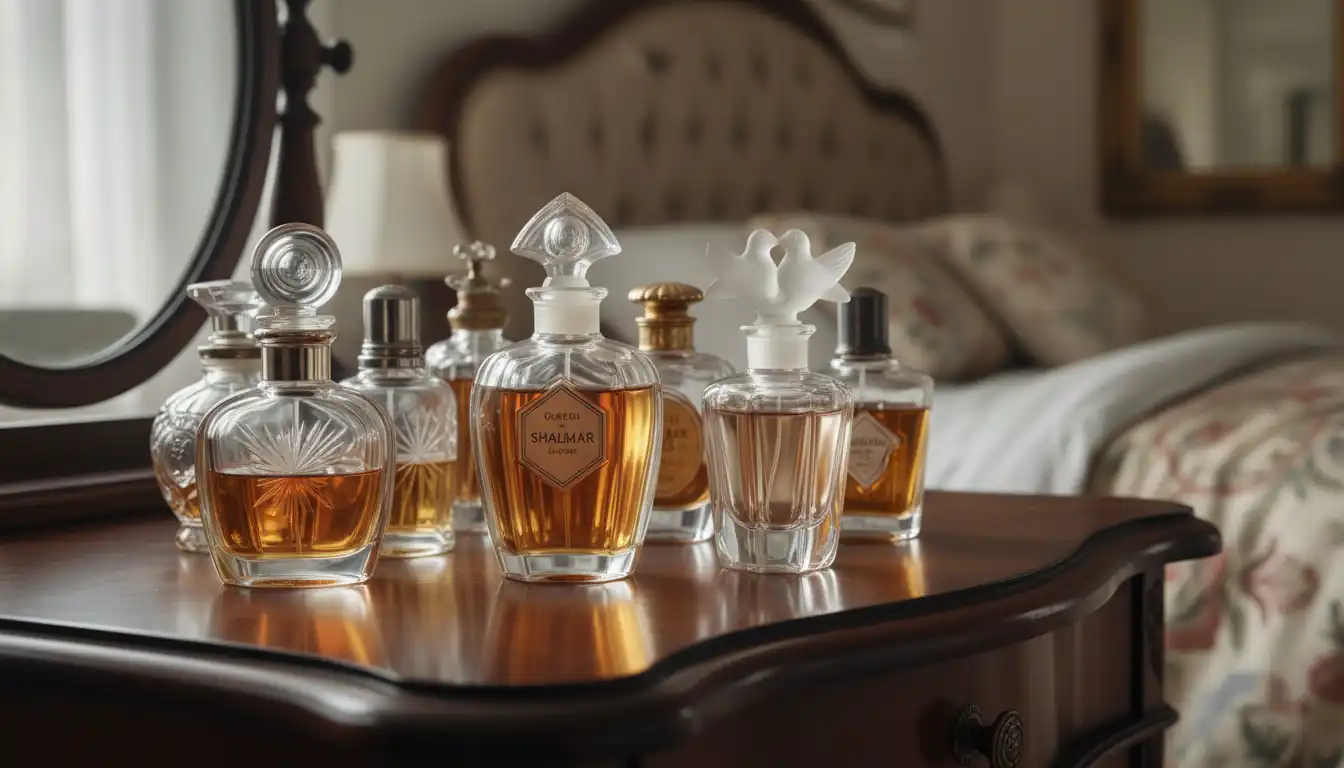
While everyone is looking for Lalique and Baccarat, there are "weird" corners of the market where savvy collectors are making a killing. These items often don't look like traditional perfume bottles, which means they are frequently overlooked by general antique dealers.
Commercial versus Factice Bottles
Have you ever seen a giant, gallon-sized perfume bottle in a department store window? These are called "factices." They were never intended for sale; they were display props provided by the perfume houses to stores. Most factices are filled with colored water (to simulate the perfume) rather than the actual fragrance.
Because they were never sold to the public, factices are rare. Collectors love them for their sheer decorative impact. A giant Chanel No. 5 factice can sell for significantly more than a standard-sized bottle of the actual perfume. If you see a bottle that looks "too big to be real," it might be a factice—and it might be worth a fortune.
The Rise of Mid-Century Novelty Designs
While the 1920s were about elegance, the 1950s were about fun. During this era, companies like Schiaparelli, Avon (in its early days), and various Parisian houses began creating "novelty" bottles. These are bottles shaped like objects:
- Animals: Poodles, cats, and birds were incredibly popular.
- Objects: Bottles shaped like telephones, violins, or even grandfather clocks.
- Characters: Figures from folklore or popular culture.
For a long time, serious collectors looked down on these as "kitsch." However, a new generation of collectors is driving up the prices for high-quality novelty bottles, especially those made by European designers. The key is to look for novelty shapes made of high-quality glass rather than cheap plastic. If the "poodle" is made of hand-blown glass with gold leaf accents, you’ve found a winner.
| Category | Why It's Valuable | What to Look For |
|---|---|---|
| Factice | Rarity and scale | Giant versions of famous bottles |
| Novelty | Cross-over appeal | Unusual shapes (animals, objects) |
| Miniatures | Portability/Set completion | Tiny, perfect replicas of large bottles |
| Travel Sets | Historical context | Bottles in original leather or velvet cases |
Conclusion
Your vanity—or the shelves of your local thrift store—could very well be hiding a masterpiece of glass art. By training your eye to recognize the weight of lead crystal, the musical ring of a fine rim, and the geometric precision of the Art Deco era, you move from being a casual observer to a knowledgeable hunter. Remember that the value of a bottle lies in the intersection of its material, its maker, and its condition.
Don't let the fear of "not knowing enough" stop you from exploring this lucrative hobby. Tools like the Relic app are designed to bridge the gap, giving you the power of a professional appraiser in the palm of your hand. The next time you see a bottle that catches the light in just the right way, pick it up. Feel the weight, check the stopper, and use your phone to see if you’ve just discovered a fortune.
The world of antique perfume bottles is a testament to the idea that beauty and value are often found in the smallest details. Happy hunting!
Identify antiques instantly
Point your camera at any antique, collectible, or vintage item. Get valuations, history, and market insights in seconds.
Download for iPhone