What is my vintage Pyrex worth, and how old is it?

By Ellen Whitlock ·
Most vintage Pyrex bowls and casseroles are typically worth $10 to $50 each. Complete sets in popular patterns run about $120 to $650. A few promotional patterns reach thousands: a 1959 Lucky in Love casserole hit $5,994 at auction. Turn yours over to read the mark and find the pattern.
What is vintage Pyrex worth?
Most Pyrex in a family kitchen is everyday production, and its value stays modest. The money is in complete sets of popular patterns and in a short list of promotional patterns made for a limited time.
| What you have | Typical value |
|---|---|
| Everyday bowls, casseroles and single piecesSingle pieces in common patterns; condition and original lids move the price. | $10–$50 |
| Complete nesting sets in popular patternsPink Gooseberry, Butterprint and New Dots sets; the pattern and the lids decide where a set lands. | $120–$650 |
| Promotional and short-run patternsDuchess, Atomic Eyes chip-and-dip, Barcode and Pink Stems; rarity sets the spread. | $400–$4,000 |
| Lucky in Love casserole, the rarest patternTwo documented auction results. | $2,600–$5,994 |
Asking prices run ahead of these ranges, because recent bankruptcy news around the brand inflated them, so treat a hopeful listing as a ceiling, not a value.
Kovels reports a four-piece Pink Gooseberry nesting set at $225 at auction in June 2025, and says New Dots sets have climbed in price since 2019. At the top, Goodwill of Western New York listed a Lucky in Love casserole on shopgoodwill.com in 2017, and 60 bidders competed for it.
How to date Pyrex from the mark on the base
Corning Glass Works made Pyrex, and the base mark changed with the decades. According to Antiques Know How, a circle around PYREX is the older layout, and straight lines of text replaced it in the 1960s. Match yours to the table.
| Mark | Years |
|---|---|
| Clear-glass circle · CGPYREX in a circle with the CG monogram, on clear glass | 1915–1924 |
| Circle · T.M. REG.The circle adds T.M. REG. and U.S. PAT. OFF. | 1925–1949 |
| Colored opal ware · circle and CGWhite glass with colored decoration, marked with the circle and CG | 1945–1959 |
| Circle · MADE IN U.S.A.The circle adds MADE IN U.S.A. and trademark symbols | 1950–1959 |
| Straight-line markThe circle is gone and the text runs in straight lines | 1960–1979 |
| Uppercase PYREXStill the standard on US kitchenware | 1980–1993 |
| Lowercase pyrexModern, and generally without collector value | 1994 on |
Eras overlap, and sources disagree on when the lowercase mark began.
Five more checks for your Pyrex
- Capitals or lowercase? Capitals mean older, and lowercase 'pyrex' is modern and usually worth less. Treat it as a first clue, since sources disagree at the edges.
- Find the model number. Opal pieces are usually marked on the bottom with a number for type and capacity. The nesting mixing bowls run 401 to 404.
- Name the pattern. Compare the decoration with the Corning Museum of Glass Pyrex Pattern Library, which sellers use to identify patterns.
- Check the lids. Original lids raise value. Lids and bases mixed from different patterns do not make a true set.
- Run a fingernail over the print. Fired-on decoration feels almost smooth, while surface paint catches, which points to a hand-painted tribute.
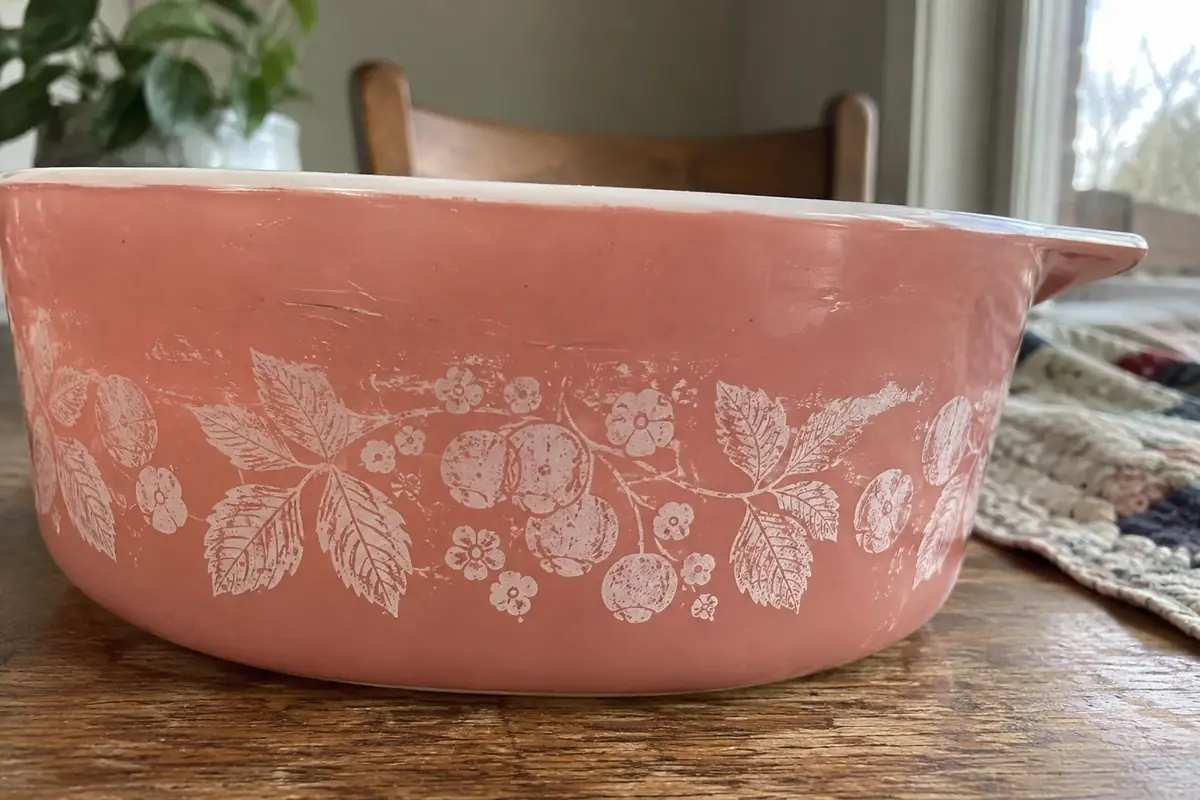
No Pyrex mark at all? It is another maker's piece. Pressed pink or green glass may be Depression glass, and a glazed pottery bowl may be McCoy pottery.
What makes one piece of Pyrex worth more?
- Pattern rarity
- Promotional, test and one-year patterns are worth far more than long-running store patterns, because fewer were made and fewer survive. Lucky in Love was introduced by Corning in 1959 and never mass produced.
- Shape
- The same pattern can be worth very different amounts depending on the piece, and some patterns came in only one shape. Pink Stems was made only as a small oval casserole, and one guide lists it at up to $1,000.
- Sets and lids
- Mixing bowls sold as a graduated nesting set bring more than single bowls, and original lids raise the price. A six-piece lot of Pink Gooseberry casseroles and Butterprint refrigerator dishes made $275 in December 2025.
- Condition
- Glossy decoration has more collector appeal than a design that has dulled or been badly scratched. One collector article says imperfections such as chips can lower a piece's value by 20 to 50 percent.
- Color
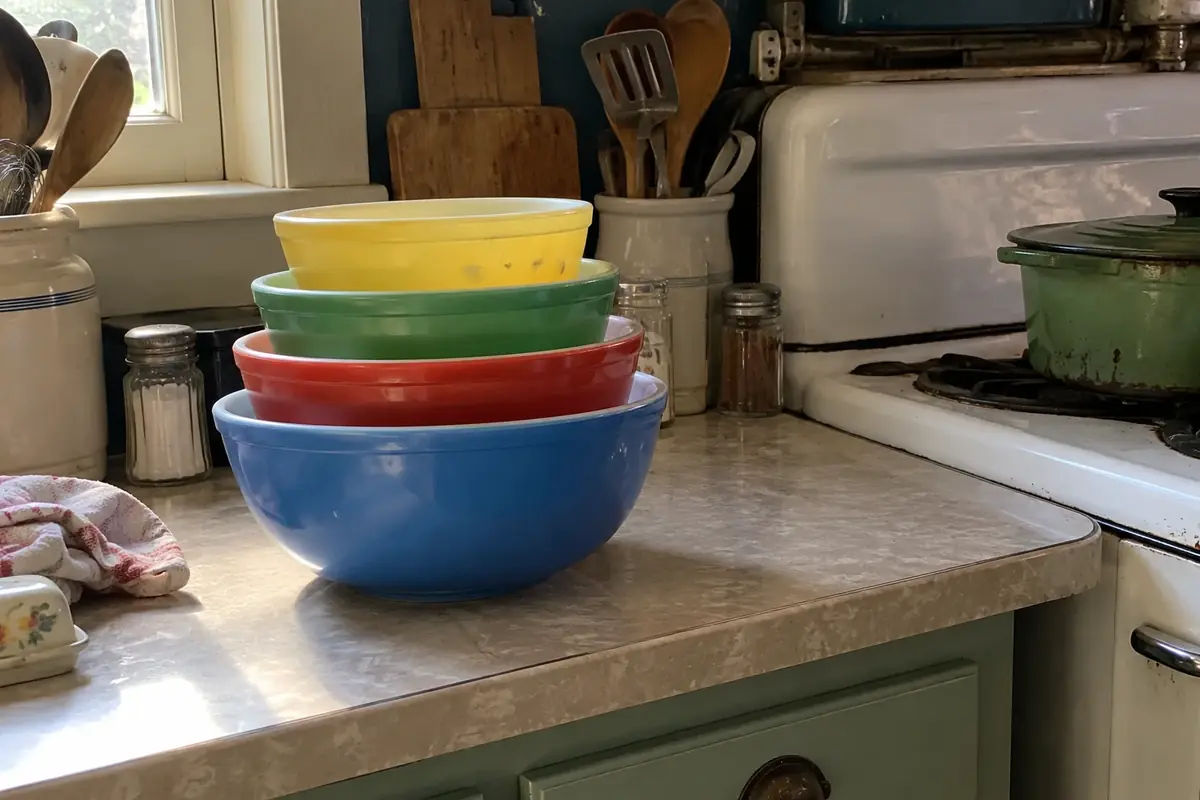
- Pink and turquoise have particularly strong appeal, including Butterprint, Gooseberry, Pink Daisy and Snowflake. Primary-color four-bowl sets in good condition run about $80 to $100.
Real Pyrex, reissue or copy?
Reissues are the trap for owners hoping for a jackpot. Wide Open Country reports that Target sold a Lucky in Love reissue in March 2018, with four-piece sets at $12, while an original casserole brought $2,600 at a 2013 auction. Signs of a reissue or newer piece:
- Snap-on lids, where the originals had opal lids
- No color bleed. On the original, the green ran through the pink hearts, and the new line corrects it.
- It feels light. Genuine opal glass is noticeably heavier than modern pieces.
- A polished, crisp foot rim. Genuine older pieces show fine, dull wear where the foot met the counter.
Which Pyrex patterns are the most collectible?
Printed patterns began in 1956 and grew to more than 150 silk-screen designs. The names owners ask about most are Butterprint, introduced in 1957 and called one of the most collectible patterns by EstateSales.org, and Gooseberry, especially the pink version, plus Snowflake and Pink Daisy.
Where to sell vintage Pyrex
Match the piece to the buyer. Etsy, eBay, Facebook Marketplace and local auction houses are the usual routes. A single common dish suits a local sale, while a complete set in a popular pattern suits a collector marketplace or an estate auction. Before you list, keep the original lids and parts together and put the model number and pattern name in the description.
Common Pyrex questions
How much is my vintage Pyrex worth?
Start by counting the pieces and checking for lids. Matched nesting bowls with their lids bring more than the same dishes sold singly.
How can I tell how old my Pyrex is?
Read the base mark, then match the decoration to a pattern. Colonial Mist in 1983 was the last colored pattern before production ended in 1986.
Is my Lucky in Love dish the real thing?
Look at the lid and the hearts. The reissue has snap-on lids and no green bleeding through the pink hearts.
Is lowercase pyrex worth anything?
Rarely, since modern lowercase pieces generally lack collector value. Sources put the start of lowercase anywhere from 1975 to after 1994, so check the pattern too.
Should I put vintage Pyrex in the dishwasher?
No. It fades the pattern, clouds the glass and dulls the shine collectors pay for.